


Free Preschool Math Worksheets
All of the math worksheets for preschoolers below are samples from the Preschool Math Worksheet Libraries on our Infinite K-8 Math Worksheet Portal.
Click any of the links below to download the corresponding preschool math worksheets and answer keys.
▶️ : Sample Worksheet Download | 🔒 : Worksheet Only Available to Members | 🔽 Jump to a Topic:
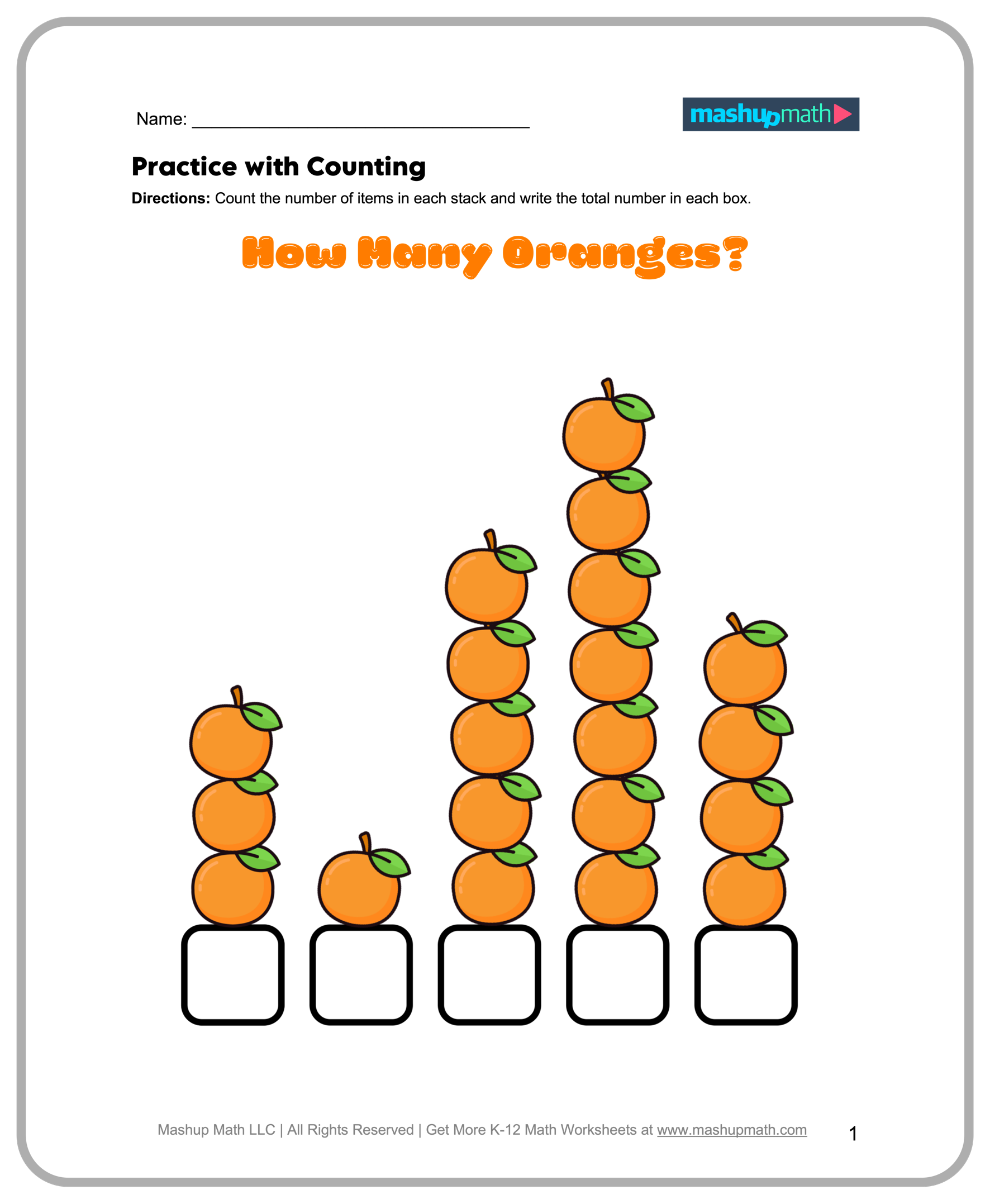


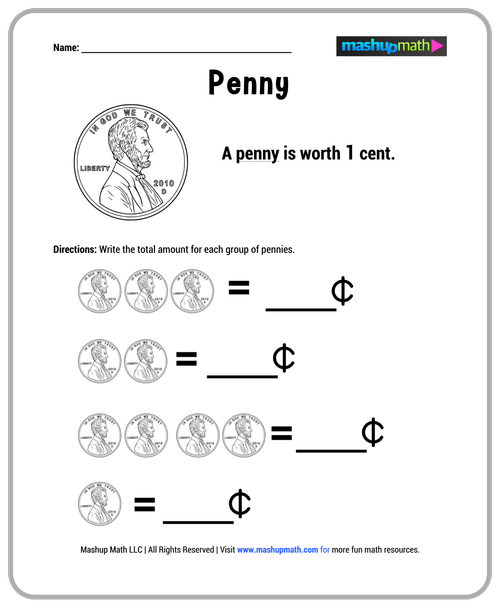
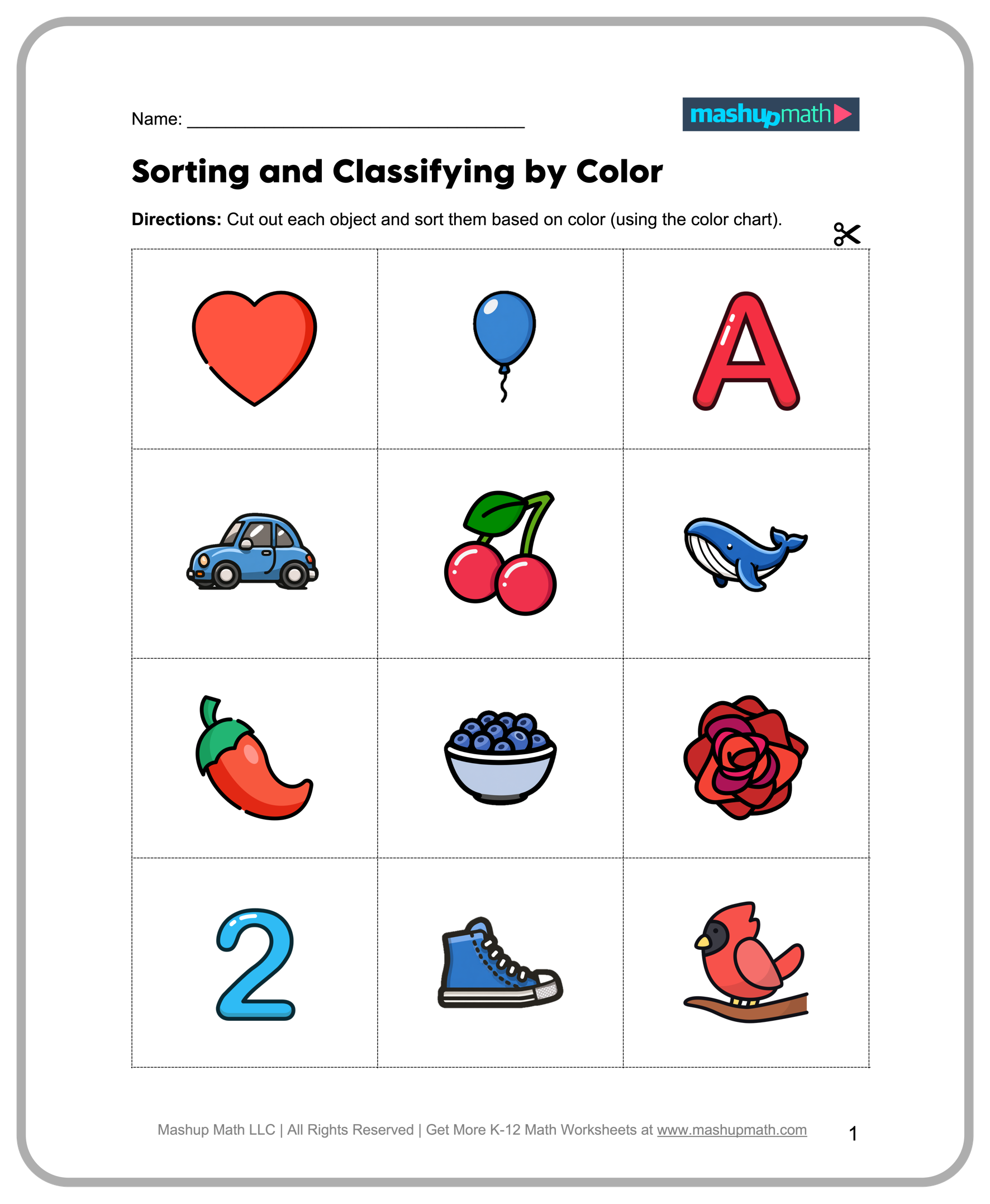
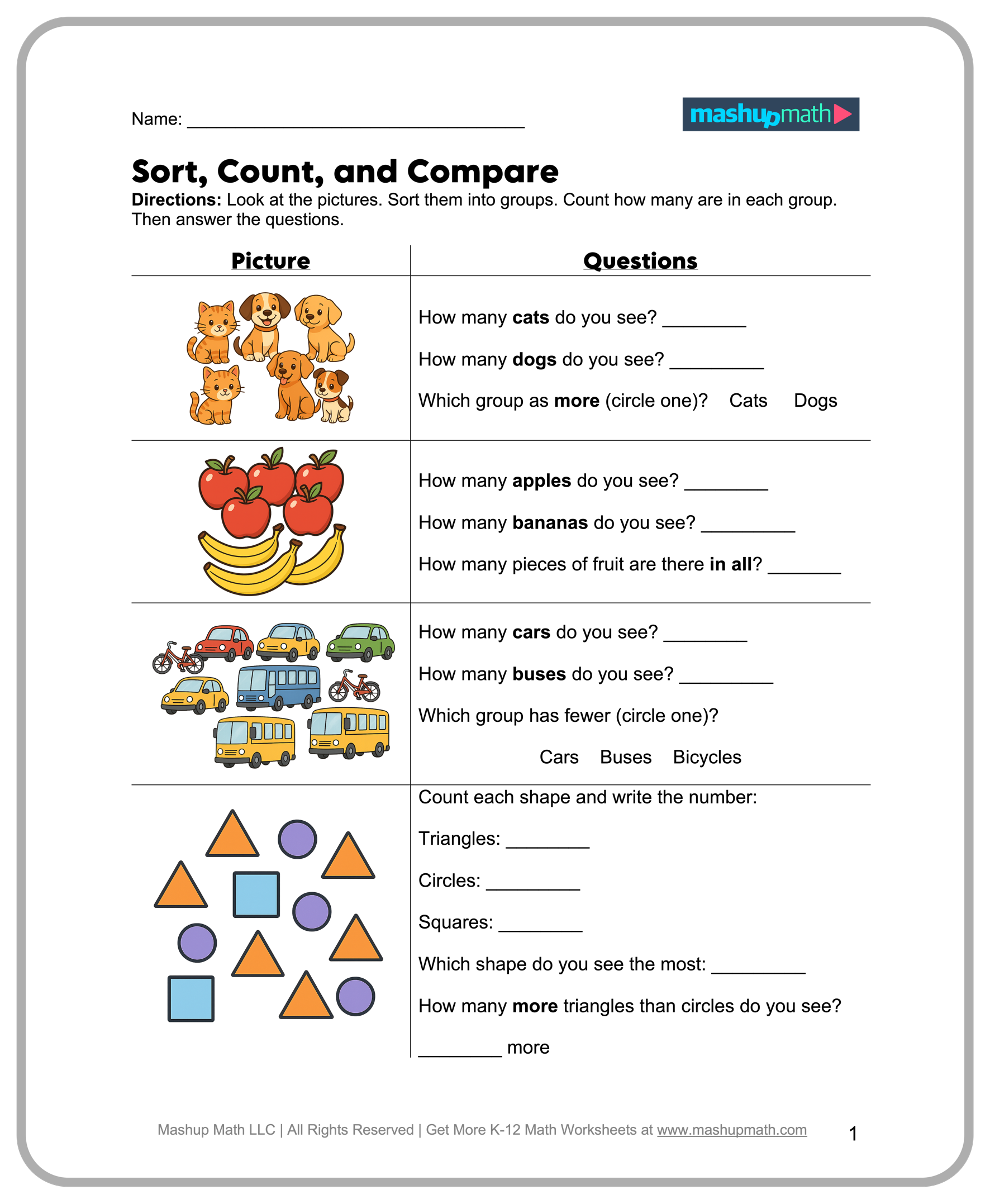
Welcome to this free library of Preschool Math Worksheets for children ages 3-5. All of the free PDF worksheets available on this page are organized based on fundamental preschool math skills including number tracing, counting, basic addition and subtraction, patterns, shapes, and more. These math worksheets for preschoolers were specifically designed to give young learns meaningful opportunities to practice, explore, and learn the building block skills of math in a fun and enjoyable way.
If you want complete access to the entire Preschool Math Worksheets Library, you can sign-up to gain access to our K-8 math worksheet portal, where members have on-demand access to ALL of our math worksheets, puzzle, and activity libraries for students in grades K-8.
🛑 Do YOU Want Free K-8 Math Resources and Activities in Your Inbox Every Week? 💁♀️
⇥ Click here to join our mailing list to start getting free learning materials for kids!

▶️ Number Tracing: 1 | 2 | 3 | 4 | 5 | 6 | 7 | 8 | 9 | 10
▶️ Practice Number Tracing 1-10
🔒 Number Tracing: 11 | 12 | 13 | 14 | 15 | 16 | 17 | 18 | 19 | 20
🔒 Practice Number Tracing 1-20
▶️ Number Reference Sheet (0-10)
▶️ Finger Counting Reference Sheet (1-10)
▶️ Practice writing numbers 0-7
🔒 Number Tracing 0-9
🔒 Practice writing numbers 8 and 9
🔒 Number Tracing 1-10
▶️ Practice writing numbers 10-13
▶️ Focus on 0-3
▶️ Focus on 4
🔒 Focus on 5
🔒 Focus on 6 and 7
🔒 Focus on 8, 9, and 10
▶️ Focus on 10
🔒 Focus on 11
▶️ Matching numbers with words (up to 10)
🔒 Matching numbers with words (up to 20)
🔒 (C) Counting numbers 1-10
🔒 (D) Counting numbers 1-10
▶️ Counting Stacks of Objects (A)
🔒 Counting Stacks of Objects (B)
▶️ Counting Using 10-Frames (A)
🔒 Counting Using 10-Frames (B)
🔒 Skip counting by 2
🔒 Skip Counting by 2 (odds)
▶️ Skip Counting by 2s (Start at 2)
🔒 Skip Counting by 2s (Start at 8)
🔒 Skip Counting by 2s (Start at 11)
🔒 Skip counting by 4
🔒 Skip counting by 5
🔒 Counting backwards 10-1 B
🔒 Counting backwards 20-1 B
▶️ Counting grouped objects up to 10
🔒 Counting grouped objects up to 20
▶️ Practice writing numbers 1-25
▶️ Practice writing numbers 26-50
▶️ Writing numbers as words 1-10
▶️ Writing numbers as words 11-20
🔒 Writing numbers as words 21-30
🔒 Writing numbers as words 31-40
🔒 Writing numbers as words 41-50
▶️ Circle a number of objects (to 10)
🔒 Circle a number of objects (to 20)
▶️ 101 Bananas! (Count to 101)
▶️ Make 5 through 10 using number bonds
▶️ Which number/group is larger?
🔒 Which number/group is smaller?
🔒 Comparing numbers B
🔒 Comparing numbers C
▶️ Comparing number using < or > (up to 25)
🔒 Comparing number using < or > (up to 50)
🔒 Even or odd? (up to 50)
🔒 Writing ordinal numbers B
▶️ Order numbers from greatest to least (up to 10)
🔒 Order numbers from greatest to least (up to 50)
▶️ Order numbers from least to greatest (up to 10)
🔒 Order numbers from least to greatest (up to 50)
▶️ Base 10 blocks-regrouping (A)
🔒 Base 10 blocks-regrouping (B)
▶️ Counting with base 10 blocks (A)
🔒 Counting with base 10 blocks (B)
🔒 Counting with base 10 blocks (C)
▶️ Express numbers as 10’s and 1’s (A)
🔒 Express numbers as 10’s and 1’s (B)
🔒 Express numbers as 10’s and 1’s (C)
▶️ Adding using base 10 blocks (A)
🔒 Adding using base 10 blocks (B)
🔒 Adding using base 10 blocks (C)
▶️ Place value: identify tens and ones (A)
🔒 Place value: identify tens and ones (B)
🔒 Place value: identify tens and ones (C)
🔒 Combine tens and ones (B)
🔒 Combine tens and ones (C)
▶️ Identifying place value: tens and ones (A)
🔒 Identifying place value: tens and ones (B)
🔒 Identifying place value: tens and ones (C)
🔒 Adding tens and ones (B)

🔒 Units of time (days)
🔒 Units of time: minutes, hours, or days?
▶️ Reading the clock (hours) (large font) (A)
🔒 Reading the clock (hours) (large font) (B)
▶️ Telling time in whole hours (A)
🔒 Telling time in whole hours (B)
▶️ Telling time in half hours (A)
🔒 Telling time in half hours (B)
▶️ Telling time in quarter hours (A)
🔒 Telling time in quarter hours (B)
▶️ Draw the time on the clock (hours)
🔒 Draw the time on the clock using a digital clock (hours)
🔒 Draw the time on the clock (hours, half hours)
🔒 Draw the time on the clock (hours, half hours, quarter hours)
🔒 Which object weighs less?

▶️ Practice with Number Bonds: 5
▶️ Practice with Number Bonds: 6
▶️ Practice with Number Bonds: 7
🔒 Practice with Number Bonds: 8
🔒 Practice with Number Bonds: 9
🔒 Practice with Number Bonds: 10
🔒 Practice with Number Bonds: 11-19
🔒 Practice with Number Bonds: 20
▶️ Adding groups on objects (equation form) (A)
🔒 Adding groups on objects (equation form) (B)
🔒 Add three (single-digit)
🔒 Adding using your fingers
▶️ Simple addition: single-digit (large font) (A)
🔒 Simple addition: single-digit (large font) (B)
🔒 Addition: make 10 (B)
▶️ Vertical addition to 10 (A)
▶️ Vertical addition to 10 (B)
▶️ Vertical addition to 20 (A)
▶️ Addition: fill in the missing number (up to 10)
▶️ Addition: fill in the missing number (up to 20)
▶️ Adding single-digit numbers
▶️ Subtract one (single-digit)
▶️ Subtract two (single-digit)
🔒 Subtract three (single-digit)
🔒 Subtract from 10 (B)
▶️ Simple subtraction: single-digit (large font) (A)
🔒 Simple subtraction: single-digit (large font) (B)
▶️ Vertical subtraction (to 10)
▶️ Vertical subtraction (to 20)
▶️ Subtraction: fill in the missing number (up to 10)
🔒 Subtraction: fill in the missing number (up to 20)
▶️ Subtracting single-digit numbers
▶️ Mixed addition and subtraction (single-digit)

▶️ Matching coins with names (USD)
▶️ Matching coins with names (CAD)
🔒 Matching coins with values (USD)
🔒 Matching coins with values (CAD)
🔒 Coin Focus: Nickel (USD)
🔒 Coin Focus: Dime (USD)
🔒 Coin Focus: Quarter (USD)
▶️ Match the total value of coins (USD)
▶️ Match the total value of coins (CAD)
🔒 Write the total value of coins (USD)
🔒 Write the total value of coins (CAD)
🔒 Piggy bank: count the coins (USD)

▶️ Sorting & Classifying (By Color) (A)
🔒 Sorting & Classifying (By Color) (B)
🔒 Sorting & Classifying (By Color) (C)
▶️ Sorting & Classifying (By Size) (A)
🔒 Sorting & Classifying (By Size) (B)
🔒 Sorting & Classifying (By Size) (C)
🔒 Sorting & Classifying (By Category) (A)
▶️ Sorting & Classifying (By Category) (B)
▶️ Sorting & Classifying (By Category) (C)
▶️ Positional Words: Where Is It? (A)
🔒 Positional Words: Where Is It? (B)
🔒 Positional Words: Where Is It? (C)
🔒 Patterns of Objects
🔒 Patterns of Shapes
▶️ Common shapes reference sheet
🔒 Matching shapes and their names
▶️ Matching Shapes to Real-World Objects (A)
▶️ Matching Shapes to Real-World Objects (B)
🔒Matching Shapes to Real-World Objects (C)
🔒 Matching Shapes to Real-World Objects (D)
🔒 Matching Shapes to Real-World Objects (E)
▶️ Matching Shapes to Their Names (A)
🔒 Matching Shapes to Their Names (B)
🔒 Drawing shapes: ovals
🔒 Drawing shapes: squares
🔒 Drawing shapes: diamonds

▶️ Sort, Count, and Compare (A)
🔒 Sort, Count, and Compare (B)
🔒 Sort, Count, and Compare (C)
🔒 Counting Tally Marks (B)
🔒 Drawing tally marks (B)
▶️ Completing tally charts (A)
🔒 Completing tally charts (B)
🔒 Completing tally charts (C)
🔒 Reading bar graphs (B)
🔒 Reading bar graphs (C)
🔒 Making bar graphs (B)
🔒 Making bar graphs (C)
🔒 Analyzing bar graphs (B)
🔒 Analyzing bar graphs (C)
🛑 WAIT! Are you looking to unlock ALL of our Preschool Math Worksheets?
When you sign up for the Mashup Math Infinite K-8 Worksheet Portal, you will gain access to all of our preschool math worksheets and answer keys all in one convenient place.
▶️ Click here to gain on-demand access to all of our preschool math worksheets
Why Are Our Preschool Math Worksheets a Perfect Fit for Your Kids?
Our free math worksheets for preschoolers are carefully designed by licensed teachers to give young learners effective, meaningful, and enjoyable experiences with learning the basic building blocks of mathematics. Each preschool math worksheet was created in a way that is visually appealing and engaging, while also providing ample practice so that kids can explore, understand, and retain important math skills and concepts.
We believe that it is incredibly important to get students interested in math at a young age, and the preschool level is great place to start. This early learning stage is particularly important because it is often a child’s first impression to the concept of numbers and mathematics. If students learn to enjoy the challenge of math at a young age, they are far less likely to give up on the subject later on in life. And, since mathematics is such an important topic and because so many desirable careers will require students to take higher level math courses at the college level, getting your students on the right path at the preschool level is a great way to start preparing for your kids’ future.
Our math worksheets for preschool children are age appropriate and they are aimed for preschool kids ages 3-5. Children can work on these worksheets with the aid of parent, guardian, or teacher, or they can work on them independently. Many parents opt to guide their child through a few of the worksheets in a one-on-one setting at first. Then, when your child begins to understand how to complete a given worksheet, they can be given more opportunities to work independently. Of course, it is always good to stay nearby during independent practice in case your child has questions or if they are struggling and need some support. Children at this age level should always be given as much time as they need to complete a preschool math worksheet, and these activities should never be timed (and kids should never be encouraged to go as fast as possible).
Since all of our preschool math worksheets can be downloaded as PDF files, they can easily be printed and shared (in color or in black-and-white) in a classroom, library, or in your home. In either learning setting, our math worksheets for preschoolers are meant to give kids important self-paced practice opportunities to learn the building blocks of math for topics including learning how to write the numbers 1-20, learning how to count, basic addition and subtraction, finger counting, and identifying patterns and shapes. This page also includes additional topics including telling time and working with money.

Effective preschool math worksheets help young learners to develop building block math skills. (Image: Mashup FP-AI)
Our math worksheet preschool library activities can be used by parents at home or by teachers in the classroom, as they are aligned with a variety of teaching styles and math curriculums, including homeschooling curriculums. And, since our preschool math worksheets library includes all of the important building block topics that every preschool, pre-k, and kindergarten student needs to learn, they can be used for primary practice and learning experiences.
On a final note, we highly encourage that young learners are given plenty of opportunities to interact with numbers and math in an open-minded and exploratory way where the focus is on effort and learning rather than simply trying to get a right answer. Since young learners have a natural curiosity and a desire to learn new things about their world, the preschool level is a wonderful time to introduce children to the world of numbers and all of the fascinating ideas and concepts related to them.
So, we highly encourage you to revisit the above activity library and download a few of our free math worksheets for preschoolers to share with your kids at home. Whether they are learning how to write numbers, how to count, how to add, or any other preschool math skill, we are confident that our worksheets will give your child a fun and meaningful learning experience that will help them along their path to becoming confident and able mathematicians in the future!

Do You Want More Preschool Math Worksheets? Click here to gain access to our complete library of worksheets and answer keys, where you can gain access to ALL of our kindergarten math resources.