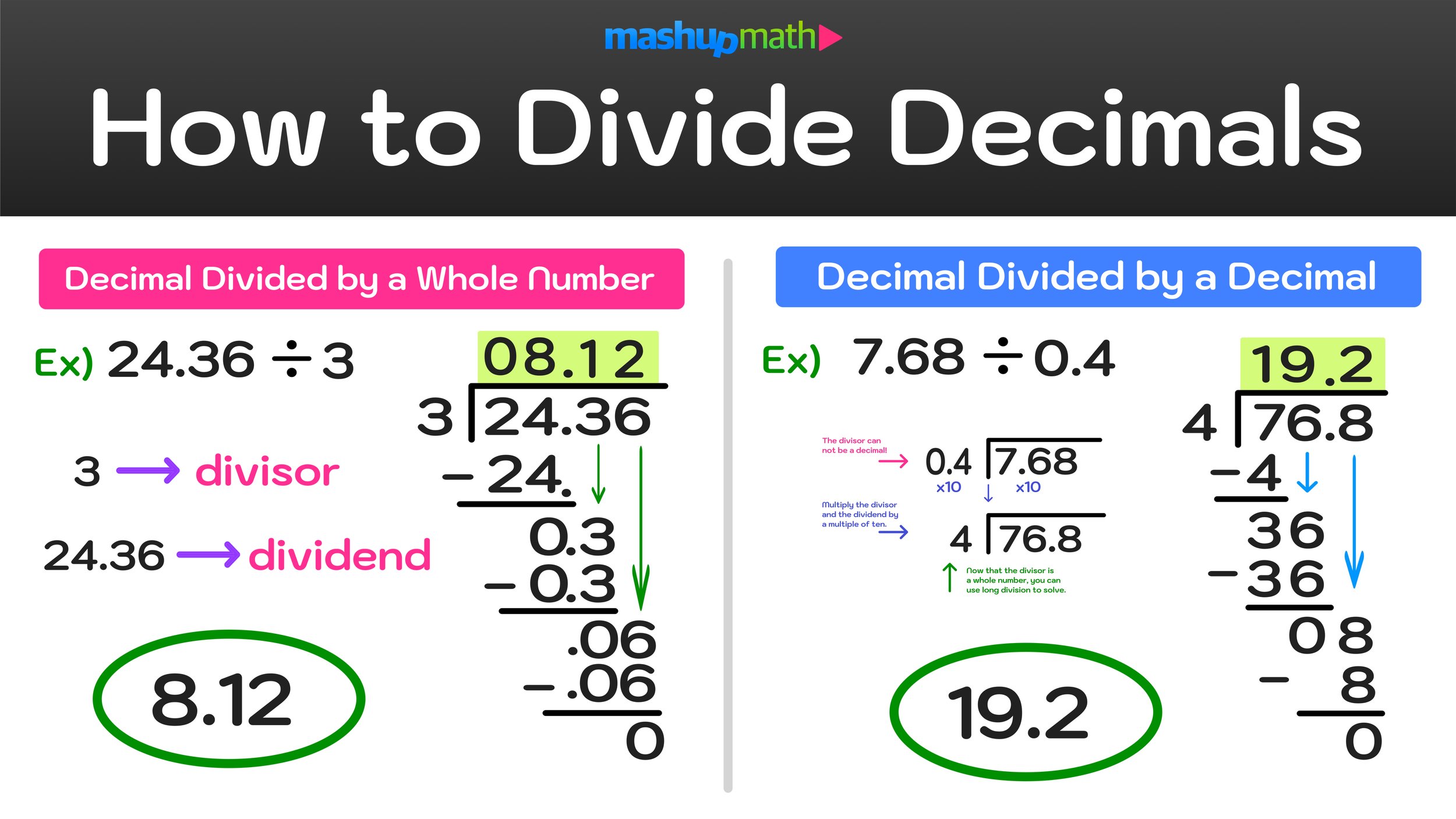
How to Divide Decimals Explained—Step-by-Step Examples and Tutorial

1 Comment

How to Divide Decimals Explained—Step-by-Step Examples and Tutorial

How to Divide Decimals Explained in 3 Easy Steps

Step-by-Step Guide: How to Divide Decimals by Whole Numbers and How to Solve Decimal Divided by Decimal Problems
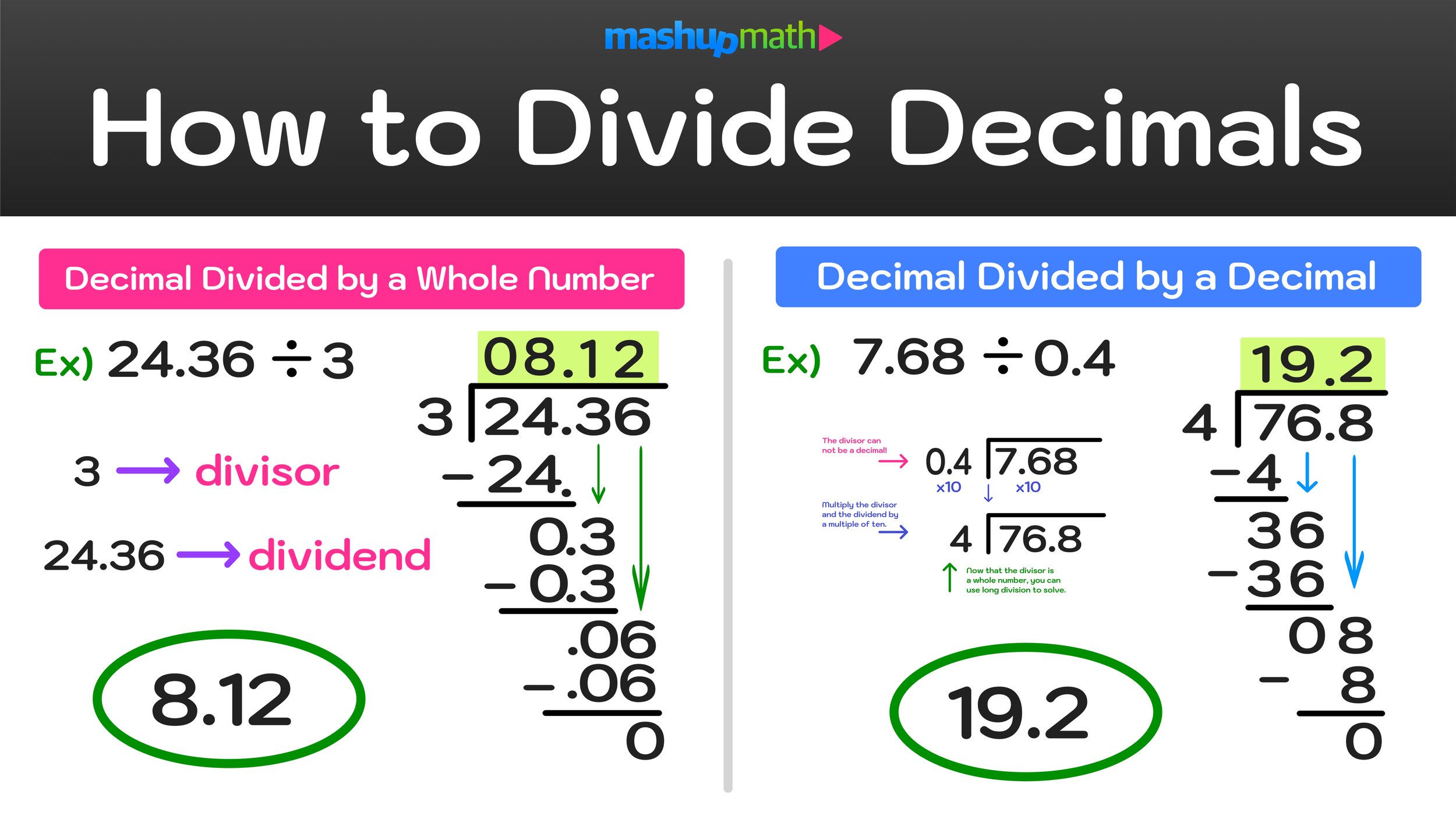
 

Free Step-by-Step Guide: Dividing Decimals Explained in 3 Easy Steps


In math, it is important to be able to work with and perform operations on decimals, which are numbers in the base-10 system that include a point that separates the whole number(s) from the attached fractional parts. For example, the number 2.5 is a decimal number that represents two and a half.

One of the more challenging operations to perform with decimals is division. However, if you know how to divide whole numbers, then you can easily learn how to divide decimals using just a few simple steps. Note that there are two different cases when it comes to dividing decimals: a decimal divided by a whole number and a decimal divided by another decimal. We will cover both cases in this guide.

Below are quick links to each section of this free Step-by-Step Guide on How to Divide Decimals:

While learning how to divide with decimals can be intimidating at first, it is a math skill that you can easily learn with practice following a simple 3-step process. This free dividing with decimals tutorial will teach you everything you need to know about how to divide with decimals, including several step-by-step practice problems for both dividing decimals by whole numbers and dividing decimals by decimals.

But, before we dive into our practice problems, let’s do a quick recap of some important vocabulary terms related to division as well as a quick review of how to perform long division. If you are already comfortable with the review information, you can use the quick links above to skip ahead to the section that best meets your needs.
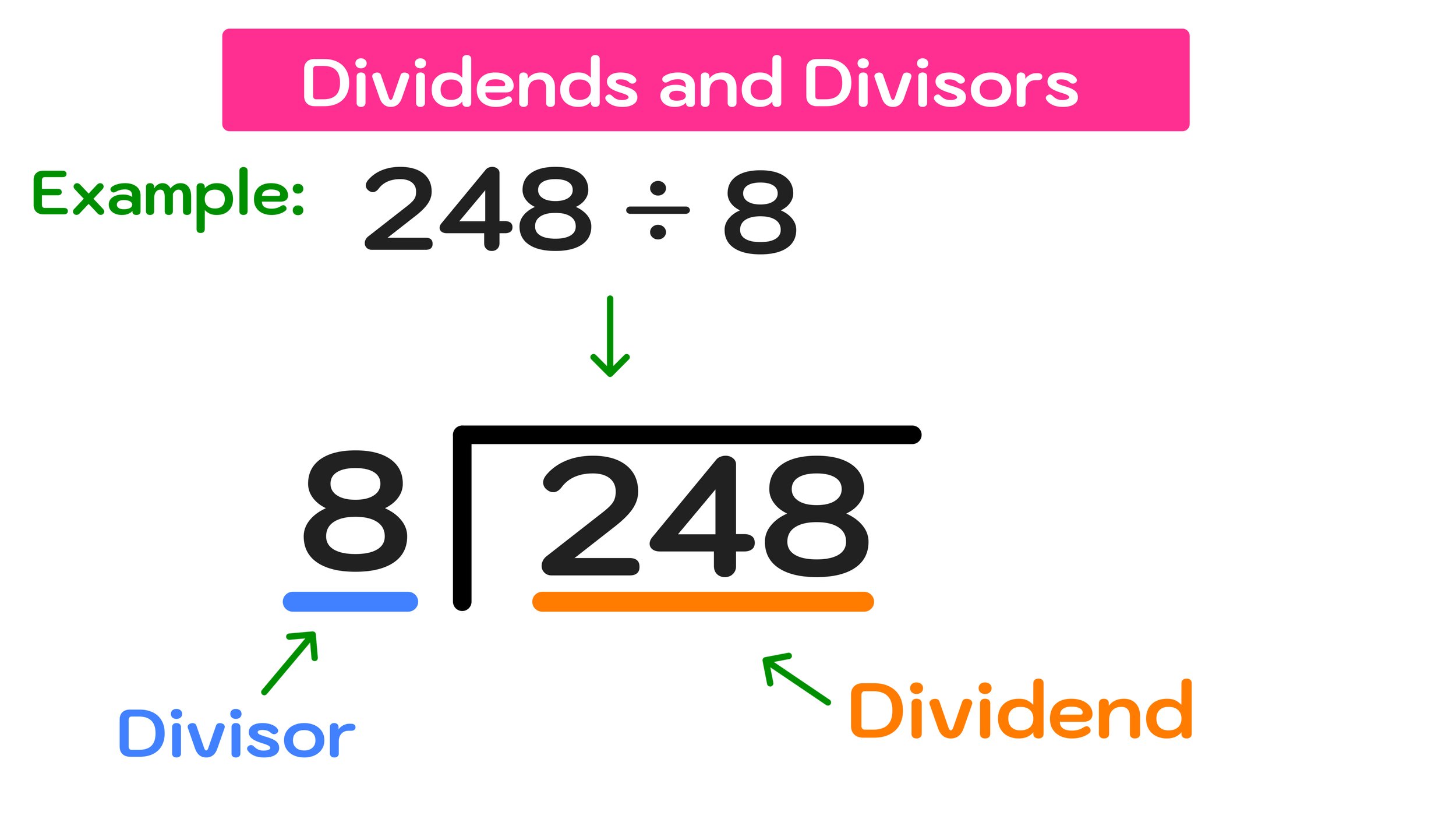
 

Figure 01: How to Divide Decimals: Key Vocabulary


What is a dividend? What is a divisor?

In this guide on dividing decimals, we will be using the terms dividend and divisor often, so make sure that you are familiar with what they mean:

  • When dividing two numbers, the dividend is the number that is being divided.

  • When dividing two numbers, the divisor is the number of parts the dividend is being divided into.

For example, consider the division problem: 248 ÷ 8

  • 248 is the dividend because it is the number being divided

  • 8 is the divisor because 248 is being divided into 8 parts.

This example is illustrated in Figure 01 above.

Because this guide will be teaching you how to divide decimals without using a calculator, we will be using long division to solve problems. Therefore, it is important that you are familiar with the divisor/dividend notation shown in Figure 01 above, where: 248 ÷ 8 → 8 | 248

Now that you know how to identify a dividend and a divisor and the divisor/dividend notation, lets do a quick review of how to perform long division using the same example of 248 ÷ 8.


Figure 02: Dividing Decimals Explained: Long Division Review


Figure 02 above shows a step-by-step review of how to use long division to determine that 248 ÷ 8 = 31.

If you are not comfortable with performing long division, then we recommend that you pause now and do a deeper review before moving forward with this tutorial on how to divide decimals.


How to Divide Decimals by Whole Numbers

The first set of examples in this dividing decimals tutorial will focus on how to divide decimals by whole numbers and will include examples for when the dividend is the whole number and when the divisor is the whole number as well.

How to Divide Decimals by Whole Numbers

Example #1: 1.5 ÷ 2

Let’s start off with a simple example that you could probably solve without the use of long division (although we will solve it using long division anyway so that you can start to become more familiar with our 3-step process for dividing decimals).

For this example, and all of the examples that follow, you will be using the following three step method for dividing decimals:

  • Step One: Identify the dividend and the divisor and determine whether or not the divisor is a whole number (if it is, move onto Step Three).

  • Step Two: If the divisor is not a whole number, multiply it by a multiple of 10 to make it a whole number (multiply tenths by 10, hundredths by 100, thousandths by 1,000, etc.). Whatever multiple of 10 that you multiplied the divisor by, you must also multiply the dividend by.

  • Step Three: Use long division to solve.

We will be applying this 3-step process of all of the dividing decimals practice problems in this guide, so don’t get intimidated if you are a little confused right now. The process will make more sense and be easier to apply after we work through a few examples.


Figure 03: How to Divide Decimals: First, identify whether or not the divisor is a whole number.


Lets start with the first step:

Step One: Identify the dividend and the divisor and determine whether or not the divisor is a whole number (if it is, move onto Step Three).

In the case of 1.5 ÷ 2

  • 2 is the divisor

  • 1.5 is the dividend

As shown in Figure 03 above, it is clear that the divisor is 2, which is indeed a whole number, so, for this example, we can skip the second step and move right onto Step Three.

Also notice that in Figure 03 above, we rewrote 1.5 as 1.50 (they both mean the same thing). Adding extra zeros after the last digit of a decimal does not change the number and often helps you to perform long division, as you will see in the next step.

Step Three: Use long division to solve.

All that you have to do now is use long division to solve the problem. You can click play on the video below to see an animated step-by-step breakdown of how to perform the long division for this problem.

Based on the video and the illustrated summary shown in Figure 04 below, you can see that:

Solution: 1.50 ÷ 2 = 0.75

This solution should make sense because dividing 1.50 in half will result in 0.75. Before moving onto another similar example of a decimal divided by a whole number, we encourage you to review the above review as we will not include videos for every example.


Figure 04: How to Divide Decimals by Whole Numbers: Example #1 Solved


Dividing Decimals by Whole Numbers

Example #2: 24.36 ÷ 3

For this next example, we will be using the exact same three-step approach as Example #1.

Step One: Identify the dividend and the divisor and determine whether or not the divisor is a whole number (if it is, move onto Step Three).

For this example:

  • 3 is the divisor

  • 24.36 is the dividend

Since the divisor in this example is a whole number (3), we can skip the second step just like we did in the previous example and move onto the third and final step.

Step Three: Use long division to solve.

To solve the second example, perform long division just as you did to solve Example #1. Remember to follow your steps carefully and to line up your decimal points.

The entire process of using long division to solve 24.36 ÷ 3 is illustrated in Figure 05 below.


Figure 05: Dividing decimals by whole numbers explained.


After completing Step Three, we can conclude that:

Solution: 24.36 ÷ 3 = 8.12

Now, lets look at a few examples of a decimal divided by a whole number where the divisor is not a whole number.


How to Divide Decimals by Whole Numbers

Example #3: 92 ÷ 2.3

For this third example of dividing decimals by whole numbers, we will again be using the same three-step method as the previous two examples (as well as all on the examples that will follow this one), except that this time we will not be able to skip the second step.

Step One: Identify the dividend and the divisor and determine whether or not the divisor is a whole number (if it is, move onto Step Three).

In this case:

  • 2.3 is the divisor

  • 92 is the dividend

Since the divisor in this example is 2.3, which is not a whole number, we will have to move onto the second step (which we were able to skip in the previous two examples).

Step Two: If the divisor is not a whole number, multiply it by a multiple of 10 to make it a whole number (multiply tenths by 10, hundredths by 100, thousandths by 1,000, etc.). Whatever multiple of 10 that you multiplied the divisor by, you must also multiply the dividend by.

When it comes to dividing decimals, we cannot have a decimal as a divisor. However, we can multiply both the divisor and the dividend by the same multiple of ten to transform the divisor into a whole number and still have a proportional relationship.

Since the final digit of 2.3 is in the tenths place value slot, we will multiply both the divisor (2.3) and the dividend (92) by 10 as shown below and in Figure 06:

  • 2.3 x 10 = 23

  • 92 x 10 = 920

*Remember that what you do to one number, you must do to the other number. If you forget to multiply both the dividend and the divisor by 10, you will get the wrong answer.


Figure 06: How to Divide Decimals by Whole Numbers: The divisor has to be a whole number.


Step Three: Use long division to solve.

After completing Step Two, all we have to do is use long division to solve 920 ÷ 23.

The step-by-step process for using long division to divide 920 by 23 is shown in Figure 07 below.
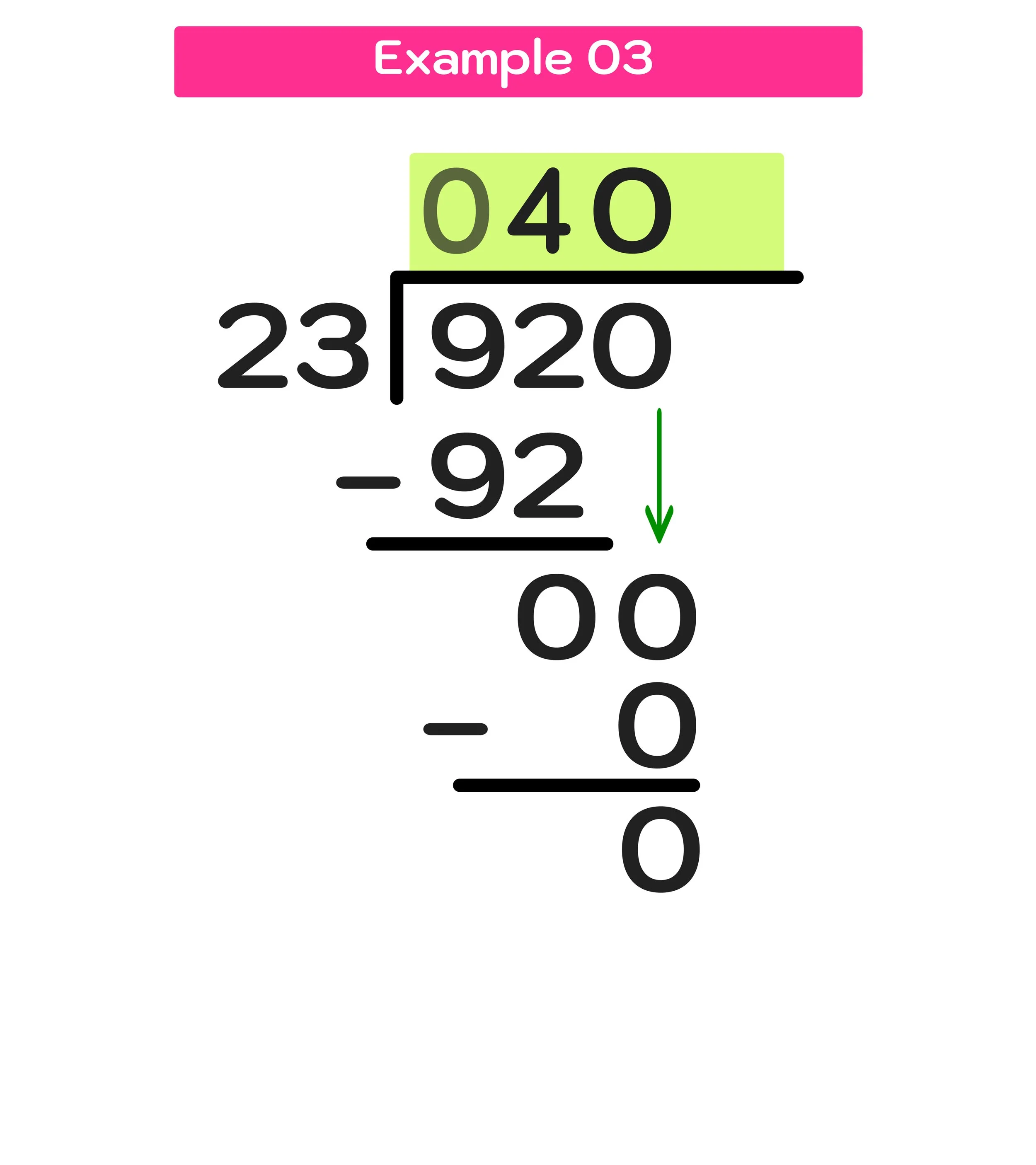
 

Figure 07: Decimal divided by a whole number


Finally, we can say that:

Solution: 92 ÷ 2.3 = 40

Next, lets look at one final example of how to divide decimals by whole numbers before we move onto learn all about dividing decimals by decimals.

How to Divide Decimals by Whole Numbers

Example #4: 16 ÷ 6.25

Step One: Identify the dividend and the divisor and determine whether or not the divisor is a whole number (if it is, move onto Step Three).

For the fourth example, the divisor is a decimal and the dividend is a whole number.

  • 6.25 is the divisor

  • 16 is the dividend

Step Two: If the divisor is not a whole number, multiply it by a multiple of 10 to make it a whole number (multiply tenths by 10, hundredths by 100, thousandths by 1,000, etc.). Whatever multiple of 10 that you multiplied the divisor by, you must also multiply the dividend by.

Since the divisor is a decimal (6.25), we will have to multiply both the divisor and the dividend by the same multiple of ten.

And since, in this example, the final digit of the divisor, 6.25, is in the hundredths place value slot, we will multiply both the divisor and the dividend by 100 as shown below and in Figure 08.

  • 6.25 x 100 = 625

  • 16 x 100 = 1,600


Figure 08: How do you divide decimals by whole numbers?


After completing long division, we can conclude that:

Solution: 16 ÷ 6.25 = 2.56

Now we will move on from dividing decimals by whole numbers to learning how to divide decimals by decimals.


Dividing Decimals by Decimals

This section of our guide focused on dividing decimals by decimals. If you used the quick links at the top of the page to skip to this section, we recommend working through the examples in the dividing decimals by whole numbers section above, because it will help you to better understand how to use the following three-step method for dividing decimals by decimals:

  • Step One: Identify the dividend and the divisor and determine whether or not the divisor is a whole number (if it is, move onto Step Three).

  • Step Two: If the divisor is not a whole number, multiply it by a multiple of 10 to make it a whole number (multiply tenths by 10, hundredths by 100, thousandths by 1,000, etc.). Whatever multiple of 10 that you multiplied the divisor by, you must also multiply the dividend by.

  • Step Three: Use long division to solve.

Just as the previous section on dividing decimals by whole numbers, we will be following the same steps for dividing decimals by decimals.

Lets go ahead and dive into the first example.


How to Divide with Decimals

Example #1: 7.68 ÷ 0.4

Step One: Identify the dividend and the divisor and determine whether or not the divisor is a whole number (if it is, move onto Step Three).

For this first example:

  • 0.4 is the divisor

  • 7.68 is the dividend

For all of the examples in this section, we will be dividing decimals by decimals, so it will always be the case that the divisor is not a whole number. Therefore, you will always have to move onto Step Two, where you will use multiplication to transform the divisor into a whole number.

Step Two: If the divisor is not a whole number, multiply it by a multiple of 10 to make it a whole number (multiply tenths by 10, hundredths by 100, thousandths by 1,000, etc.). Whatever multiple of 10 that you multiplied the divisor by, you must also multiply the dividend by.

Again, a decimal divided by a decimal can not be solve using long division when the divisor is not a whole number. Luckily, you can easily transform the divisor into a whole number by multiplying both the divisor and the dividend by a multiple of ten and still have a proportional relationship where you can use long division to solve the problem.

Since the final digit of 0.4 is in the tenths place value slot, you can multiply both the divisor (0.4) and the dividend (7.68) by 10 as shown below and as illustrated in Figure 09.

  • 0.4 x 10 = 4

  • 7.68 x 10 = 76.8

*Always remember that whenever you multiply the divisor by a multiple of 10, you also have to multiply the dividend by that same multiple of 10. If you forget to multiply both by the same multiple of 10, you will not be able to correctly solve the problem.
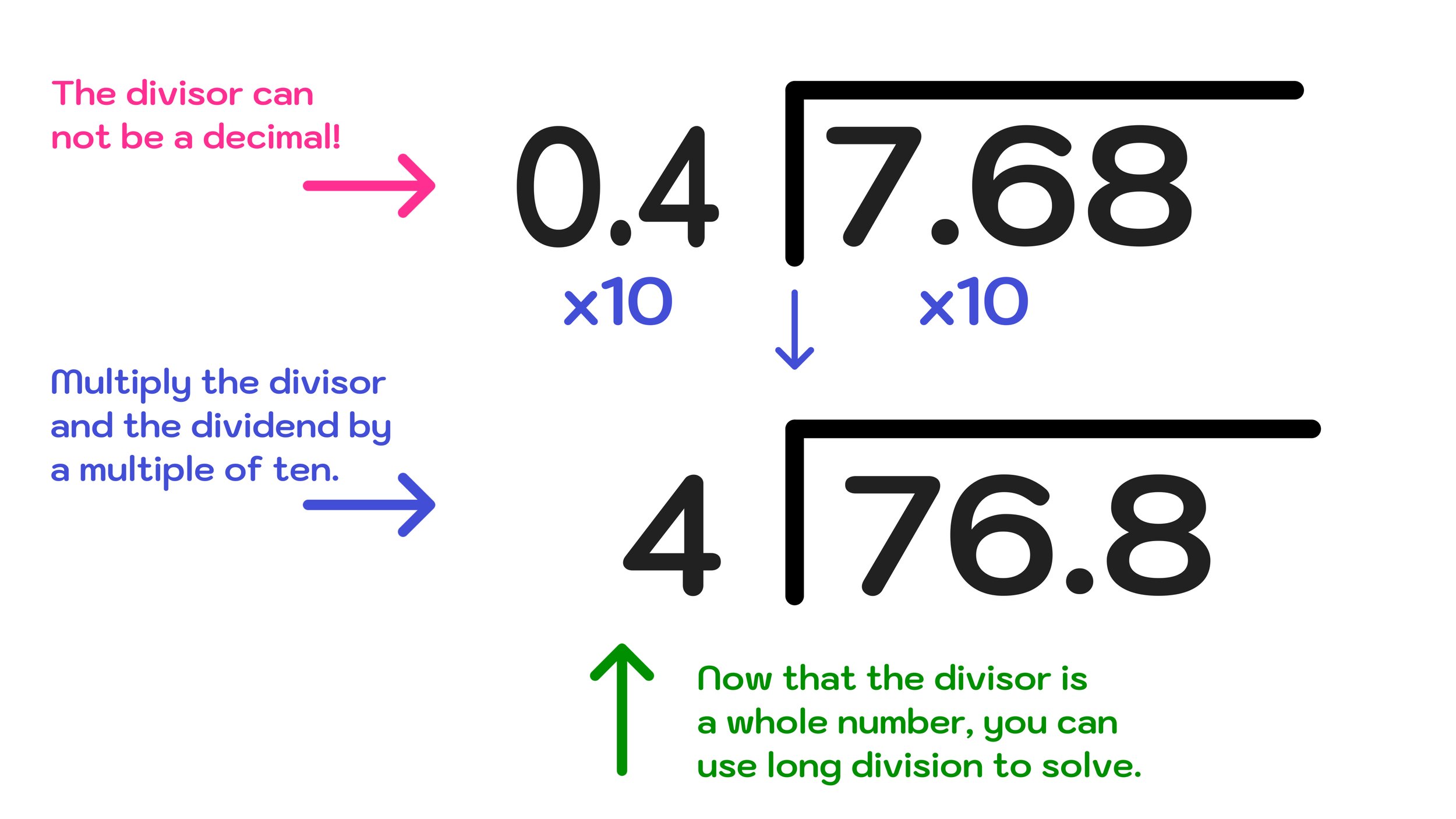
 

Figure 09: How to Divide with Decimals: Use multiples of 10 to transform the divisor into a whole number.


Step Three: Use long division to solve.

Now that you have transformed the divisor into a whole number, you can use long division to solve the problem. You can click play on the video below to see an animated step-by-step breakdown of how to perform the long division for this problem.

Based on the video and the illustrated summary shown in Figure 10 below, we can conclude that:

Solution: 7.68 ÷ 0.4 = 19.2

Before you continue onto the next example of how to divide decimals by decimals, we highly recommend that you review the step-by-step long division tutorial above as we will not include video tutorials for every problem.
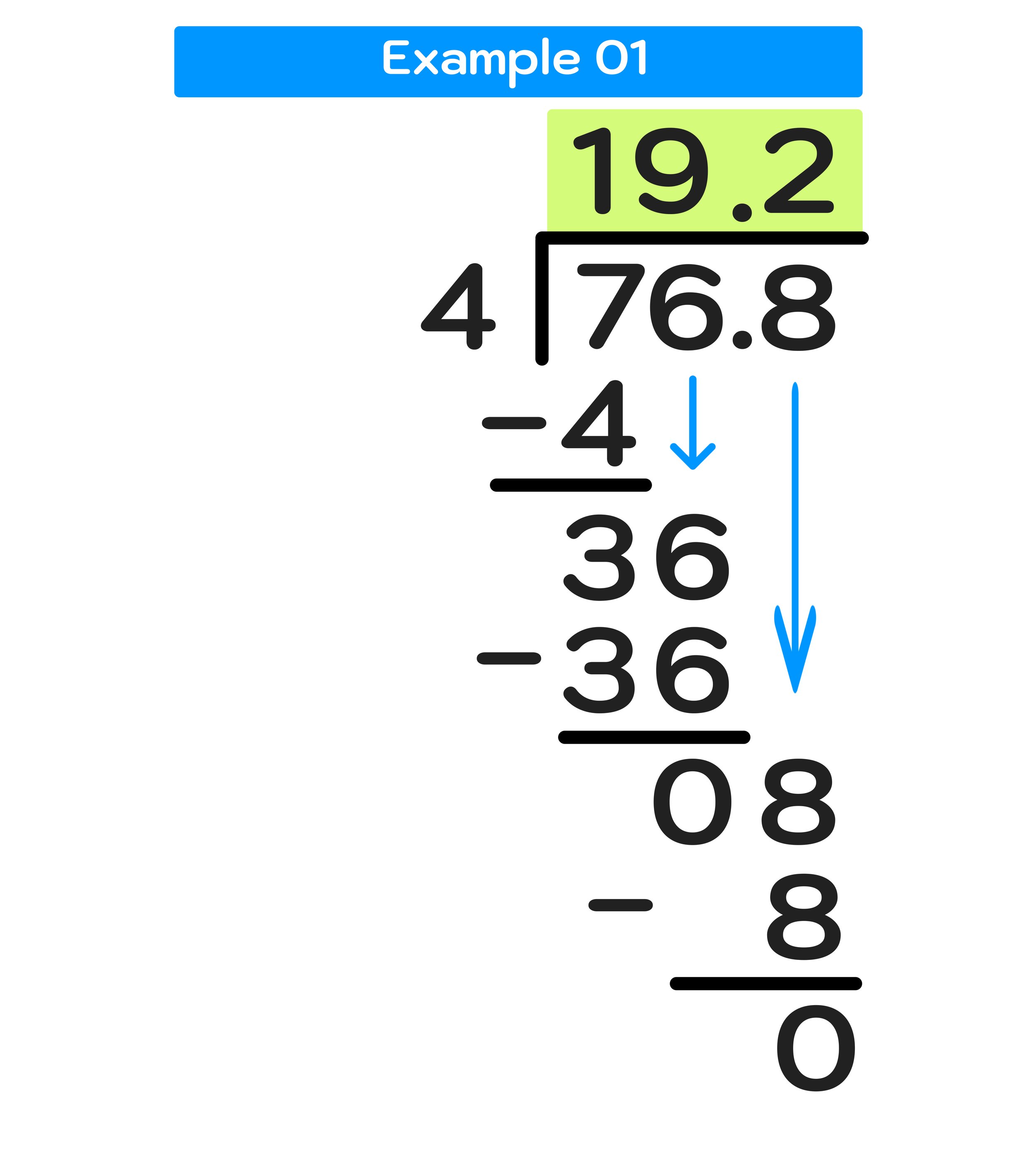
 

Figure 10: How to divide decimals by decimals.


How to Divide Decimals by Decimals

Example #2: 38.4 ÷ 0.24

Just like the previous example, we will use our three step method to solve a decimal divided by a decimal problem.

Step One: Identify the dividend and the divisor and determine whether or not the divisor is a whole number (if it is, move onto Step Three).

For this first example:

  • 0.24 is the divisor

  • 38.4 is the dividend

Step Two: If the divisor is not a whole number, multiply it by a multiple of 10 to make it a whole number (multiply tenths by 10, hundredths by 100, thousandths by 1,000, etc.). Whatever multiple of 10 that you multiplied the divisor by, you must also multiply the dividend by.

Since the divisor, 0.24, is a decimal, you will have to multiply it (and the dividend) by a power of ten to make it a whole number. Since the last digit of 0.24 is in the hundredths place value slot, we will multiply both the divisor and the dividend by 100 as shown below and in Figure 11.

  • 0.24 x 100 = 24

  • 38.4 x 100 = 3,840


Figure 11: Solving a decimal divided by a decimal problems.


Step Three: Use long division to solve.

Finally, you now have a divisor that is a whole number, so you can simply use long division to solve 3,840 ÷ 24 to find the solution to this problem, as illustrated in Figure 12 below.
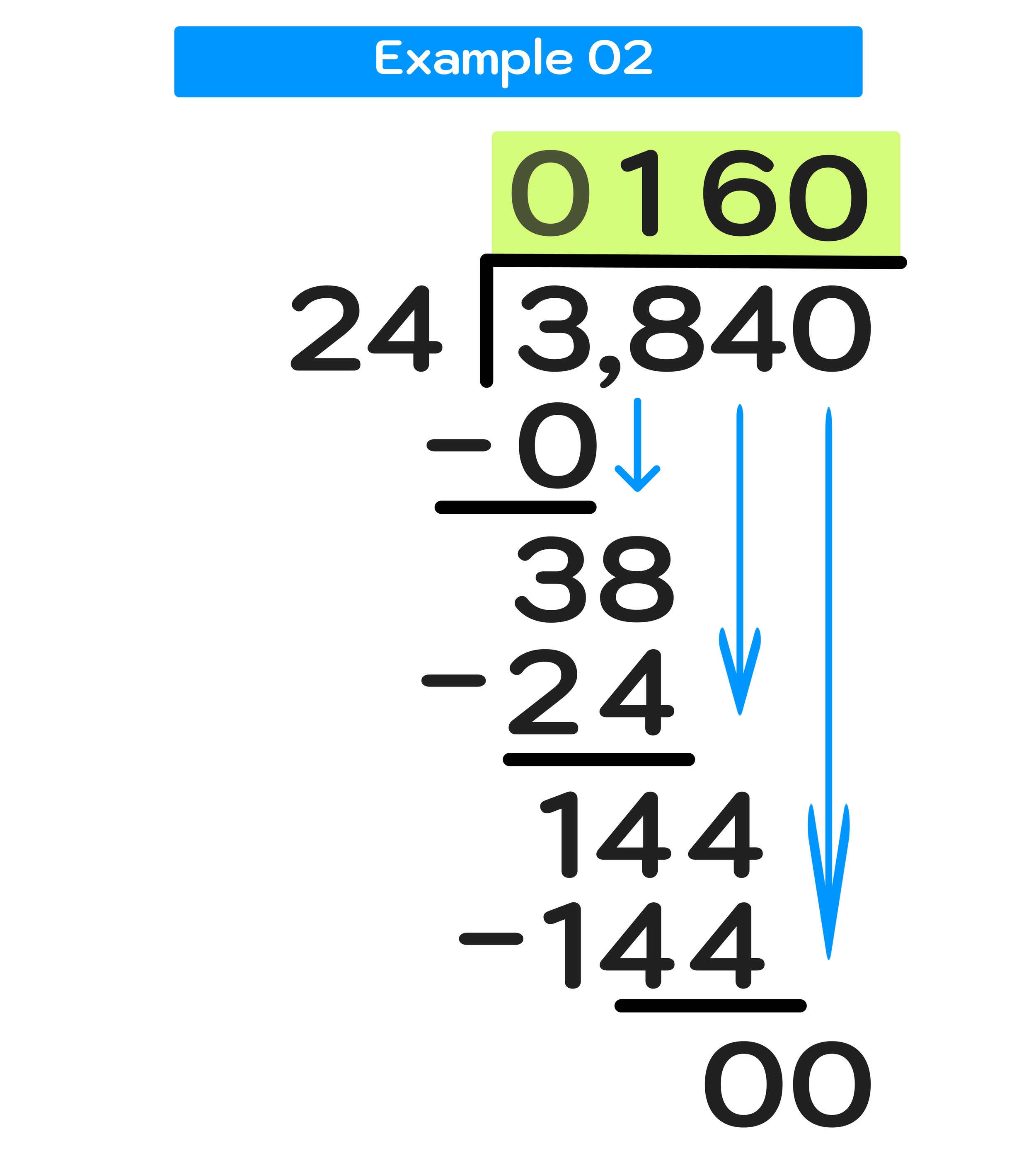
 

Figure 12: How to Divide Decimals Step-by-Step


Solution: 38.4 ÷ 0.24 = 160

Now, lets work through one final example.


How to Divide Decimals by Decimals

Example #3: 4.76 ÷ 1.36

Step One: Identify the dividend and the divisor and determine whether or not the divisor is a whole number (if it is, move onto Step Three).

For this first example:

  • 1.36 is the divisor

  • 4.76 is the dividend

Step Two: If the divisor is not a whole number, multiply it by a multiple of 10 to make it a whole number (multiply tenths by 10, hundredths by 100, thousandths by 1,000, etc.). Whatever multiple of 10 that you multiplied the divisor by, you must also multiply the dividend by.

Since the divisor, 1.36, is a decimal, you will have to multiply it (and the dividend) by 100 to transform it into a whole number (we chose to multiply the dividend and the divisor by 100 because the last digit of 1.36 is in the hundredths decimal slot).

  • 1.36 x 100 = 136

  • 4.76 x 100 = 476

Step Three: Use long division to solve.

Now you can find the solution by using long division to solve 476 ÷ 136 as shown in Figure 13 below.


Figure 13: Dividing decimals example #3 solution.


Solution: 4.76 ÷ 1.36 = 3.5


Dividing Decimals Worksheet

Are you looking for some extra practice with solving problems involving dividing decimals?

You can click the link below to download your free Dividing Decimals Worksheet, which includes a complete answer key so you can check your work. Be sure to apply the three-step process shared in this guide (and also featured on the worksheet) when solving the problems.

Download Your Free Dividing Decimals Worksheet (w/ Answer Key)

Access More Free Topic-Specific Math Worksheets

Dividing Decimals Worksheet Preview

Conclusion: How to Divide Decimals

Learning how to divide decimals by whole numbers or other decimals is an important math skill that every student will eventually have to learn how to do.

While dividing decimals can seem challenging, as long as you know how to perform long division, you can easily solve dividing decimals problems by using the following 3-step approach:

  • Step One: Identify the dividend and the divisor and determine whether or not the divisor is a whole number (if it is, move onto Step Three).

  • Step Two: If the divisor is not a whole number, multiply it by a multiple of 10 to make it a whole number (multiply tenths by 10, hundredths by 100, thousandths by 1,000, etc.). Whatever multiple of 10 that you multiplied the divisor by, you must also multiply the dividend by.

  • Step Three: Use long division to solve.

By working through the examples in this guide as well as the practice problems on the free dividing decimals worksheet, you will gain invaluable practice and experience with dividing decimals, which will make solving problems where you have to divide decimals a simple and easy task.


Keep Learning:

1 Comment

21 Cute Math Pickup Lines for All Ages!

Comment

21 Cute Math Pickup Lines for All Ages!

21 Cute Math Pickup Lines for All Ages!

Looking to break the ice and start a conversation with a math fanatic?

Sometimes the right pickup line is all that you need. When it comes to courting someone who appreciates math, using a math-themed pickup line can go a long way.

So, to help you add a few cute and effective math pickup lines to your charm portfolio, today we are sharing 21 math pickup lines for all ages that any math fan will surely love.

A pickup line is a charming, clever, and/or humorous question or remark that is used to spark a conversation with someone by grabbing their attention or interest, typically in the form of courting, flirting, or dating. Pickup lines come in a variety of forms, as some are direct and bold, while others are funny, corny, and often cringe-worthy.

The math pickup lines below range from simple and complex to irrational and unreal to funny and mildly risqué. Be sure to check them all out and see which one will be your perfect square root of one hundred! Then use them to break the ice with someone you would like to start a conversation with when the time is right.

Remember that math pickup lines should be used with the goal of breaking the ice, sparking a positive response, and starting a friendly conversation.

So, go ahead and scroll down and enjoy this list of cute and effective math pickup lines that you can use to come across as charming, witty, humorous, and mathematically savvy with that special someone you are interested in.

And, if you try some of these math pickup lines and come up empty, then pat yourself on the back and move on with your life. After all, there are plenty of points on the coordinate plane.


Math Pickup Lines

1.) Are you good at adding numbers? Try adding mine to your contacts.

2.) Are you the square root of 100? Because you’re a solid 10.

3.) If your beauty was a function, it would be exponential!


4.) Do you want to know my favorite math equation? You + Me = Us

5.) Are you a 45-degree angle? Because you’re acute-y

6.) I have memorized the first 200 digits of pi. If you gave me your phone number, I could memorize that too.


7.) If you give me your digits, I can call-cu-later!

8.) If we were a right triangle, I’d want to be adjacent to your hypotenuse.

9.) Expressing my love for you is like trying to divide by zero… It simply cannot be defined!


10.) Are you a parabola? Because you have beautiful curves.

11.) If you give me just a FRACTION of your heart, you will always be the numerator to my denominator.

12.) You must be a 90º angle. Because you are looking all-right!


13.) Are you the square root of negative one? Because you are unreal.

14.) Are we two intersecting lines? Because I feel like we’re sharing a common point.

15.) If I was a math function, then you’d be my asymptote, because I will always move towards you.


16.) Are you the center of a circle? Because my thoughts are always revolving around you.

17.) If our love was a math function, then our limit would not exist.

18.) If you’re not mean, would you let me know if I’m in your range?


19.) My feelings for you are like quadratic equations – they’re complex and they have multiple solutions.

20.) Let’s take our relationship to its limit and see if we converge.

21.) If I was a math textbook, you would be the answer key. Because you’re the solution to all of my problems.


Now that you have added a few new math pickup lines to your tool belt, you can use them to attempt to capture the interest and attention of someone who loves math. Having the right pickup line is important, but being confident in your delivery goes a long way too. Never let fear prevent you from trying to make conversation with someone, but also be willing to take no for an answer. If someone does not want to talk, then respect their decision and move on. The more that you try starting conversations, the more comfortable you will become, and using pickup lines can improve your chances, so why not give them a shot?


Did your math pickup line fail? Take the L and move on.


(Do you want more free K-8 math resources and activities in your inbox every week? Click here to sign up for our math education email newsletter)

22.) Wake up, people!

More K-8 Education Resources You Will Love:

51 Funny Teacher Memes That Will Make You Laugh Out Loud

To celebrate the art of teaching—warts and all—we are sharing some humor related to the more challenging and aggravating aspects of being a teacher by sharing some all too relatable funny teacher memes for teachers of all subjects and grade levels.

Comment

Hard Math Problems for 6th Graders: Pumpkins and Watermelons

1 Comment

Hard Math Problems for 6th Graders: Pumpkins and Watermelons

Hard Math Problems for 6th Graders

Can Your 6th Graders Solve the Pumpkins and Watermelons Problem?

Hard Math Problems for 6th Graders: The Pumpkin and Watermelon Problem

Looking for more fun math riddles and brain teasers to share with your 6th graders? If so, then you will love today’s hard math problem, which is quite the brain bender.

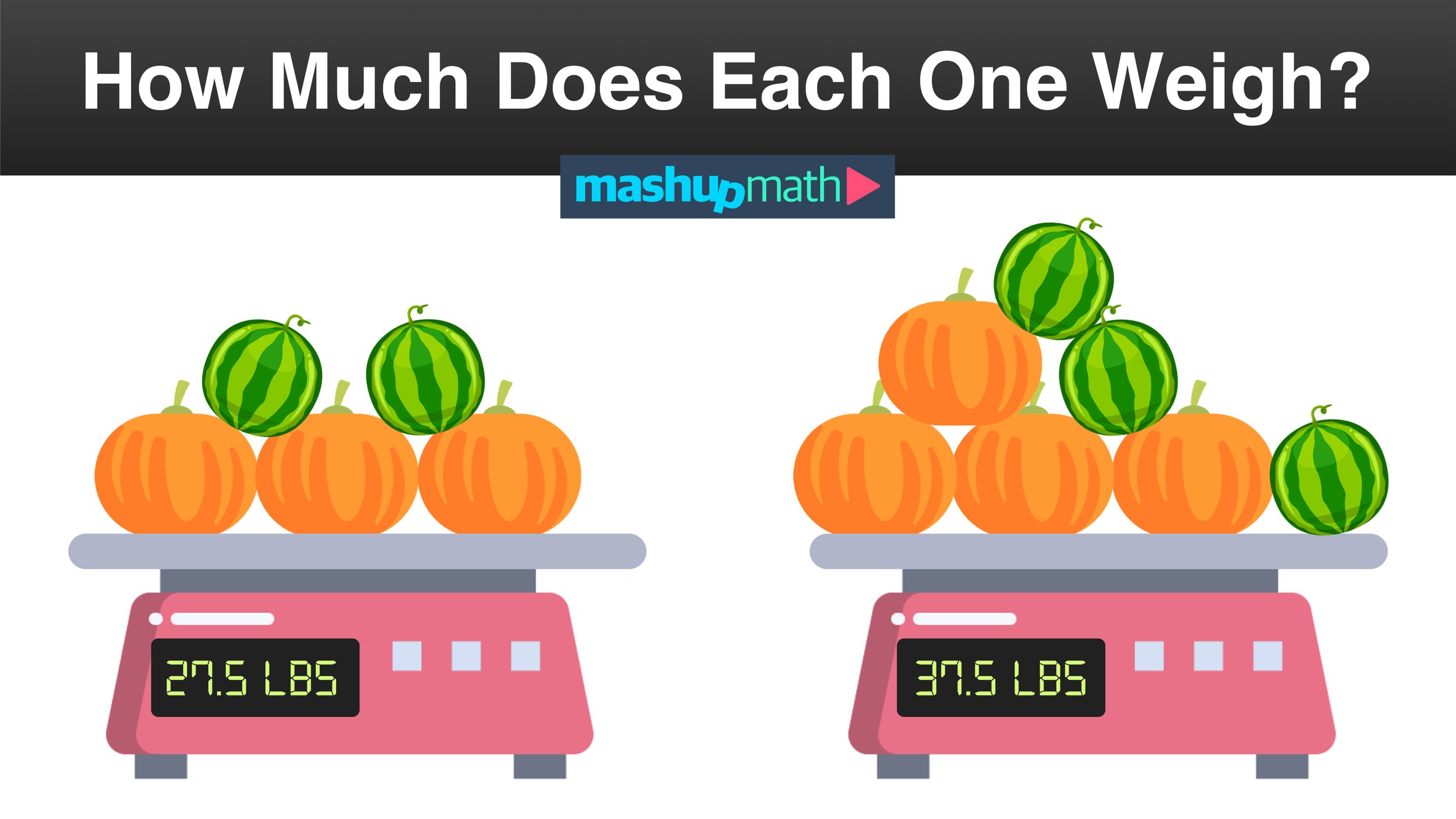
Here is the problem, which involves figuring out the weights of pumpkins and watermelons:

Three pumpkins and two watermelons weigh 27.5 pounds. Four pumpkins and three watermelons weigh 37.5 pounds. Each pumpkin weighs the same as the other pumpkins. Each watermelon weighs the same as the other watermelons. How much does each pumpkin weigh? How much does each watermelon weigh?

Before we dive into solving this math problem, let’s talk about why these types of multi-step problems are considered hard math problems for 6th graders in the first place.

This math problem is not the typical type of problem that a 6th grade student will encounter, as the answer cannot be found in a direct or linear way. Also, the problem requires students to work with two different variables—pumpkins and watermelons, which is a much more challenging algebraic task than they may be used to.

However, this problem is appropriately challenging for 6th graders and they have the prerequisite skills to solve this problem using a variety of possible strategies. Once your 6th graders have found the relationship and the difference between the quantities, they can choose a strategy that they are comfortable with to determine the individual weight of a pumpkin and of a watermelon.

If you want to try to solve the problem for yourself, now would be the time to pause and try and solve it on your before continuing on to the answer.


Solution: How Much Does Each Item Weigh?

While there are many ways to solve this problem, we will offer one possible solution, which utilizes tape diagrams to help students visualize a very key piece of information—that the difference between the two statements:

  • Three pumpkins and two watermelons weigh 27.5 pounds; and

  • Four pumpkins and three watermelons weigh 37.5 pounds

—is that the combination of one pumpkin and one watermelon is equal to 10 pounds.

Once students figure this out, they can use this fact to isolate P in the 27.5 lb group and determine that the weight of one pumpkin is 7.5 pounds. They can then repeat this process again using the 27.5 lb group to determine that the weight of one watermelon is 2.5 pounds, as shown in the figure below.


Hard Math Problems for 6th Graders


Final Answer…

One pumpkin weighs 7.5 pounds and one watermelon weighs 2.5 pounds.

How did you and your students do with this problem? It surely was not easy, and it required your 6th graders to make sense of a complex problem that required multiple steps and some creative problem-solving techniques to get through.

Are you looking for more fun and challenging math activities, puzzles, and brain teasers to share with your 6th grade students? Check out our free math worksheet and activity libraries.


Do YOU Want More Fun Math Riddles, Puzzles, and Brain Teasers?

Wasn’t that fun? If you want to take on more brain-bending math puzzles to sharpen your mind and improve your problem-solving skills, check out the links below:

1 Comment

What Color is Math?

What Color is Math?

What Color is Math?

A Deep Dive into the Colorful Subject that is Mathematics


What Color is Math?


It’s interesting to wonder “what color is math?” After all, mathematics is about digits, equations, shapes and figures, and logical thinking—not colors. In fact, most students would probably say that math is not related to colors at all and maybe even that math has no color. But would saying that math has no color be true? This post will take an open-minded exploration into mathematics and its often overlooked color palette.

We will start by looking into the relationship between mathematics and color as seen in history, everyday life, education, nature, and our emotions related to learning mathematics.

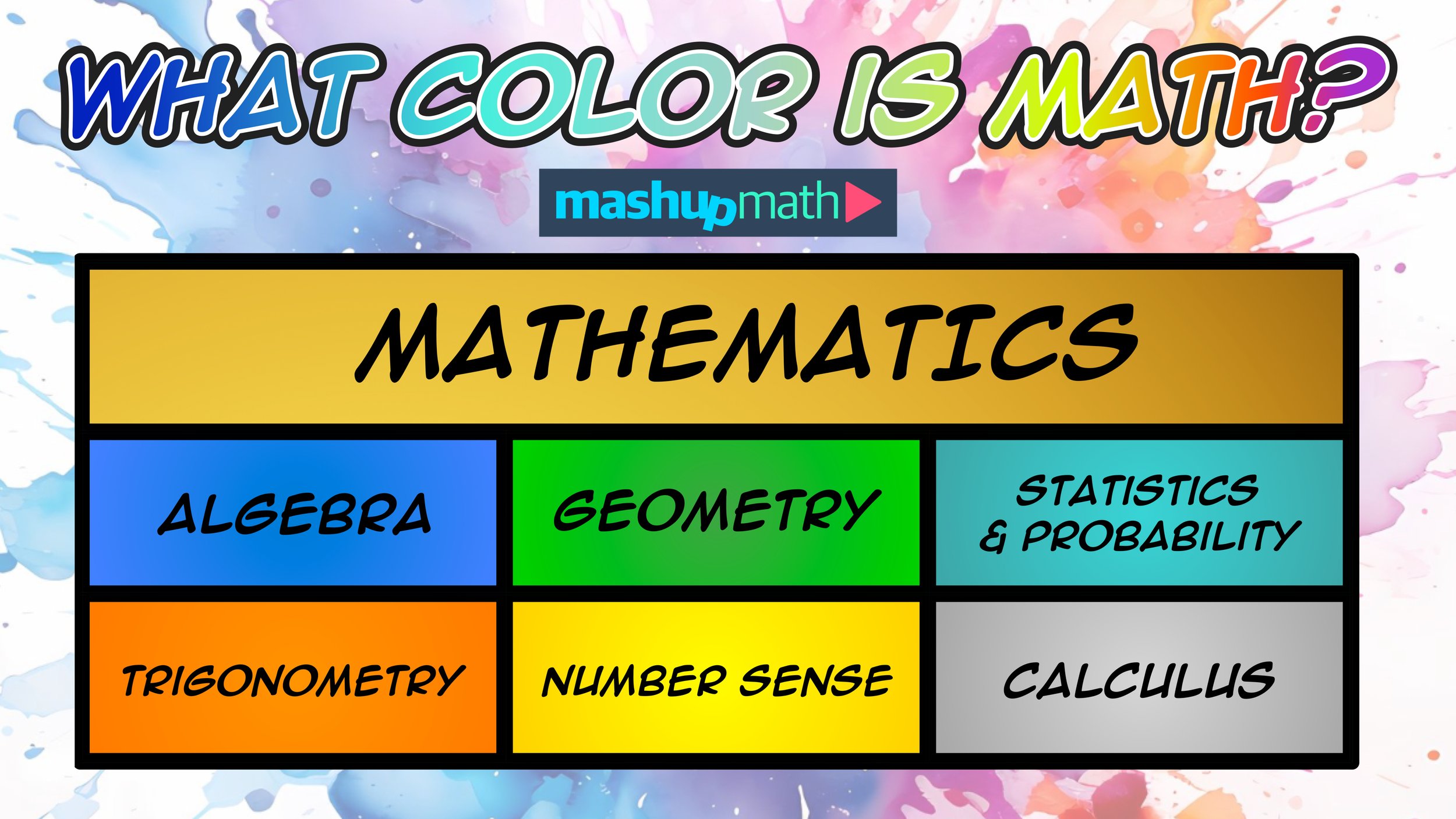
Finally, we will give a definitive answer to “what color is math?” as well as colors that best represent several fields of mathematics including algebra, geometry, and calculus.

The History of Math

Did you know that the earliest cultures that practiced mathematics actually associated colors with numbers and important math concepts? For example, the ancient Mayans used a color-coded system for their mathematical calendar cycles. Also, Chinese culture has attributed colors to numbers, which play a significant role in the field of numerology—especially for ancient Chinese culture, which believed that numbers could influence your fate and personal fortune in life. Given that the idea of mathematics having color has been present for so long, it makes exploring the questions, what color is math?, worthwhile.


Ancient Chinese mathematicians believed that numbers could influence your fate and personal fortune. (Image: Mashup Math MJ)

The ancient Mayans used a color-coded system for their mathematical calendar cycles. ( (Image: Mashup Math MJ)


Math in Every Day Life

In modern day life, we use colors to represent mathematical quantities and to categorize things all the time. For example, when it comes to driving, the color green means go and the color red means stop.

And when it comes to data, tables and figures are used to represent statistics and they rely on color to differentiate between quantities, categories, and events. A pie chart with each section being the same color would be useless, which is why colors are used to detail each different section.

Since colors help us to visualize and differentiate things, providing specificity, clarity, and comparison, they are an amazing tool that can be used in mathematics to help you to identify patterns, differentiate quantities, and display data in a way that is easy to analyze and understand.


What Color is Math? Data tables and charts rely on color to differentiate quantities and categories. (Image: Mashup Math FP)


Colors for Teaching Math

Math teachers often use colors to help their students to understand math in a variety of ways. For example, young students often use colorful hands-on resources such as fraction strips to develop deep conceptual understanding of a topic or skill.

The use of colors helps students to differentiate between values, compare and contrast them, and make conclusions. It is colors that allow students to engage with mathematics in a visual and tactile way, which fosters the development of math skills and connections.

At higher levels of math, students can use colors to navigate multi-step problems such as performing proofs in Geometry, where complex diagrams can easily become impossible to read without the use of colors to differentiate each step. By looking at completed color-coordinated geometry proof, one could easily answer the questions “What color is math?” by saying that the subject in fact encompasses the entire rainbow.

Fraction Strips

Geometry Proofs

Math in Nature

What color is math? If we seek the answer to this question in nature, we will see a wide range of mathematical concepts naturally displayed in vivid color.

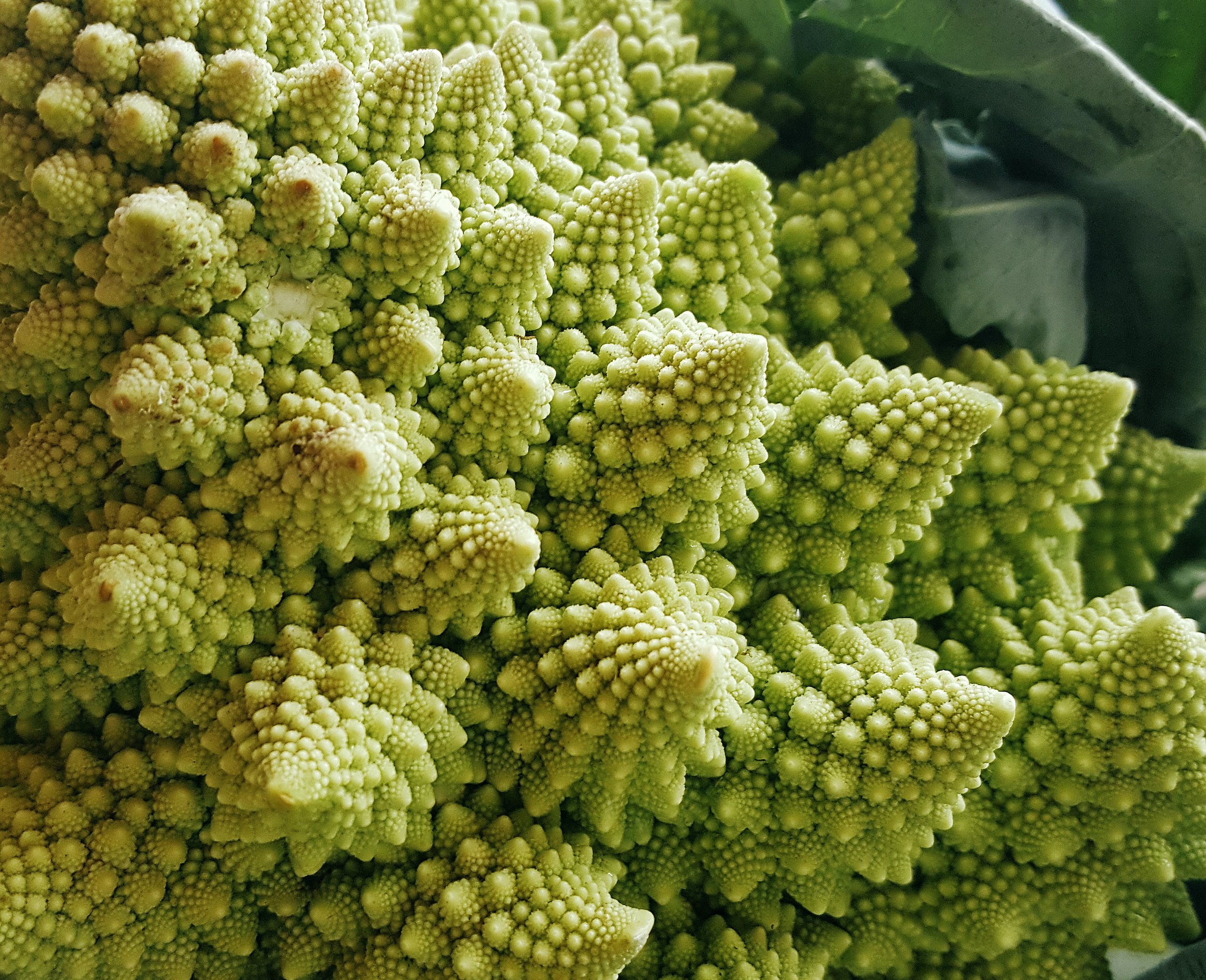
For example, the famous Fibonacci sequence—a series of numbers where every number is the sum of the two numbers preceding it, can be seen in the spirals or buds of Romanesco Broccoli. In this case, the answer to the question “What color is math?” is green! When it comes to observing the Fibonacci sequence in the heads of sunflowers, you could say that math is vibrant yellow or golden orange. And in the case of pinecones, you could say that math is a deep woody brown.

These types of fractals are amazing displays of mathematics in nature and their associated colors are more than just something pretty to look at—the colors themselves are expressions of mathematics and they help us to understand the nature of mathematical series and sequences in our world.

Romanesco Broccoli

Photo by VENUS MAJOR on Unsplash

Sunflowers

Photo by Paul Green on Unsplash

Pinecones

Photo by Vishwasa Navada K on Unsplash

Math and Emotions

Now that you are more familiar with the relationship between mathematics and color in history, everyday life, teaching, and nature, it’s time to think about the role that colors play in thoughts, feelings, and emotions when we interact with math.

Mathematics is, after all, a subject that is practiced by humans who are emotional creatures. By exploring the question “What color is math?” we are actually expanding our understanding of it because we are thinking about the subject in a more creative way.

Of course there is no one correct answer, but it would be a fruitful exercise to consider the colors of your emotions when you perform mathematical tasks such as:

  • Vibrant Gold: When you finally solve that challenging problem

  • Deep Blue: When you are learning something new, thinking deeply, and concentrating

  • Bright Red: When you are struggling with a concept and feeling frustrated and/or anxious.

Because math learners will experience all of these emotions as well as everything in between, we can say that the color of math is truly the full spectrum of colors.

Frustration

(Image: Mashup Math MJ)

Concentration

(Image: Mashup Math MJ)

Success

(Image: Mashup Math MJ)

Answer: What Color is Math? 🟨

Here we will do our best to give a definitive answer to the question “What color is math?”

Mathematics as a subject does not inherently have a designated color, but we can assign it one given its attributes.

Based on our subjective interpretation of mathematics, if we had to assign it to one color, vibrant gold would be extremely fitting. Since the color gold represents timeless beauty, value, and universality, you could say that mathematics is a universal and golden tool that helps us to explain the universe. Gold has been a standard of value for millions of years, just as math remains the cornerstone of science and progress.

If we had to assign it to one color, vibrant gold would be extremely fitting. Since the color gold represents timeless beauty, value, and universality.

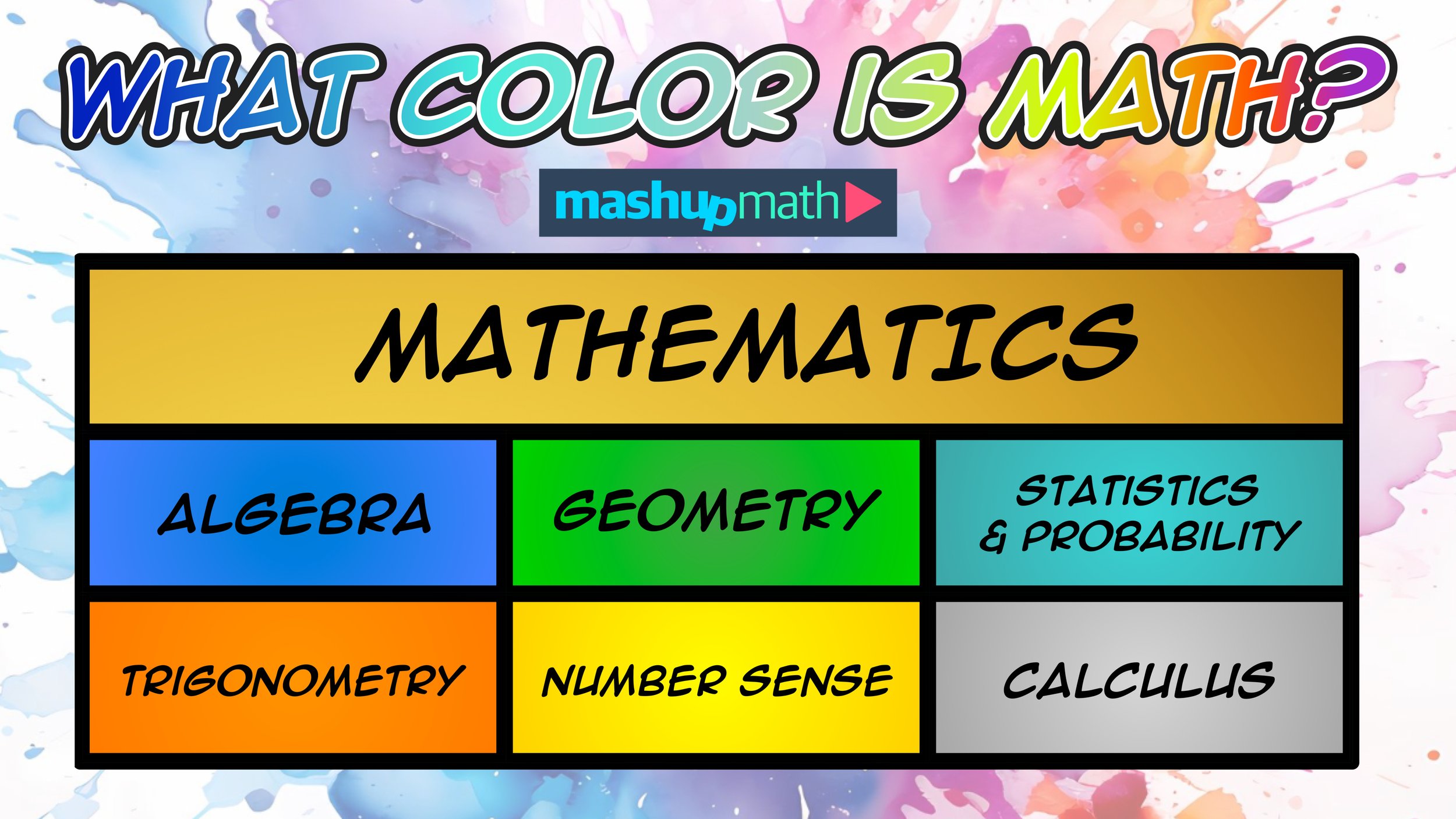
With the same subjective approach in mind, we can also state the colors of six key branches of mathematics:

  • 🔵 Algebra is Blue: Since the color blue is associated with logical thinking and clarity, it fits well with the analytical and logical processes associated with algebraic problem solving.

  • 🟢 Geometry is Green: Since geometry is the study of shapes and their positions in space and relationships between figures and objects, green is fitting because it is associated with balance, harmony, nature and growth.

  • 🟠 Trigonometry is Orange: Trigonometry is the study of waves and cyclic relationships, where there is inherent energy and rhythm. Since orange is a blend of red (symbolizing intensity) and yellow (symbolizing brightness and forward progress), orange is a fitting color.

  • ⬜ Calculus is Gray: The color gray does not mean boring in this case. In an elegant way, gray balances the properties of both black and white, just as the field of calculus balances quantities that are both infinitely small and infinitely large. Calculus also deals with the continuous spectrum of numbers and values and includes instances of infinity and absolute nothingness, just as black is the absence of color and white is the sum of all colors.

  • 🟡 Number Sense is Yellow: Yellow often represents energy, insight, and discovery. This elementary math topic is focused on developing a sense for numbers and their relationship to each other. Number sense is foundational and grasping it will light the way for young students to take on more challenging and complex math concepts in the future.

  • 💠Statistics and Probability are Teal: Since statistics and probability are a blend of two topics:

    data analysis and predicting the likelihood of future events, the blend of blue and green that is teal is a solid fit. The blue aspect represents logic and systemic problem solving while the green aspect represents unpredictability and variability in a logic vs. nature dynamic.


What color is math?


Conclusion

If you were looking for a single answer, then you may be disappointed. While math and color go hand-in-hand, it is impossible to say that mathematics is any one color.

In fact, it would be more appropriate to say that math is every color. At times, math is colored red for passion and persistence. At others, math is colored blue for deep thinking and concentration. Sometimes math glows in golden yellow for discovery and enlightenment and at others a deep forest green for nature and wisdom. And when math is not those colors, it is a kaleidoscope of all of the shades and hues that exist between them.

In conclusion, mathematics is a beautiful subject that can change and morph between the full spectrum of colors, which is why it continues to captivate us and allow us to better understand our universe.


More Free Resources You Will Love:

Why Am I So Bad at Math? (And How to Get Better)

If you are wondering, why am I so bad at math? The fault is likely due to you having a fixed mindset for learning, which is often a product of being negatively affected by harmful misconceptions about your ability to learn math.


How to Solve Inequalities—Step-by-Step Examples and Tutorial

4 Comments

How to Solve Inequalities—Step-by-Step Examples and Tutorial

How to Solve Inequalities Explained

Step-by-Step Guide: How to Solve an Inequality Equation


Free Step-by-Step Guide: How to solve inequalities and inequality equations


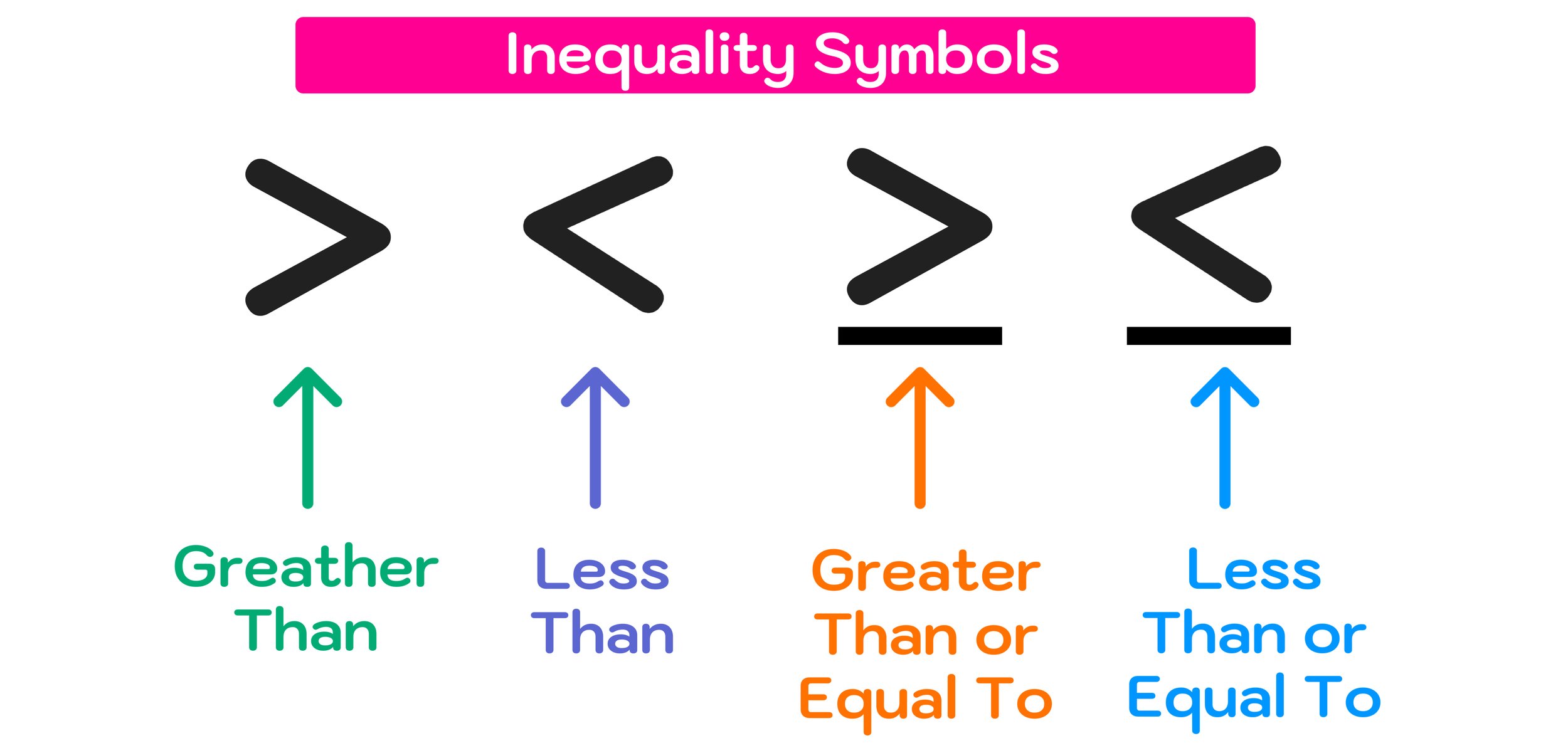
In math, an inequality is a symbol that is used to represent the relationship between two values or expressions that are not necessarily equal to each other. There are four types of inequality symbols:

  • > : greater than

  • < : less than

  • ≥ : greater than or equal to

  • ≤ : less than or equal to

Understanding how to solve inequalities is an important math skill that all students will need to be successful in algebra and beyond. To acquire this skill, you will have to build upon your knowledge of solving equations and extend that understanding to solving inequalities.

This free Step-by-Step Guide on How to Solve Inequalities covers the following:

While learning how to solve an inequality is a little trickier than learning how to solve an equation, you can easily learn how to solve inequalities by working through this guide. By working through the step-by-step practice problems below, you will gain plenty of helpful practice with solving inequalities, which will put you on the path of being able to solve any inequality with ease.

While you are probably eager to dive into a few practice problems, let’s start off with a quick review of a few key vocabulary terms that you should deeply understand before you begin learning how to solve an inequality.


Figure 01: There are four types of inequality symbols: > : greater than, < : less than, ≥ : greater than or equal to, and ≤ : less than or equal to.


What is an inequality?

As said earlier, in math, an inequality is a relationship between two values or expressions that are not equal to each other. Because the values or expressions are not equal to each other, we have to use an inequality sign instead of an equals (=) sign.

You already know that there are four types of inequalities: > : greater than, < : less than, : greater than or equal to, and : less than or equal to (these four types of inequalities are illustrated in Figure 01 above).

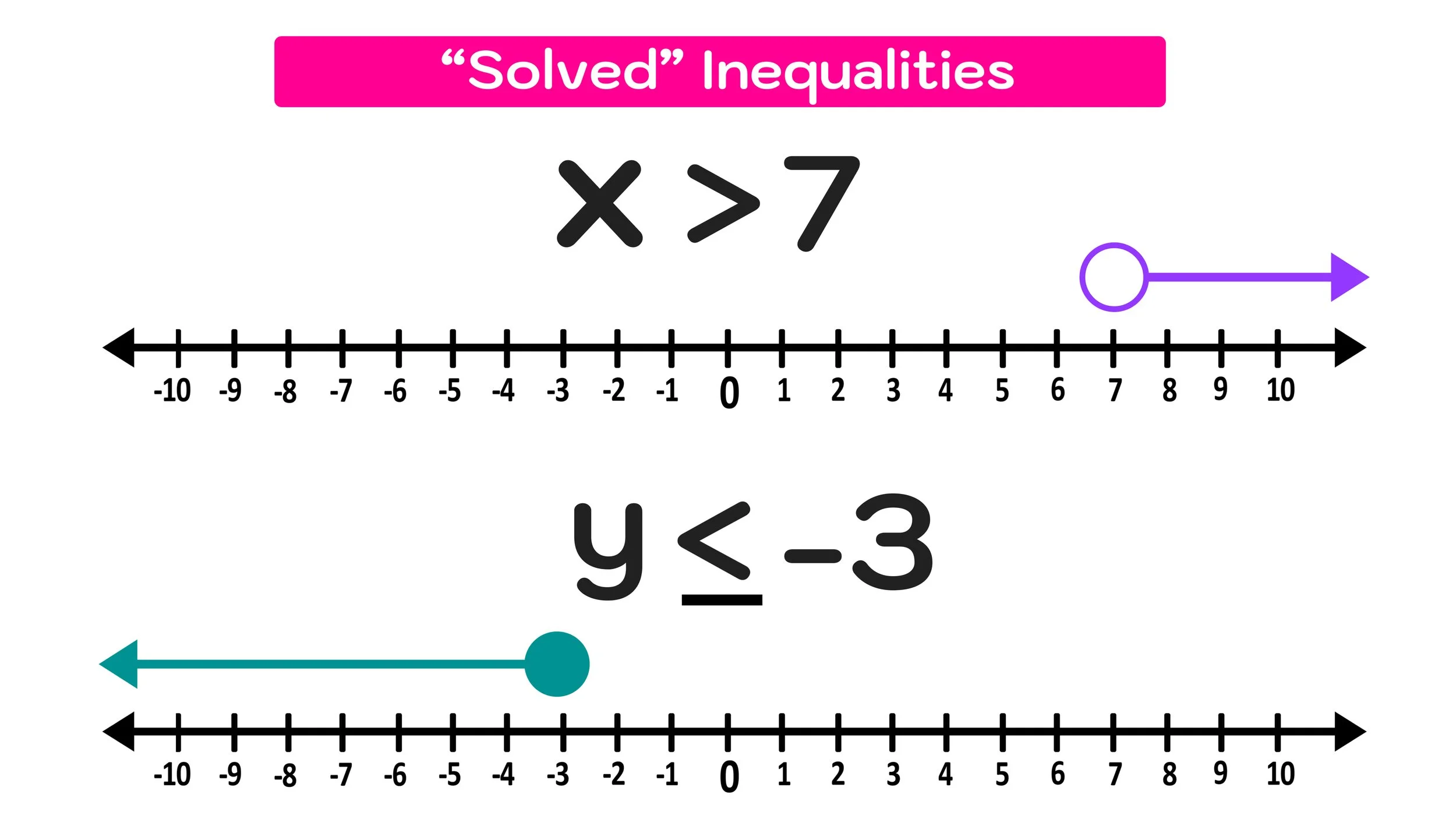
Basic inequalities do not need to be solved since the variable is already by itself.

For example, consider the inequalities x>7 and y≤-3.

These inequalities can be thought of as solved because the variables are already on their own. These “solved” inequalities are illustrated in Figure 02 below.


Figure 02: How to solve inequalities. What do solved inequalities look like?


But, what if we had an inequality that looked like this: x - 3 > 7

Since the variable, x, is not by itself, this inequality still needs to be solved, and the remainder of this guide will show you exactly how to do that.

Now that you are familiar with the key vocabulary terms, it’s time to look at a few examples.


How to Solve Inequalities Example #1

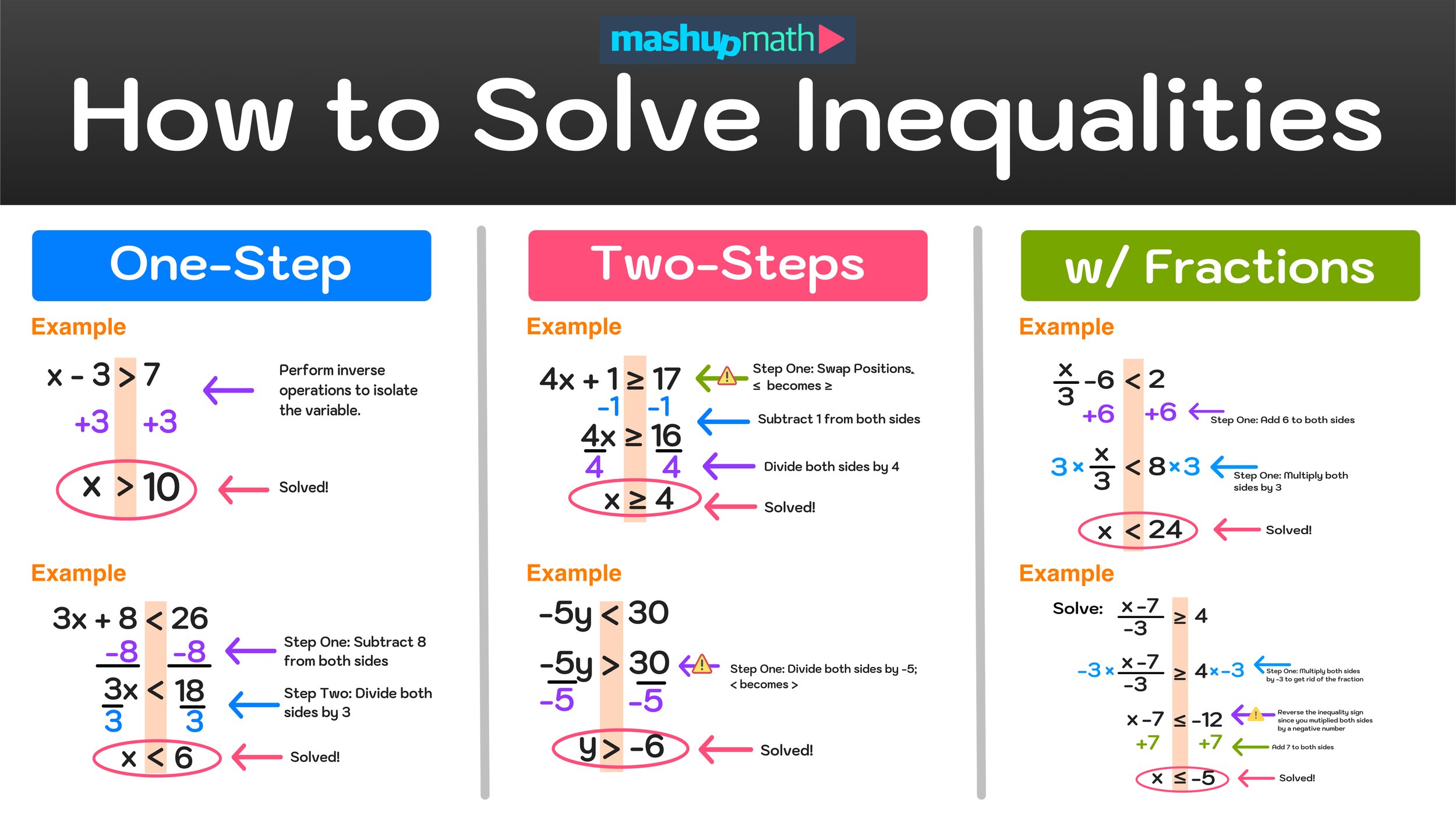
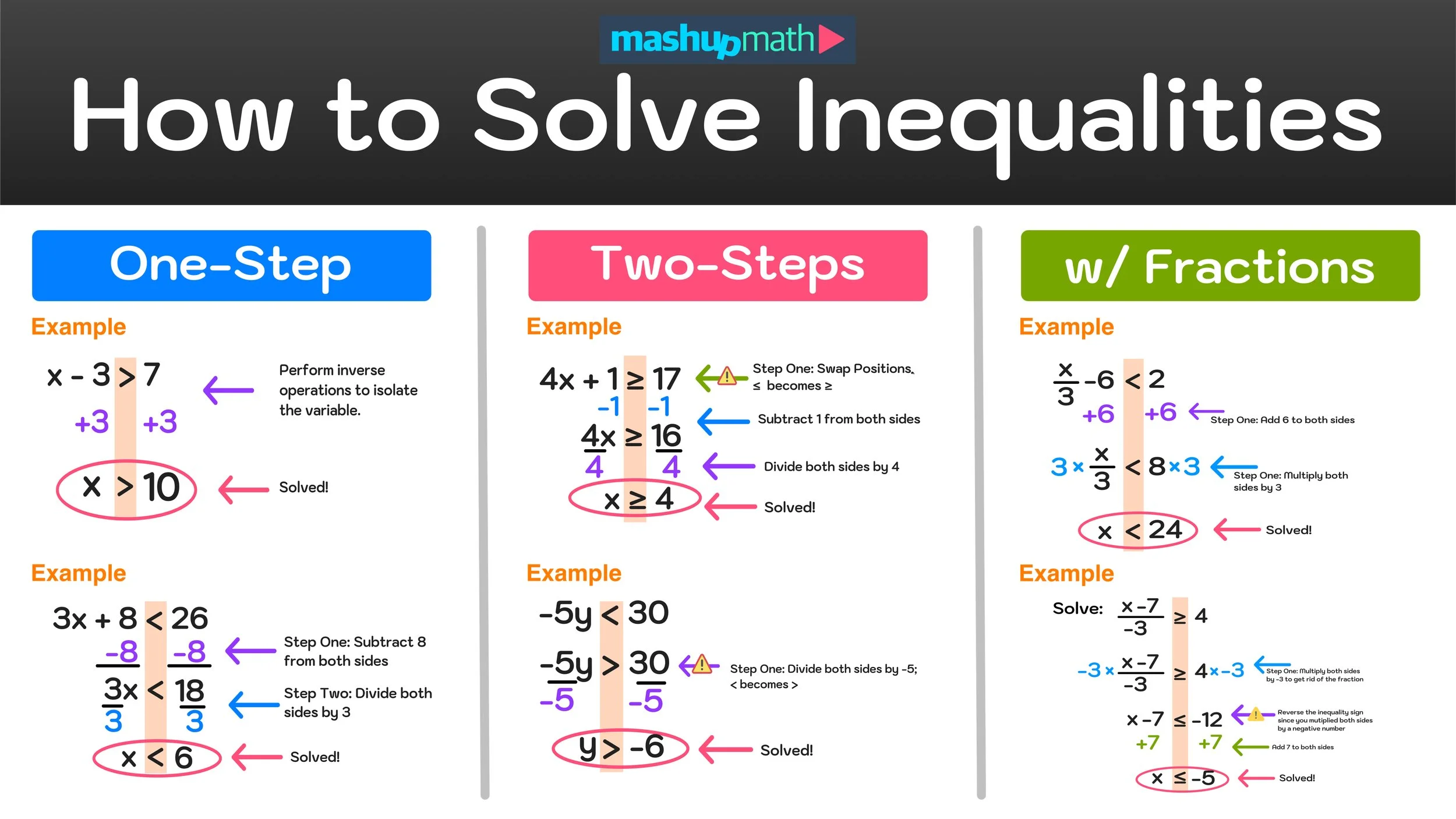
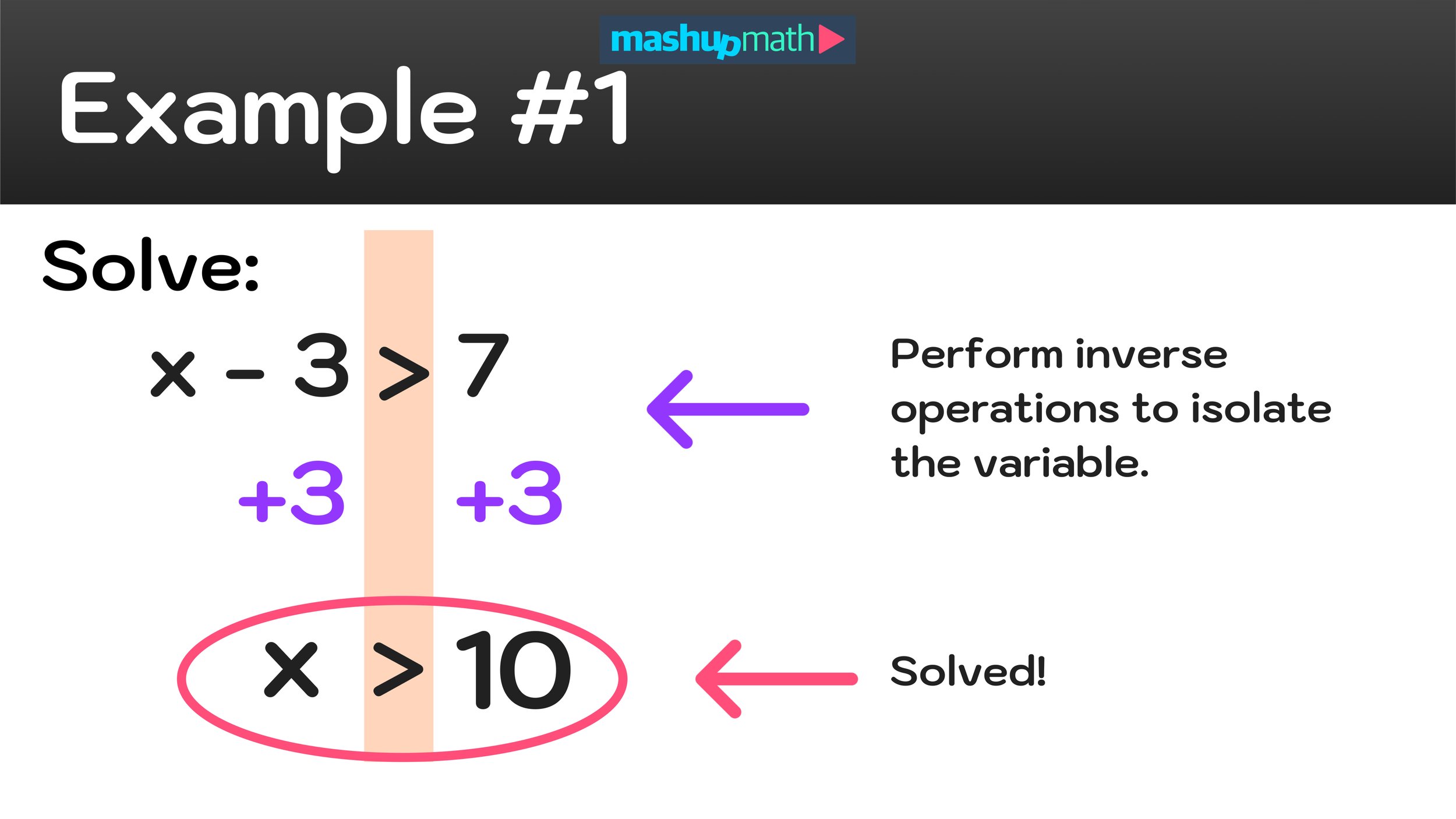
Example: x - 3 > 7

Just as you would solve an equation, to solve an inequality, you must use inverse operations to isolate the variable, which, in this example, is x.

You can isolate x easily by adding 3 to both sides of the inequality sign as follows:

  • x - 3 > 7

  • x -3 + 3 > 7 +3

  • x > 10

Now the inequality is solved! The answer is x>10. The step-by-step procedure to solving this first example is illustrated in Figure 03 below.


Figure 03: How to solve an inequality: x-3>7


This first example of how to solve inequalities was relatively simple and only took one step to solve. Now, let’s move onto solving a slightly more difficult inequality.

How to Solve Inequalities Example #2

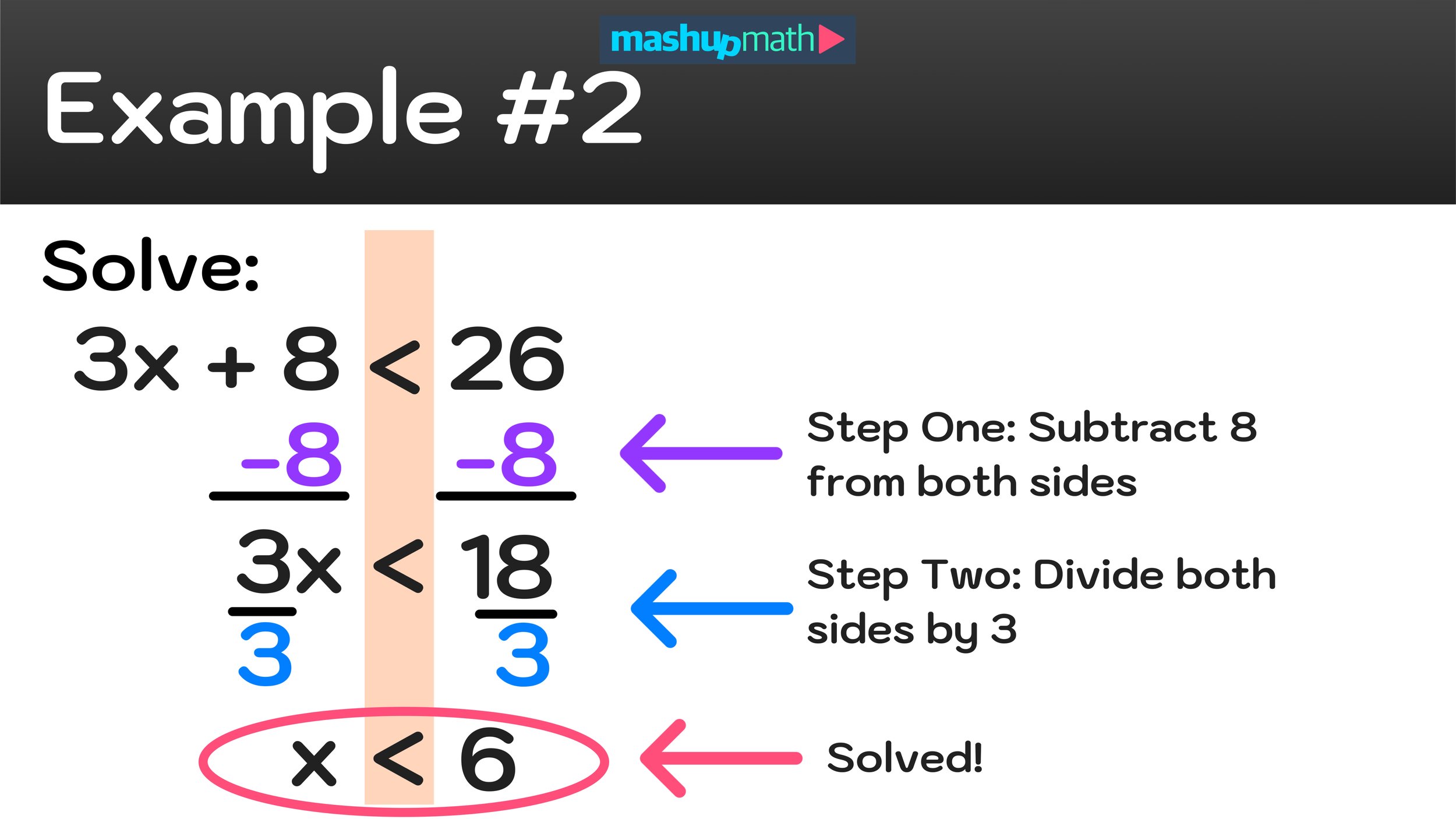
Example: 3x + 8 < 26

Again, to solve the inequality you have to isolate the variable x by performing inverse operations as follows:

  • 3x + 8 < 26

  • 3x - 8 < 26 - 8

  • 3x < 18

  • 3x/3 < 18/3

  • x < 6

Solving this example required two steps (step one: subtract 8 from both sides; step two: divide both sides by 3). The result is the solved inequality x<6.

The step-by-step procedure to solving example #2 is illustrated in Figure 04 below.


Figure 04: How to solve an inequality: 3x+8<26


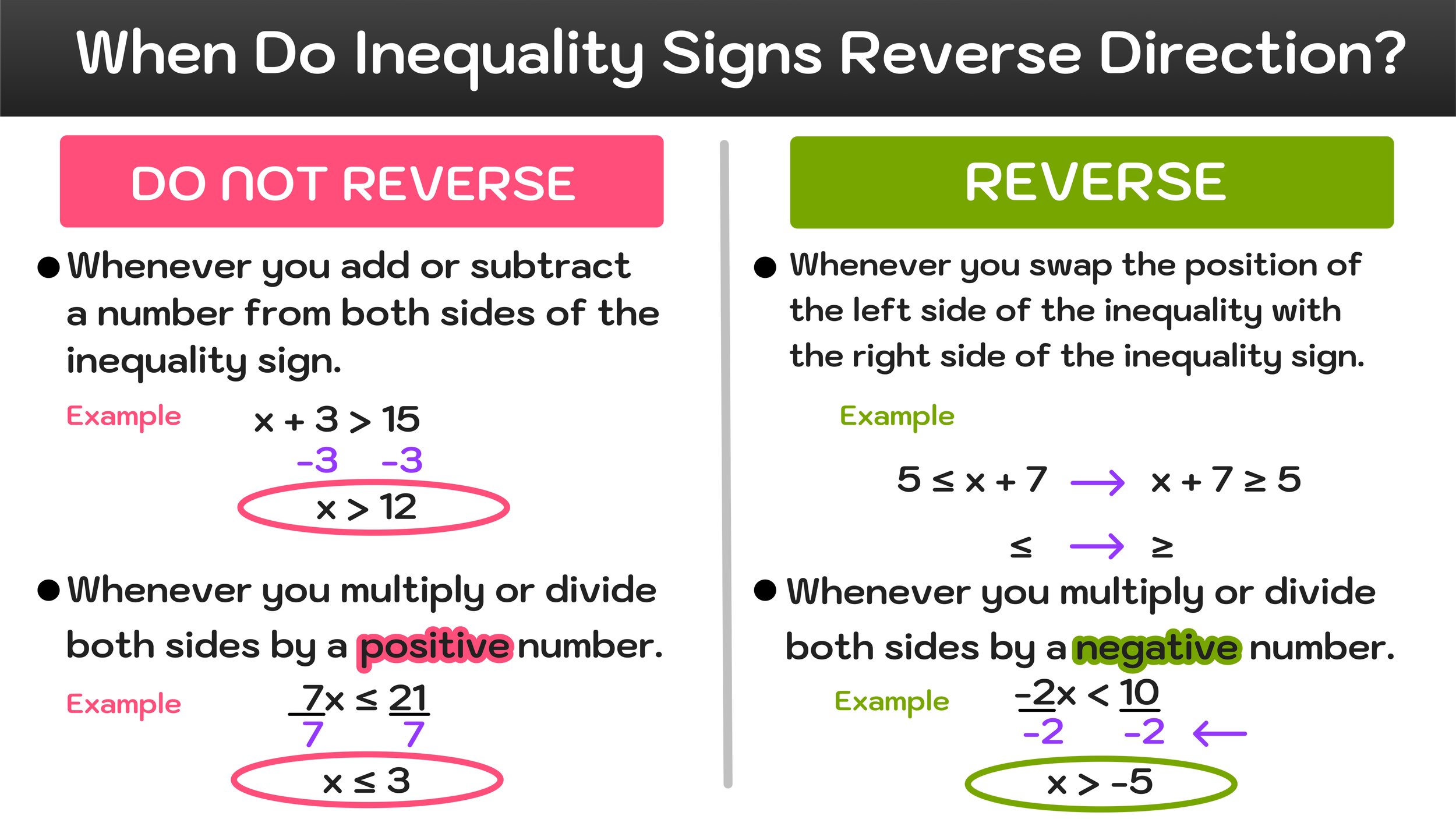
When Do Inequality Signs Reverse Directions?

The first two examples of solving inequalities are considered basic and they can both be solved in two steps or less.

However, more complex inequalities can include instances when the inequality sign will reverse direction in one of the following ways:

  • > becomes <

  • < becomes >

  • ≥ becomes ≤

  • ≤ becomes ≥

So, when do you have to worry about reversing the direction of an inequality sign?

Let’s start by listing all of the instances when you are safe and do not have to change the direction of the inequality sign.

  • Whenever you add or subtract a number from both sides of the inequality

  • Whenever you multiply or divide both sides of the inequality by a positive number

Both of these cases occurred in examples #1 and #2, which is why we did not have to change the direction of the inequality sign.

However, you do have to change the direction of the inequality sign under these instances:

  • 🔄 Whenever you swap the position of the left side of the inequality with the right side of the inequality

  • 🔄 Whenever you multiply or divide both sides of the inequality by a negative number

These rules are illustrated in Figure 05 below.


Figure 05: When do inequality signs reverse direction?


Now, let’s take a look at a few examples of solving inequalities where you will have to reverse the direction of the inequality sign.


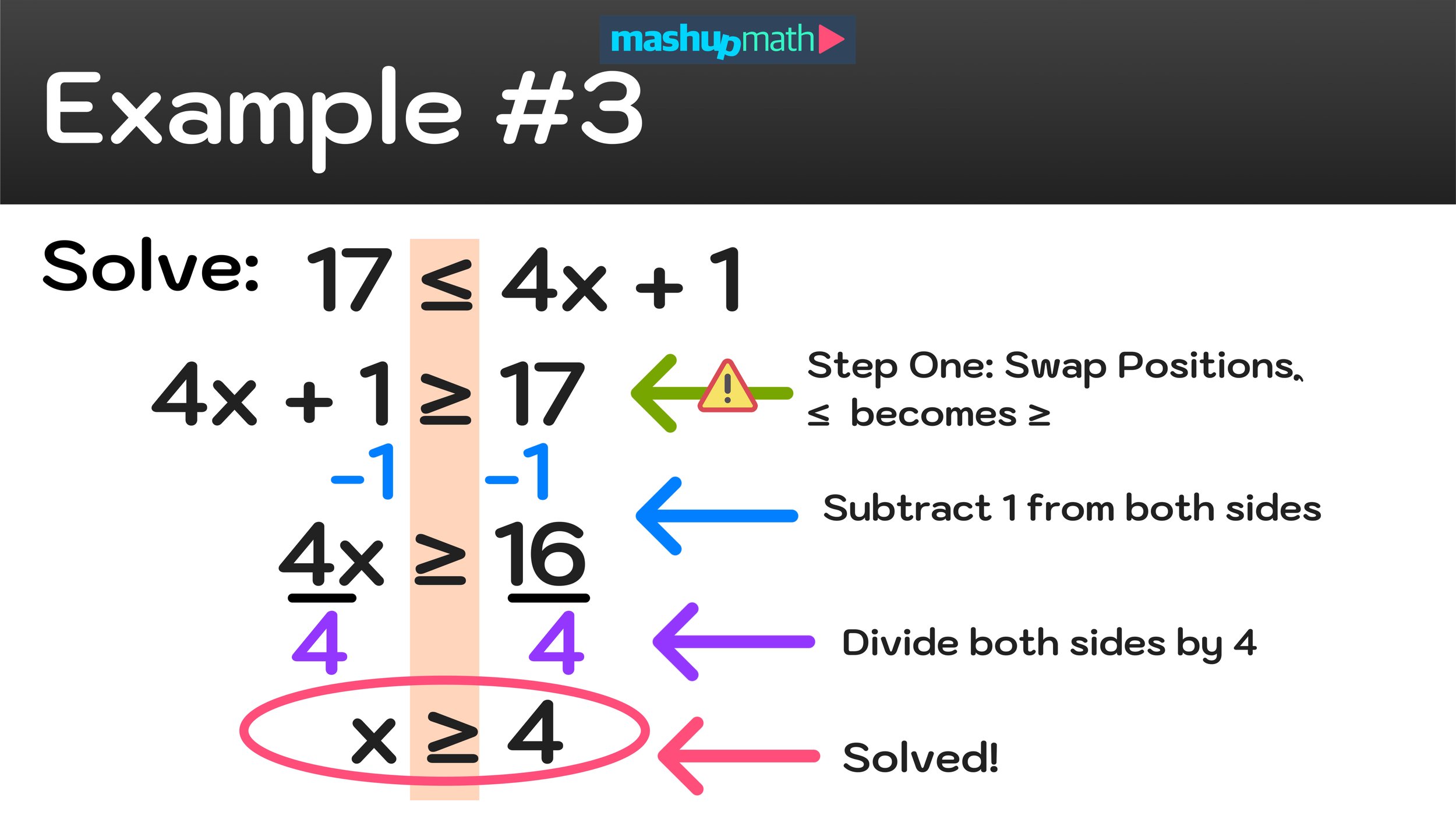
How to Solve Inequalities Example #3

Example: 17 ≤ 4x + 1

This example is a bit different because the variable, x, is on the right side of the equal sign and we typically express solved inequalities with the variable on the left.

You can still solve this problem the same way that you solved example #2, but first you must swap the left side of the inequality with the right side. However, remember that swapping the position of the left side and the right side requires you to also reverse the direction of the inequality as follows:

  • 17 4x + 1 ➙ 4x + 1 17

⚠️ Notice that the reversed position to become !

Now, you can solve 4x + 1 17 as follows:

  • 4x + 1 17

  • 4x + 1 -1 17 -1

  • 4x 16

  • 4x/4 16/4

  • x 4

The inequality has been solved and the final result is x ≥ 4.

The steps for solving example #3 are detailed in Figure 06 below.


Figure 06: How to solve an inequality when the variable is on the right.


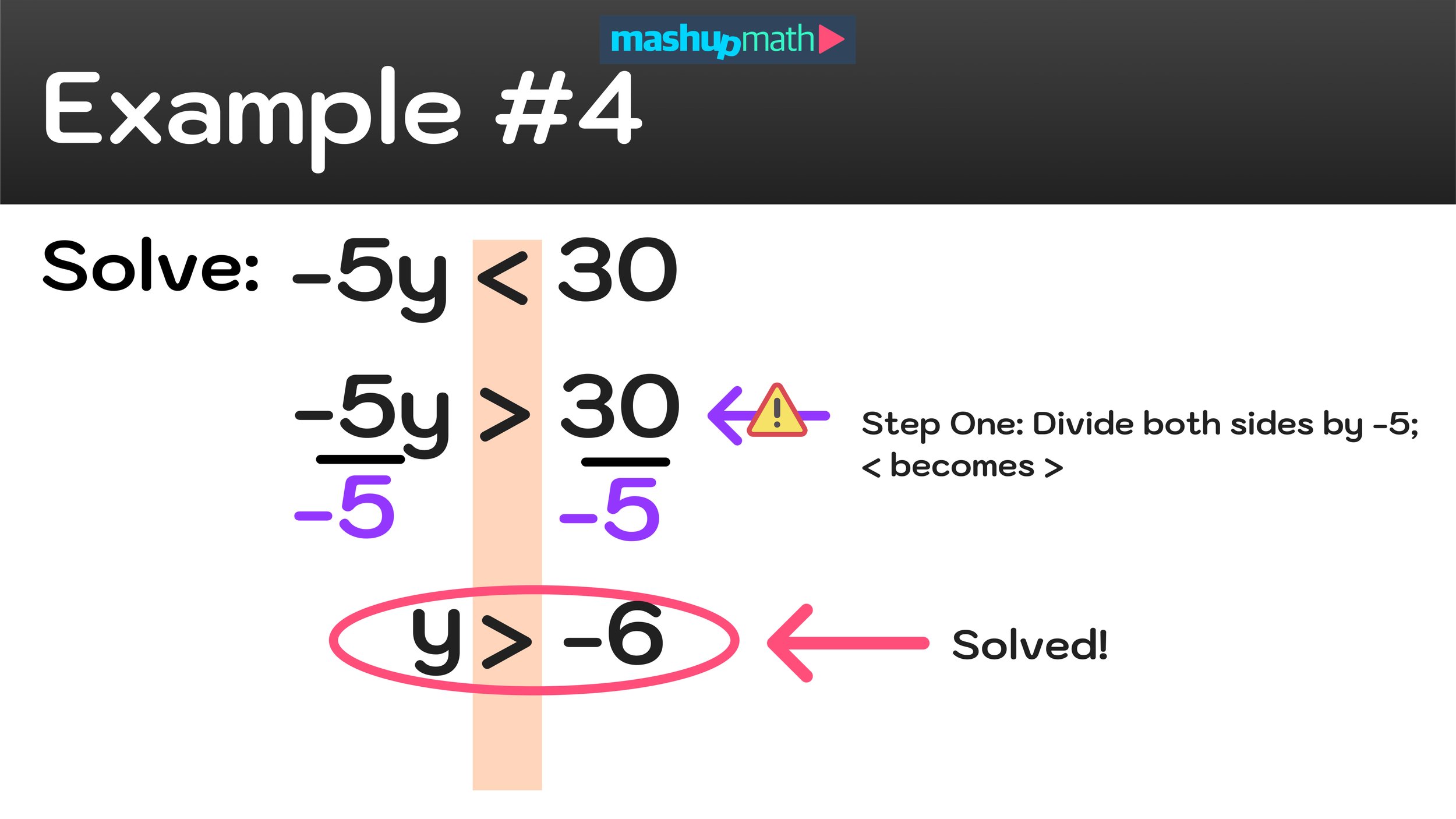
Now that we have covered the first instance of when you have to reverse the direction of an inequality sign, let’s see an example of the second instance—Whenever you multiply or divide both sides of the inequality by a negative number.

How to Solve Inequalities Example #4

Example: -5y < 30

Solving this inequality will require only step to isolate the variable, y, on the left side of the inequality. However, since that one step involves multiplying or dividing by a negative number, you must also reverse the direction of the inequality sign as follows:

  • -5y < 30

  • -5y/-5 > 30/-5 (⚠️ since you divided by a negative, < becomes >)

  • y > -6

The inequality has been solved and the final result is y > -6.

The steps for solving example #4 are detailed in Figure 07 below.


Figure 07: How to solve an inequality when you have to multiply or divide both sides by a negative number.


How to Solve Inequalities with Fractions

Now that you have some more experience with solving inequalities and you know when you have to reverse the direction of the inequality sign, let’s take a look at two more complex examples that involve fractions.

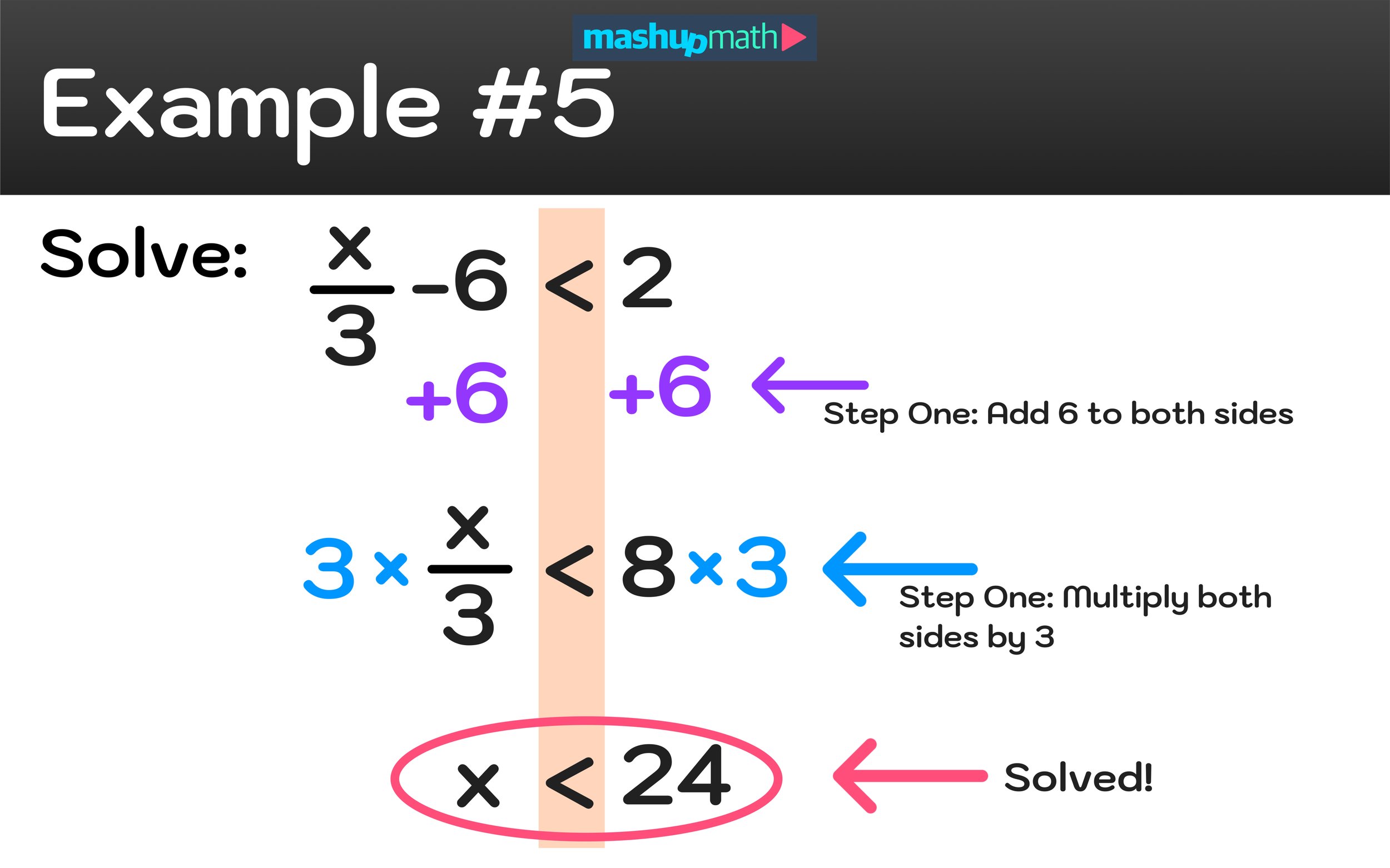
How to Solve Inequalities with Fractions Example #5

Example: x/3 - 6 < 2

When it comes to solving inequalities with fractions, the same strategy as the previous examples will apply. To solve, you have to use inverse operations to isolate the variable on the left side of the equation.

And, if you have to swap the positions of the left and right sides of the inequality or if you multiply or divide both sides by a negative number, then you will have to reverse the direction of the inequality sign.

You can solve this inequality as follows:

  • x/3 - 6 < 2

  • x/3 -6 +6 < 2 + 6

  • x/3 < 8

  • 3 x (x/3) < 3 x (8)

  • x < 24

The inequality has been solved and the final result is x < 24.

*Note that this example did not require you to reverse the direction of the inequality sign since you did not have to swap positions or multiply/divide by a negative number.

The step-by-step process for solving example #5 is shown in Figure 08 below.


Figure 08: Solving Inequalities with Fractions Example #5


How to Solve Inequalities with Fractions Example #6

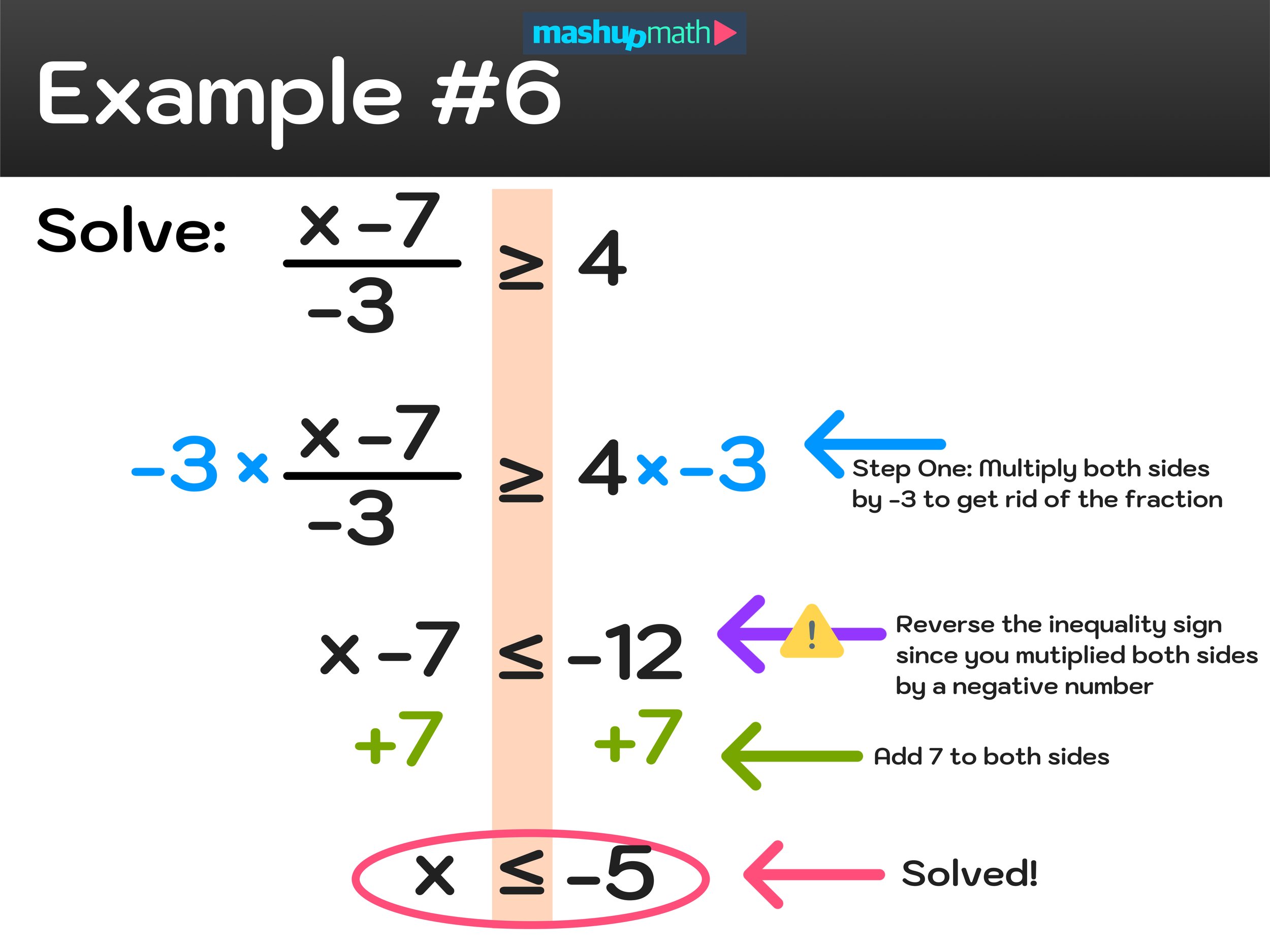
Example: (x-7)/-3 ≥ 4

This next example is the most complex one we have seen so far, but our strategy of using inverse operations to isolate the variable remains the same.

You can solve this inequality as follows:

  • (x-7)/-3 ≥ 4

  • (x-7)/-3 x -3 ≥ 4 x -3 (multiply both sides by -3 to get rid of the fraction)

  • x-7 ≤ -12 (⚠️ because you multiplied both sides by a negative, ≥ becomes ≤)

  • x-7 +6 ≤ -12 +7

  • x ≤ -5

The inequality has been solved and the final result is x ≤ -5.

⚠️ Note that we did have to reverse the inequality sign from ≥ to ≤ because we multiplied both sides by negative 3.

The step-by-step process for solving example #5 is shown in Figure 09 below.


Figure 09: Figure 08: Solving Inequalities with Fractions Example #6


As we enter the last section of this step-by-step guide to solving inequalities, let’s take a look at two more multi-step examples. If you can solve these next two problems using the previously discussed strategies, then you will be able to solve almost any problem related to solving inequalities.

How to Solve Inequalities with Fractions Example #7

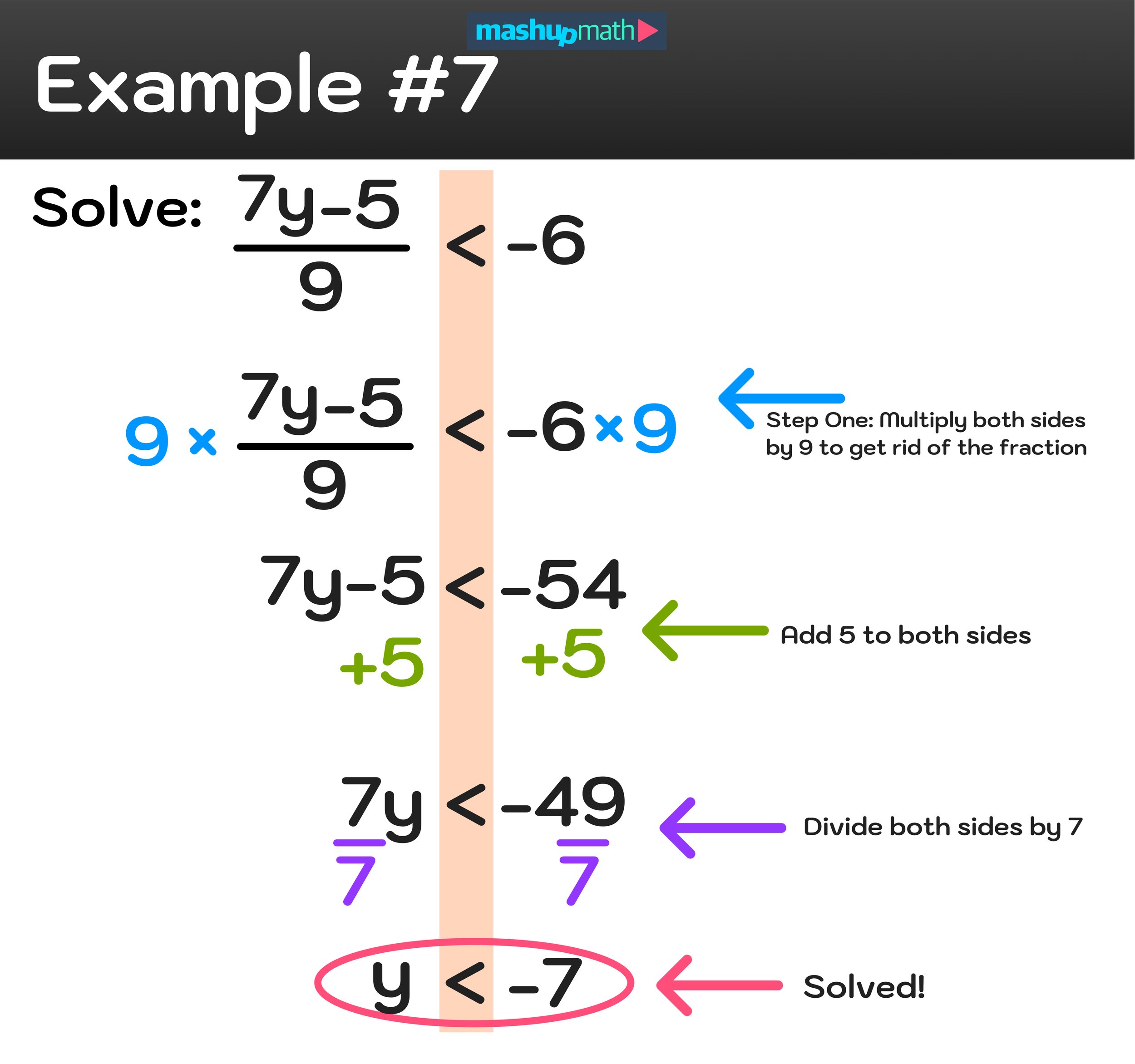
Example: -6 > (7y-5)/9

This example will require a few steps in order to isolate the variable x, but we can still used inverse operations to solve as follows:

  • -6 > (7y-5)/9 ➙ (7y-5)/9 < -6

⚠️ Notice that the variable, y, is on the right side of the inequality sign, so we will start by reversing the positions of the left side and the right side, which also means that we have to reverse the direction of the inequality sign.

  • (7y-5)/9 < -6

  • (7y-5)/9 x 9 < -6 x 9

  • 7y-5 < -54

  • 7y -5 +5 < -54 + 5

  • 7y < -49

  • 7y ÷ 7 < -49 ÷ 7

  • y < -7

The inequality has been solved and the final result is y < -7.

Note that we did not have to reverse the inequality sign because the number that we multiplied both sides of the equation by was a positive 9.

The step-by-step process for solving example #7 is shown in Figure 10 below.


Figure 10: Solving Inequalities with Fractions Example #7


How to Solve Inequalities with Fractions Example #8

Are you ready for one final example of how how to solve inequalities with fractions? This one is a little tricky, but you have all of the tools that you need to solve it as long as you take it step-by-step.

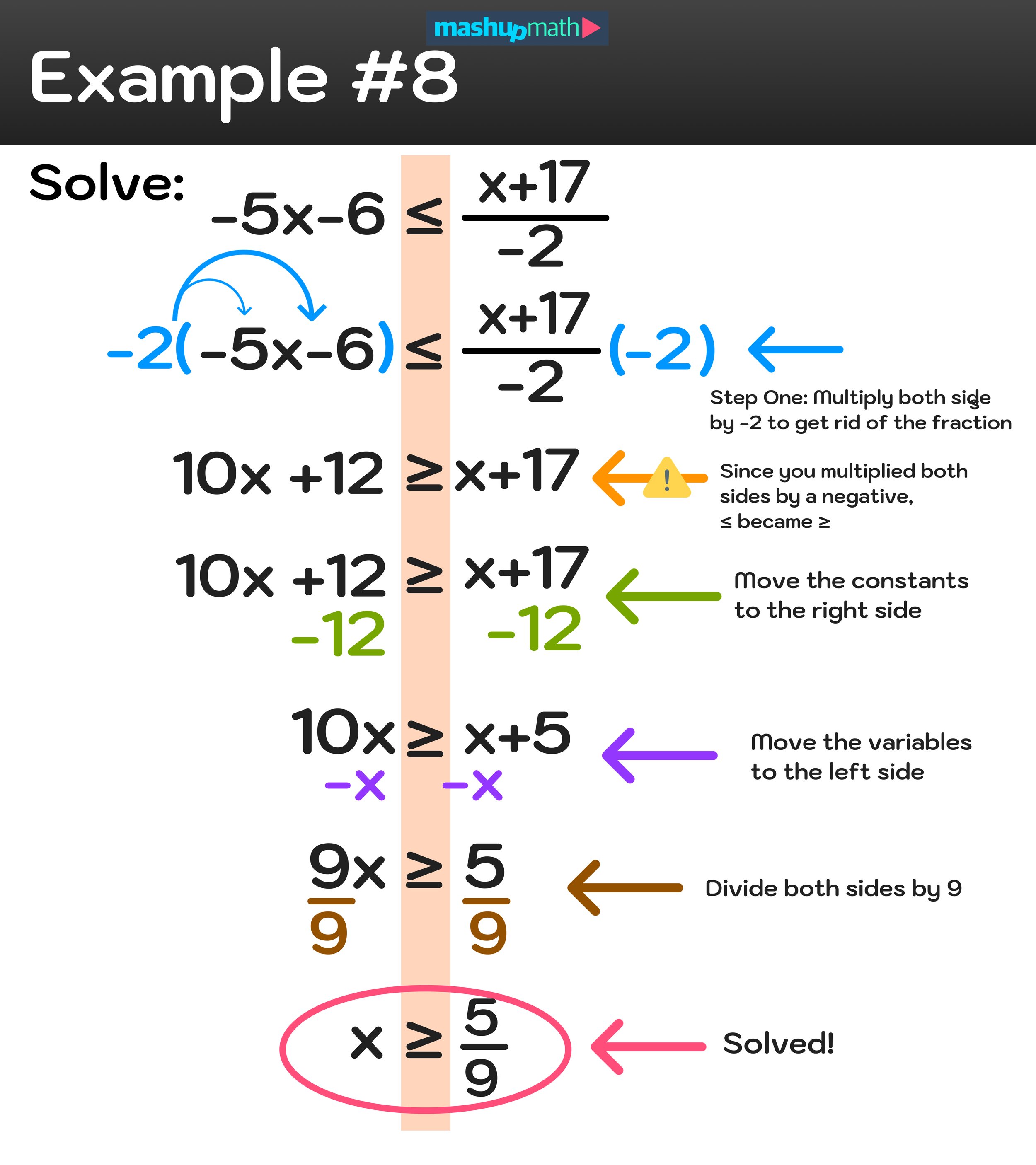
Example: -5x - 6 ≤ (x+17)/-2

The first thing that you are probably noticing is that there are x’s on both sides of the inequality sign. Since the goal is to isolate x on the left side of the inequality, you will have to use inverse operations to get x by itself.

Let’s start by getting rid of the fraction on the right side of the inequality by multiplying both sides by -2.

  • -2(-5x - 6) ≤ (x+17)/-2(-2)

To solve the right side of the inequality, you will have to use the distributive property to multiply both terms (-5x-6) by -2.

  • 10x + 12 ≥ x+17 ⚠️

⚠️ And because we just multiplied both sides by a negative number, we had to reverse the direction of the inequality sign, so ≤ became ≥

Now we can continue solving this inequality by using inverse operations:

  • 10x + 12 ≥ x+17

  • 10x + 12 -12 ≥ x +17 -12 (move the constants to the right side)

  • 10x ≥ x + 5

  • 10x -x ≥ x -x +5 (move the variables to the left side)

  • 9x ≥ 5

  • 9x ÷ 9 ≥ 5 ÷ 9 (isolate x)

  • x ≥ 5/9

The inequality has been solved and the final result is x ≥ 5/9.

Note that it’s totally fine for our final result to be a fraction.

The step-by-step process for solving example #8 is shown in Figure 11 below.


Figure 10: Solving Inequalities with Fractions Example #8


Free Solving Inequalities Worksheet (w/ Answers)

Are you looking for some extra independent practice on how to solve inequalities and how to solve inequalities with fractions?

You can use the link below to download a free solving inequalities worksheet pdf file that includes a complete answer key. We recommend that you work through each problem on your own keeping this guide close by as a reference.

Download your free Solving Inequalities Worksheet (One-Step) PDF

Download your free Solving Inequalities Worksheet (Two-Steps) PDF


Preview: Solving Inequalities Worksheet PDF


While you work through the practice problems, keep the lesson summary main points below in mind.

Conclusion: How to Solve Inequalities

  • Like equations, inequalities can be solved by using inverse operations to isolate a variable on the left side of the inequality.

  • Solving an inequality by adding/subtracting numbers on both sides of the inequality or by multiplying/dividing both sides by a positive number does not result in a reversal of the inequality sign.

  • ⚠️ On the other hand, swapping the positions of the left and right sides of an inequality or multiplying/dividing both sides by a negative number requires you to reverse the position of the inequality sign such that: > becomes <, < becomes >, ≥ becomes ≤, and ≤ becomes ≥

  • When solving inequalities with fractions or inequalities with variables on both sides, the process of using inverse operations to isolate the variable and solve remains the same, albeit with a few more steps involved.


Keep Learning:


4 Comments