Which One Doesn't Belong? Free Math Activities for Grades 1-8

Comment

Which One Doesn't Belong? Free Math Activities for Grades 1-8

Free ‘Which One Doesn’t Belong?’ Activities for Your Upcoming Lesson Plans!

Are you looking for an engaging math activity to boost your warm-ups, transitions, and/or exit ticket activities?

If you’re not familiar with using ‘Which One Doesn’t Belong?’ (WODB) activities and why they are amazing for boosting student engagement in the math classroom, click here to learn everything you need to know.

I started sharing WODB activities with my students because I was struggling to find ways to get all of my students engaged, especially those who struggle with mathematics and are reluctant to participate.

I was inspired by the work of Christopher Danielson, so I started creating my own WODB activities geared towards students in elementary and middle school.

The results? My student engagement skyrocketed! Since WODB activities don’t have a single correct answer (the idea is to get students thinking mathematically and learn how to justify their answers), all of my students (even ones who rarely participate) felt comfortable sharing and getting involved.

Now I use WODB at least once a week!

Again, if you want more information on how WODB activities work and how you can use them to boost student engagement in your classroom, click here to learn everything you need to know.

And check out these brand new FREE WODB math activities:

HowToDownload.jpg

1.) Shapes and Figures

2.) Groupings and Grids

*Remember that WODB activities purposely do not have a single correct answer. Click here to learn more.

3.) Patterns and Ratios
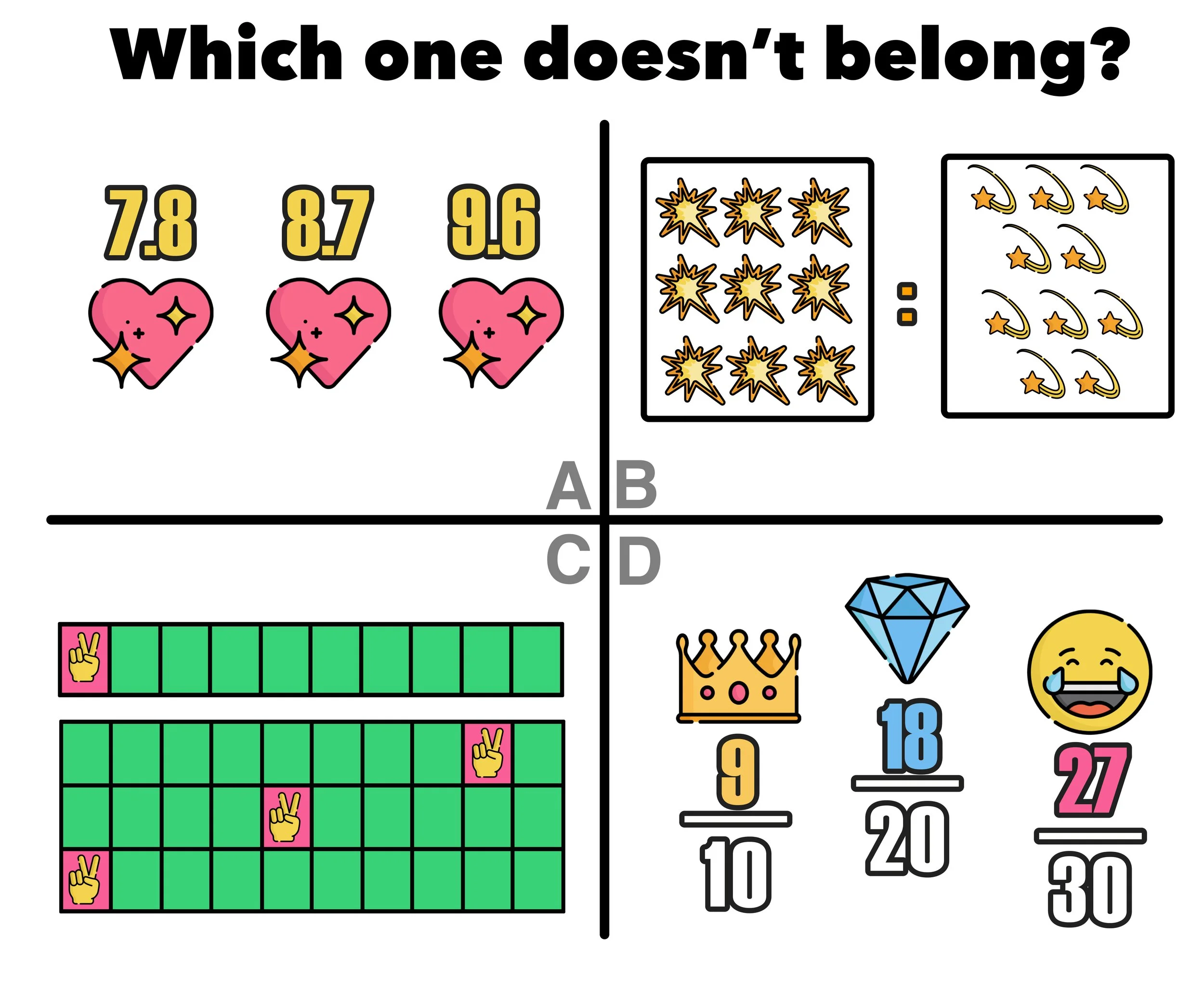
*Remember that WODB activities purposely do not have a single correct answer. Click here to learn more.

4.) Numbers!

*Remember that WODB activities purposely do not have a single correct answer. Click here to learn more.

5.) Equations

*Remember that WODB activities purposely do not have a single correct answer. Click here to learn more.


These puzzles are samples from my best-selling workbook 101 Daily ‘Which One Doesn’t Belong?’ Math Activities for Grades 3-8.

Get Your PDF Download

You Might Also Like…


I am interested in…


Comment

Multiplication Table Worksheets: Free Printable Math Puzzles

Comment

Multiplication Table Worksheets: Free Printable Math Puzzles

Can Your Students Solve These Multiplication Table Math Puzzles?

EQMBMPkXkAU7uxW.jpg

Are you looking for some fun and engaging activities to help your kids practice and understand multiplication?

I started using multiplication table puzzles with my students every week last school year, and the results were pretty awesome, especially when it came to improving their ability to multiply and divide values without relying on memorization.

And if you're a fan of Stanford's Jo Boaler, then you know that she is a huge proponent of using visual math activities (like multiplication table puzzles) to improve student performance.

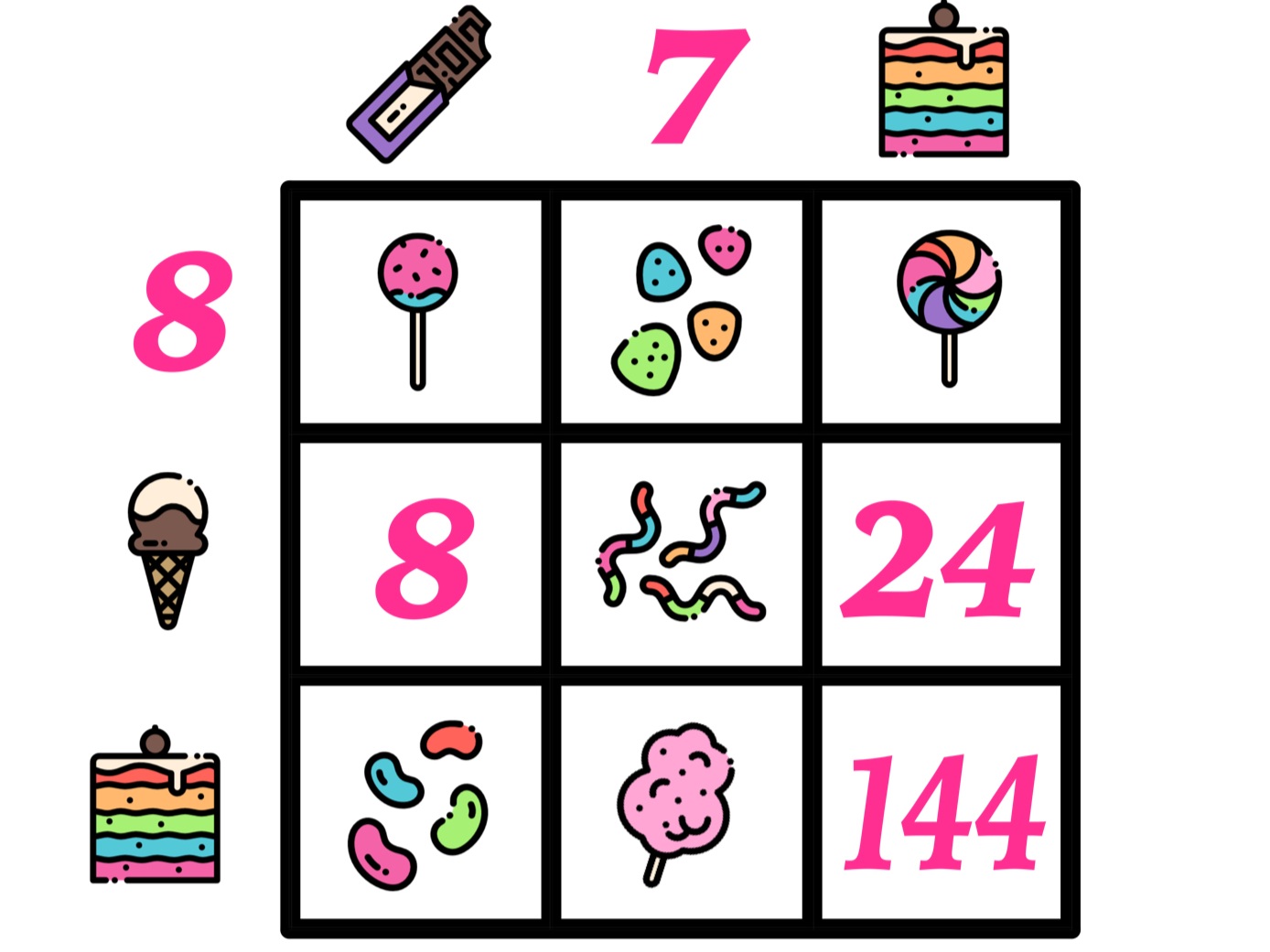
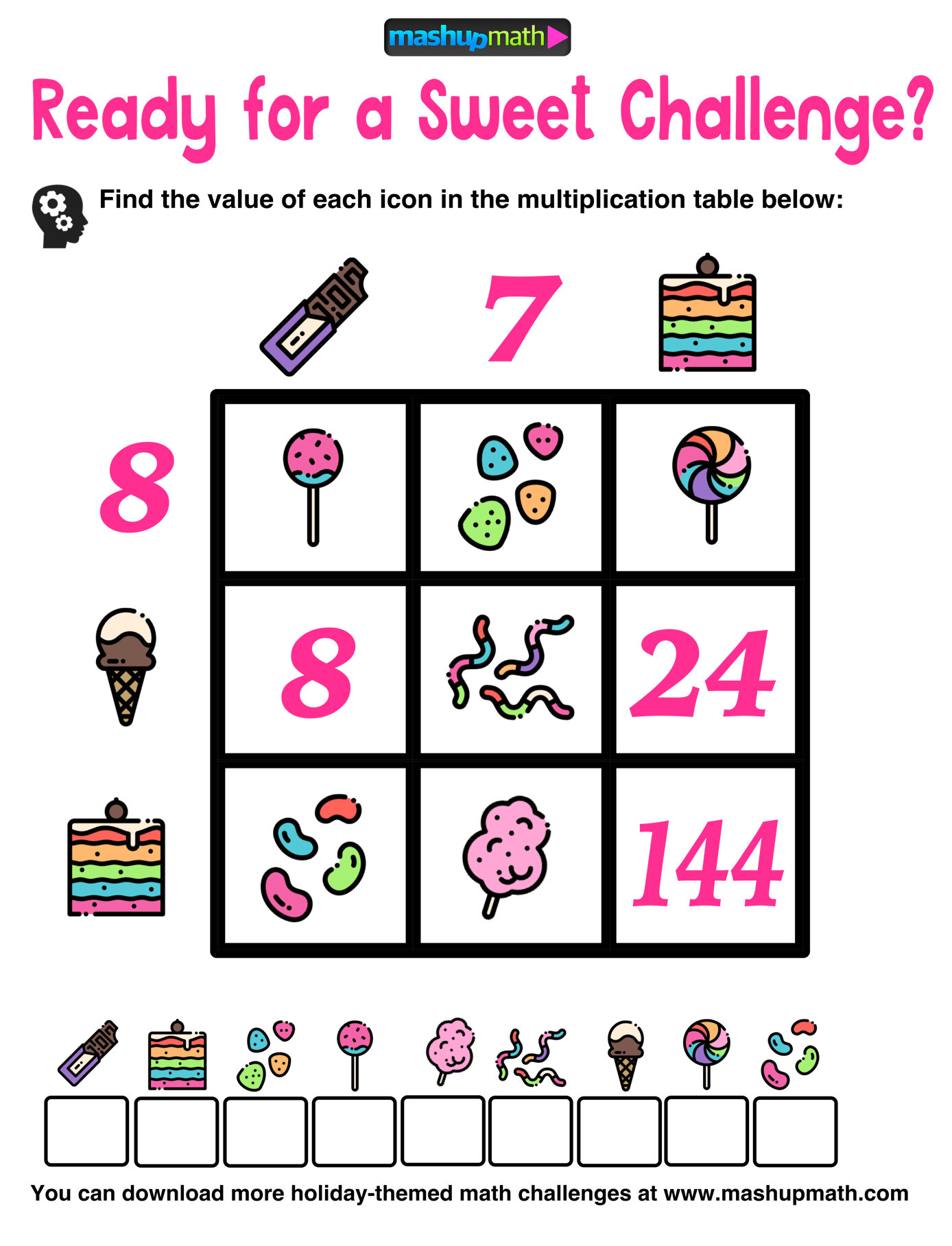
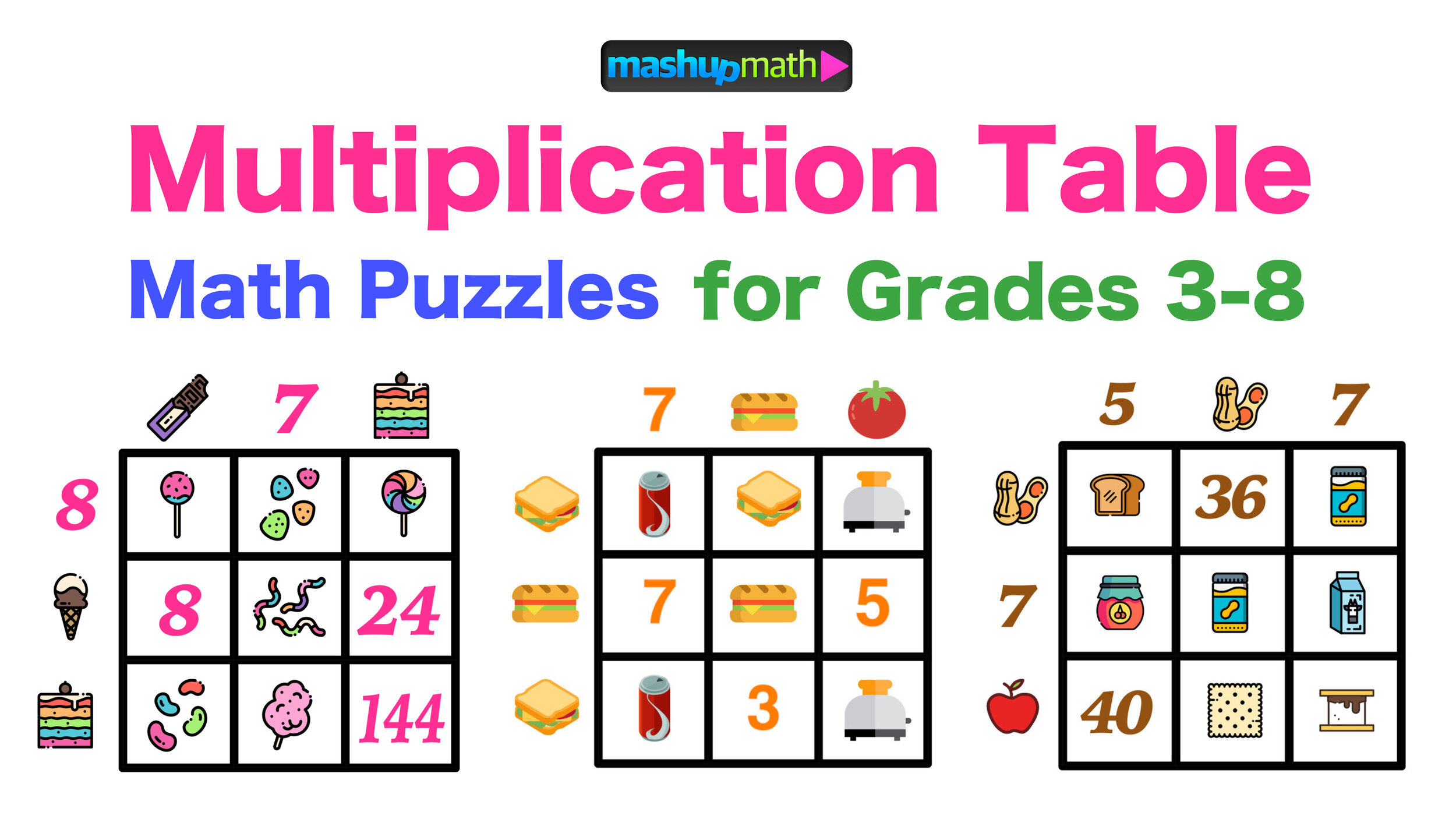
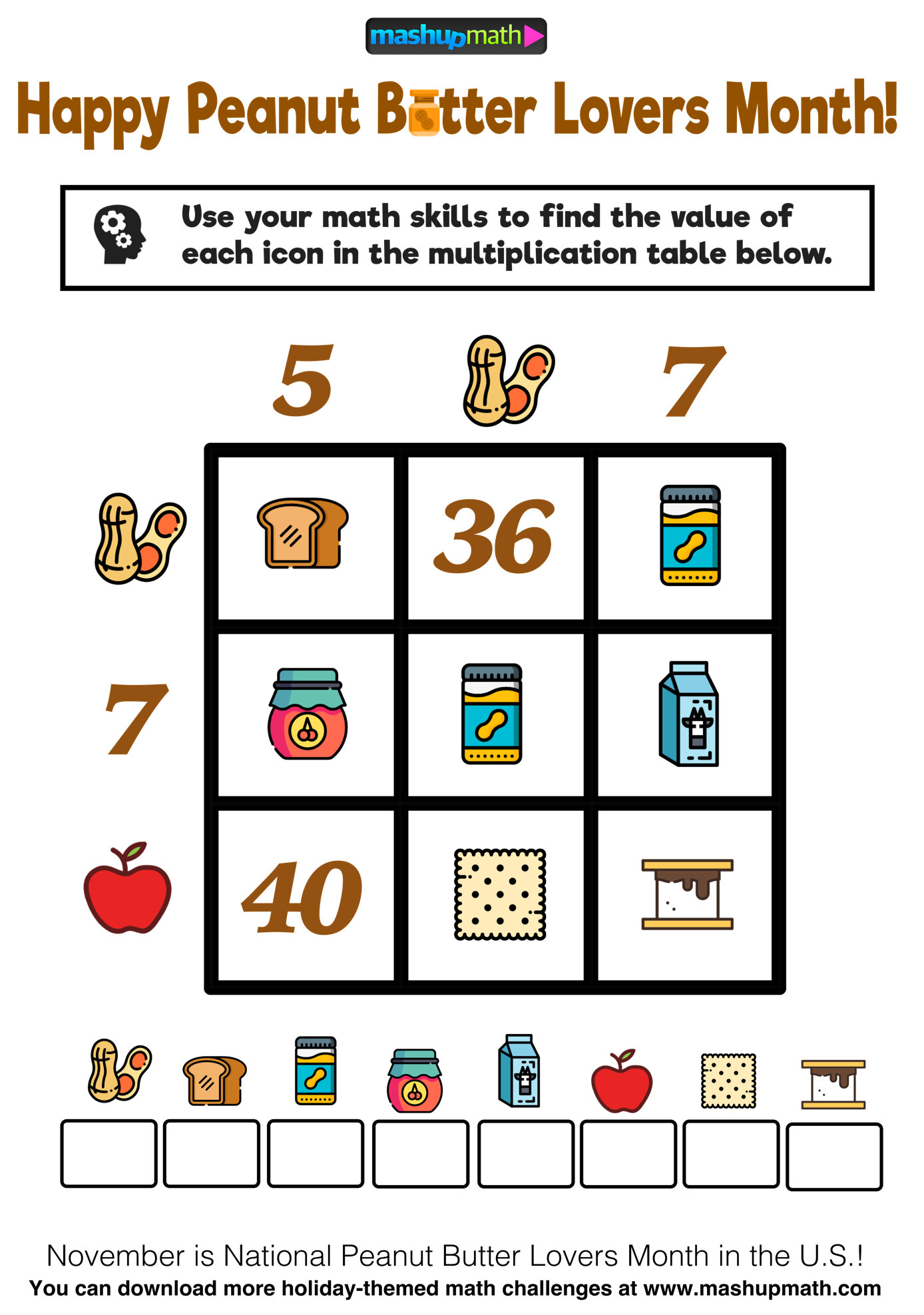
The following puzzles challenge students to use their math and reasoning skills to find the value of different symbols contained within a multiplication table.

They work like a bingo-table where the icon in each box represents the product of its corresponding column and row.

So go ahead and share the puzzles with your kiddos this week! They make for a great warm-up or cool-down activity for sparking mathematical discussion and creative problem-solving!

You Might Also Like: Free Math Worksheets for Grades 1-8

Keep reading to access the answer key and to download your free Multiplication Table Worksheet!

HowToDownload.jpg

1.) Candy Time!

2316b576-813e-49fb-a472-757c01450946.jpg

*Keep reading to get the answer key.

2.) Sandwich Day!

74d56f8f-9001-4fd7-9591-5c9ff8cc3f5c (1).jpg

*Keep reading to get the answer key.

3.) Peanut Butter Time!

707d9bd2-75c1-4d8f-9bc2-90492cc745b0.jpg

*Keep reading to get the answer key.

These puzzles are samples from my best-selling workbook 101 Math Challenges for Engaging Your Students in Grades 3-8.

The book is available as a PDF download and you can also get a hard copy on Amazon (Free Amazon Prime Shipping Included; pages are in black-and-white).

Get More Math Puzzles

Click here to download your free PDF worksheet!

And here are the solutions to today’s multiplication table puzzles:

Candy Puzzle:

Snip20191014_1.png

Sandwich Day Puzzle:

Snip20191014_6.jpg

Peanut Butter Puzzle:

Snip20191014_4.png

You Might Also Like…
MultTable_Pin.jpg
 
 
MT_Puzzles.jpg

I am interested in…


Comment

Multiplying Square Roots and Multiplying Radicals Explained

Comment

Multiplying Square Roots and Multiplying Radicals Explained

Learn How to Multiply Radicals and How to Multiply Square Roots in 3 Easy Steps (Free Worksheet Included)

Snip20191009_3.png

Learn How to Multiply Radicals (and How to Multiply Square Roots) in 3 Easy Steps

Before you learn how to multiply radicals and how to multiply square roots, you need to make sure that you are familiar with the following vocabulary terms:

Radical vs. Radicand

The radical is the square root symbol and the radicand is the value inside of the radical symbol. The radicand can include numbers, variables, or both.

 
Snip20191009_4.png
 

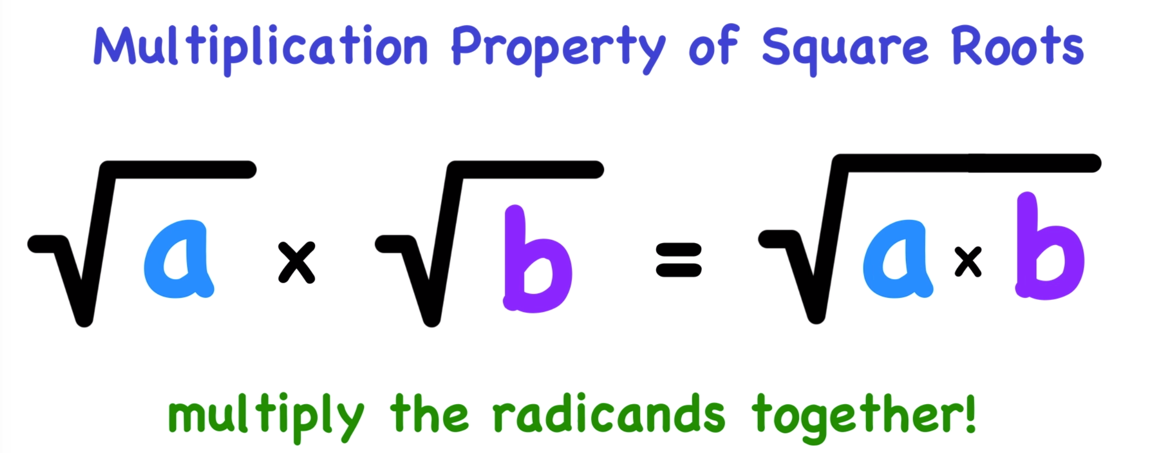
The Multiplication Property of Square Roots

The key to learning how to multiply radicals is understanding the multiplication property of square roots.

The property states that whenever you are multiplying radicals together, you take the product of the radicands and place them under one single radical.

 
Snip20191009_6.png
 

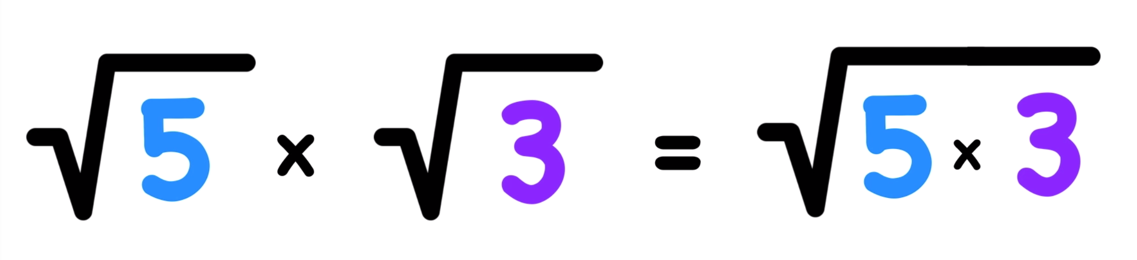
For example, radical 5 times radical 3 is equal to radical 15 (because 5 times 3 equals 15).

 
Snip20191009_8.png
Snip20191009_9.png
 

How to Multiply Radicals and How to Multiply Square Roots Example

Now let’s take a look at an example of how to multiply radicals and how to multiply square roots in 3 easy steps.

Problem:

Snip20191009_10.png
 

Step One: Simplify the Square Roots (if possible)

In this example, radical 3 and radical 15 can not be simplified, so we can leave them as they are for now.

Step Two: Multiply the Radicands Together

Now you can apply the multiplication property of square roots and multiply the radicands together. In this case, radical 3 times radical 15 is equal to radical 45 (because 3 times 15 equals 45).

Snip20191009_12.png
Snip20191009_13.png
 

Step Three: Simplify the Result (if possible)

The third and final step is to simplify the result if possible.

Can radical 45 be simplified?

The answer is yes.

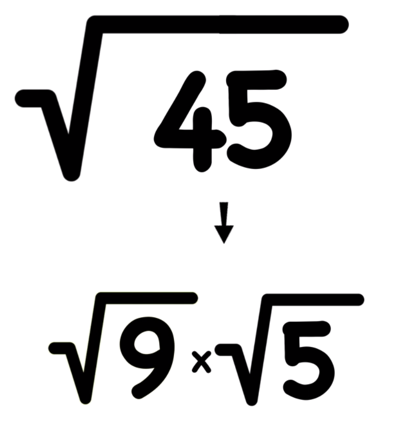
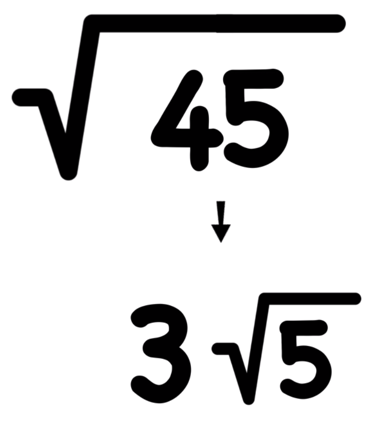
Since radical 45 is equal to radical 9 times radical 5, and because radical 9 is equal to 3 (since 9 is a perfect square), we can simplify radical 45 to 3 times radical 5 (see the diagram below for a more detailed look on how to simplify square roots).

Snip20191009_14.png
Snip20191009_17.png
Snip20191009_19.png
Snip20191009_20.png

Finally, we can conclude that the final answer is:

 
Snip20191009_21.png
 

Looking for more sample problems? Check out the free video lesson below to learn more about how to multiply radicals and how to multiply square roots :


How to Multiply Radicals and How to Multiply Square Roots Worksheet (with Answer Key)

Are you looking to get some more practice with multiplying radicals, multiplying square roots, simplifying radicals, and simplifying square roots?

Click the link below to access your free practice worksheet from Kuta Software:

Free Multiplying Radicals Worksheet

Share your ideas, questions, and comments below!

(Never miss a Mashup Math blog--click here to get our weekly newsletter!)

Keep Learning:

NewBlogImage.png

By Anthony Persico

Anthony is the content crafter and head educator for YouTube's MashUp Math . You can often find me happily developing animated math lessons to share on my YouTube channel . Or spending way too much time at the gym or playing on my phone.

Comment

Box and Whisker Plots Explained in 5 Easy Steps

3 Comments

Box and Whisker Plots Explained in 5 Easy Steps

Box and Whisker Plot Definition

Source: Mashup Math MJ

A box and whisker plot is a visual tool that is used to graphically display the median, lower and upper quartiles, and lower and upper extremes of a set of data.

Box and whisker plots help you to see the variance of data and can be a very helpful tool.

This guide to creating and understanding box and whisker plots will provide a step-by-step tutorial along with a free box and whisker plot worksheet.

Let’s get started by looking at some basketball data!


How to Make a Box and Whisker Plot

 
Snip20190926_5.png
 

Observe the following data set below that shares a basketball players points scored per game over a seven-game span:

Snip20190926_6.png

Step One: The first step to creating a box and whisker plot is to arrange the values in the data set from least to greatest.

In this example, arrange the points scored per game from least to greatest.

Snip20190929_2.png

Step Two: Identify the upper and lower extremes (the highest and lowest values in the data set).

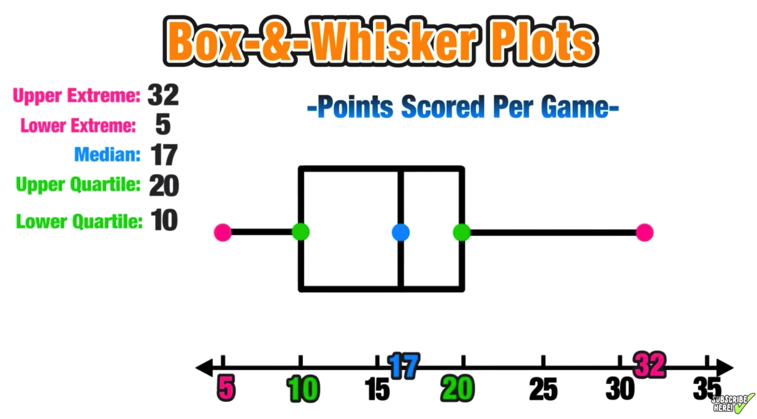
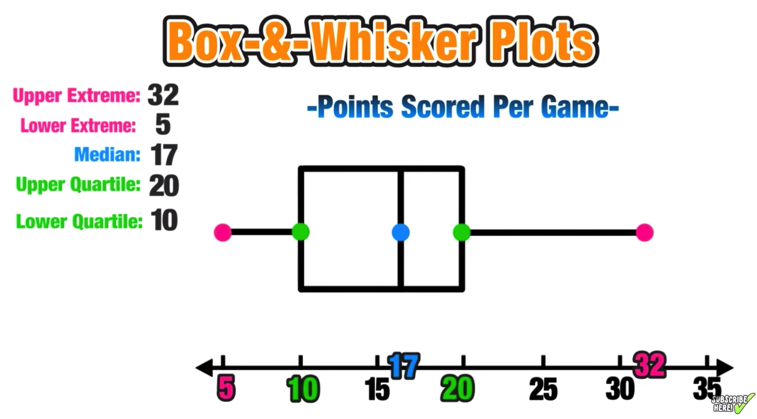
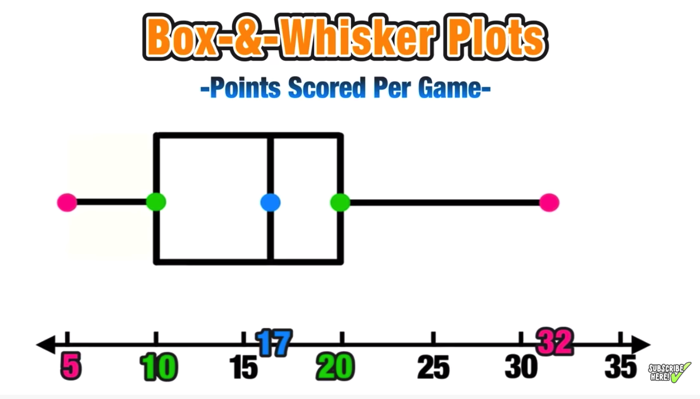
The lower extreme is the smallest value, which is 5 in this example.

The upper extreme is the highest value, which is 32 in this example.

Snip20190929_3.png

Step Three: Identify the median, or middle, of the data set.

In this example, the median is 17.

See Also: Check Out This Awesome Mean, Median, and Mode Activity

Snip20190929_4.png

Step Four: Identify the upper and lower quartiles.

To find the lower quartile and the upper quartile, start by splitting the data set at the median into lower and upper regions.

Snip20190929_5.png

The upper quartile is the median of the upper region, and the lower quartile is the median of the lower region.

In this example, the upper quartile is 20 and the lower quartile is 10.

Snip20190929_6.png

Now we have all of the information that we will need to construct our box and whisker plot!

Snip20190929_7.png

Step Five: Construct the Box and Whisker Plot

To construct a box and whisker plot, start by drawing a number line that fits the data set.

Snip20190929_8.png

Start by plotting points over the number line at the lower and upper extremes, the median, and the lower and upper quartiles.

Snip20190929_9.png

Next, construct two vertical lines through the upper and lower quartiles, and then constructing a rectangular box that encloses the median value point.

Snip20190929_10.png

Then construct a vertical line through the median point that extends to the top and bottom of the rectangle.

This is the box in the box and whisker plot.

Snip20190929_12.png

Finally, draw horizontal lines that connect the lower quartile to the lower extreme and the upper quartile to the upper extreme to complete the box and whisker plot.

The box and whisker plot is complete!

The box and whisker plot is complete!

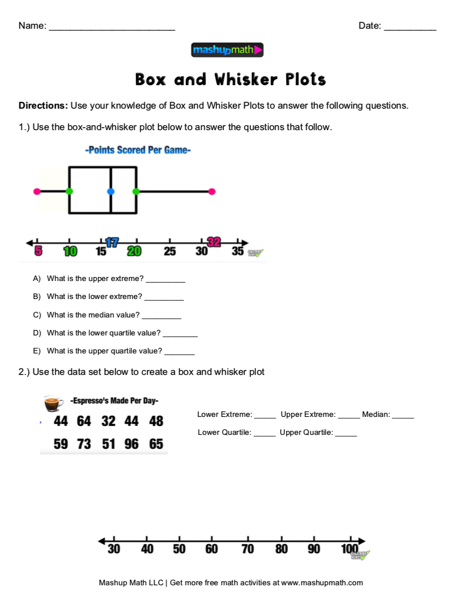
Box and Whisker Plot Worksheet

Snip20190929_20.png

Are you looking to get some more practice with making and analyzing box and whisker plots?

Check out the following free box and whisker plot worksheet, which is available as a PDF download!

Click here to download your free Box and Whisker Plot worksheet.

Answer key included.


Box and Whisker Plot Video Lesson

Check out our free Box and Whisker Plots Explained video lesson on YouTube for a more in-depth look:

Tags:  box and whisker plot explained, box and whisker plot definition, box and whisker plot problems, box and whisker plot outliers, box and whisker plot worksheet, box and whisker plot range


Have thoughts? Share your thoughts in the comments section below!

static1.squarespace.png

(Never miss a Mashup Math blog--click here to get our weekly newsletter!)

By Anthony Persico

Anthony is the content crafter and head educator for YouTube's MashUp Math. You can often find me happily developing animated math lessons to share on my YouTube channel . Or spending way too much time at the gym or playing on my phone.

Related Posts:

 
BoxWhisker_Pin.jpg

3 Comments

Are Your Kids Ready for These Halloween Math Activities?

1 Comment

Are Your Kids Ready for These Halloween Math Activities?

Are You Ready to Celebrate Halloween with Your Math Students This Year?

Are your students excited to celebrate Halloween this year?

If so, then you can channel their enthusiasm for this spooky time of year towards learning math with some brand new Halloween-themed two truths and one lie math activities for grades 3-8.

Go ahead and share these activities at any point during your math lessons this month to boost student engagement and bring some holiday festiveness into your classroom. You may also like our 13 Days of Spooky Math Puzzles and these fun hands-on Halloween math activities for all ages. Enjoy!


Image Source: Mashup Math FP


The following Halloween Math Activities for elementary and middle school students are samples from my best-selling PDF math workbooks: 101 Two Truths and One Lie! Math Activities for Grades 3-5 and 101 Two Truths and One Lie! Math Activities for Grades 6-8.

Two Truths and One Lie (2T1L) math activities revolve around your students being presented with three facts, images, or statements (only two of which are true). The objective is for students to identify which statement is false and justify why (verbally, in writing, or both).

2T1L activities are an excellent strategy for boosting student engagement, sparking mathematical thinking, and opening small-group or full-class discussions. They are great for warm-up and cool-down activities during the first or final minutes of class.

Click here to learn more about how you can use two truths and one lie math activities to engage your students.

HowToDownload.jpg

Free Halloween Math Activities for Grades 3, 4, and 5

(keep reading to get puzzles for grades 6, 7, and 8)

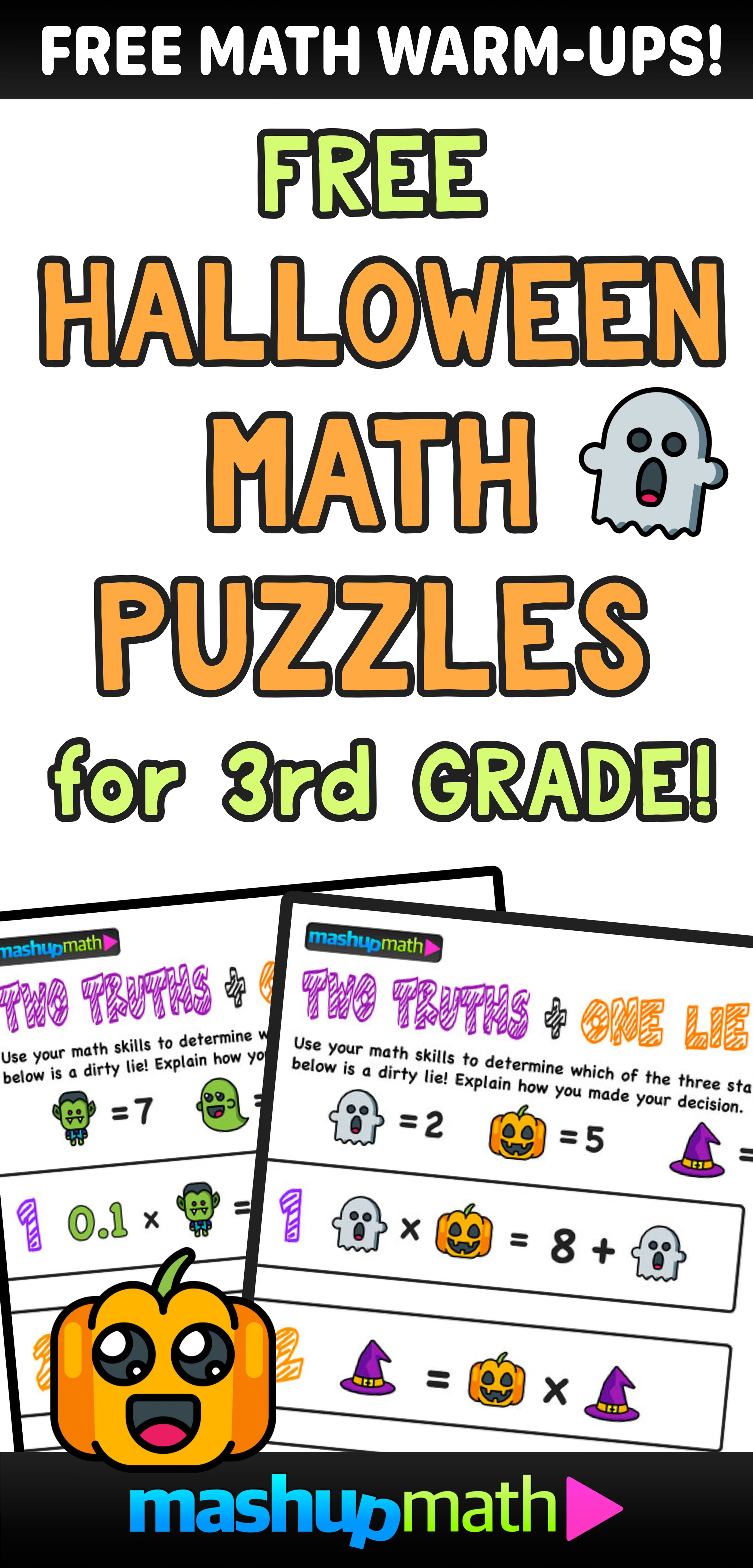
3rd Grade

4th Grade

5th Grade

Answer Key: 3rd Grade: 3 | 4th Grade: 2 | 5th Grade: 2

You can learn more about 2T1L activities and access more free samples here.


Wait! Get 100+ More Two Truth and One Lie Math Activities for Your Students!

Get Your Activities
Get Your Activities

Free Halloween Math Activities for Grades 6, 7, and 8

6th Grade

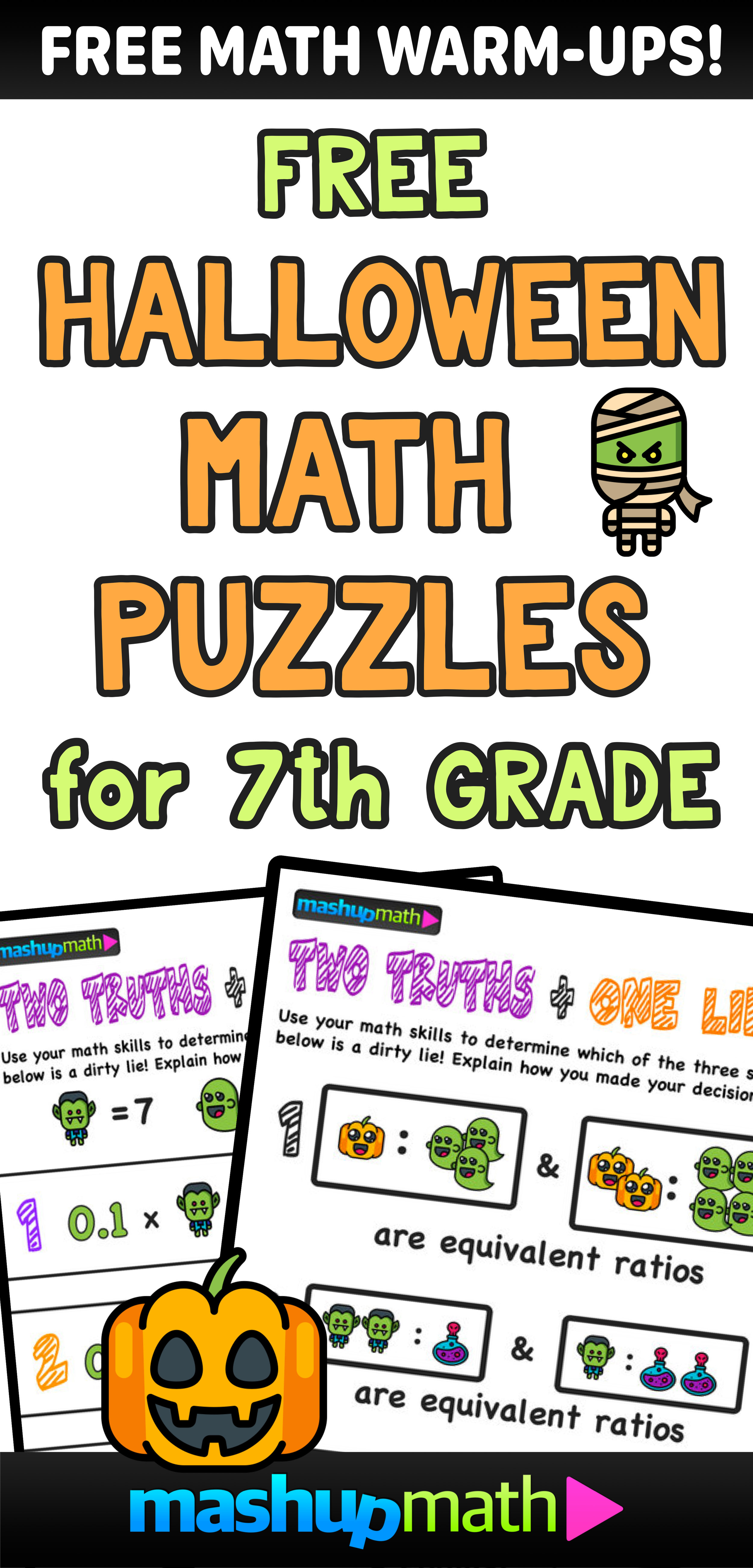
7th Grade

8th Grade

Answer Key: 6th Grade: 2 | 7th Grade: 2 | 8th Grade: 1

You can learn more about 2T1L activities and access more free samples here.

Looking for more Two Truths and One Lie Math Activities?

You can now share 101 Daily Two Truths & One Lie! Math Activities for Grades 3, 4, & 5 OR Grades 6, 7, & 8 with your kids with our brand new PDF workbooks!

Here are a few more free samples that you can download and share with your kids (right-click to download each graphic and save it to your computer):

Looking for more for grades 3, 4, & 5? Download your 101 ‘Two Truths and One Lie!’ Math Activities for Grades 3, 4, & 5 eBook!


Of course, sharing math puzzles with your students is just one effective strategy for boosting engagement in your classroom. Subscribe to our mailing list here to get more free daily resources, lesson plans, ideas, and insights for K-12 math teachers in your inbox every week.

Read More Posts About Math Education:


Bitmoji.png

By Anthony Persico

Anthony is the lead educator and founder of Mashup Math. He lives in Denver, Colorado and is also a YouTube for Education partner. Follow him on Twitter at @mashupmath.

HalloweenPin_3.jpg
HalloweenPin_6.jpg
HalloweenPin_4.jpg
HalloweenPin_7.jpg
HalloweenPin_5.jpg
HalloweenPin_8.jpg
 

1 Comment