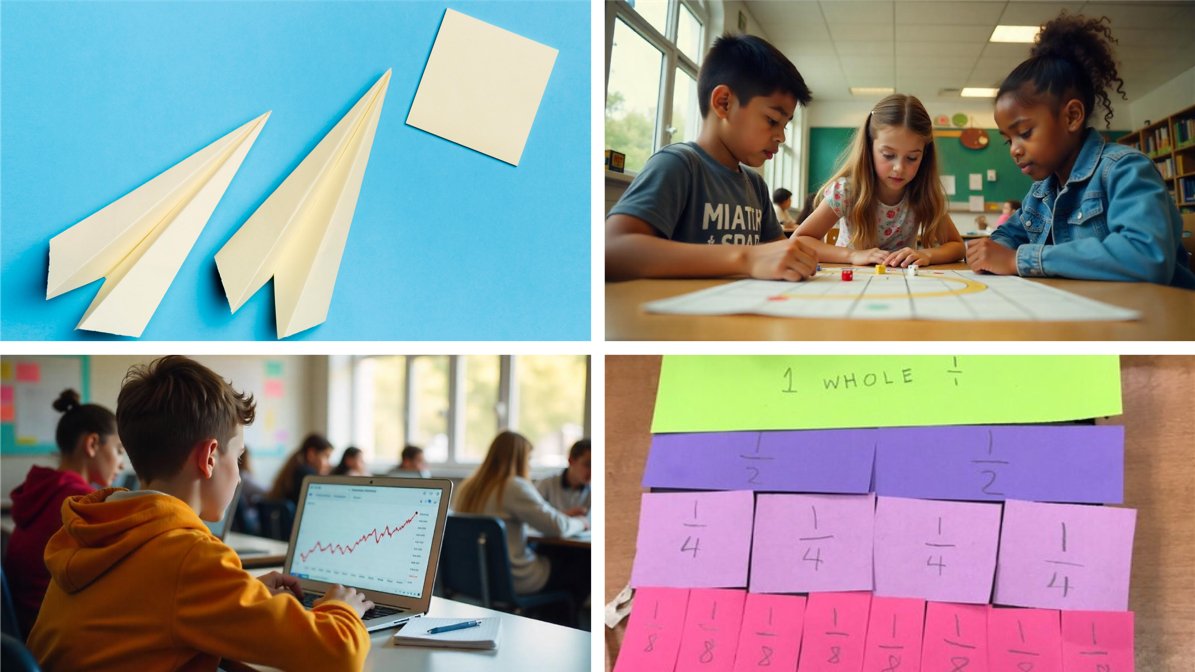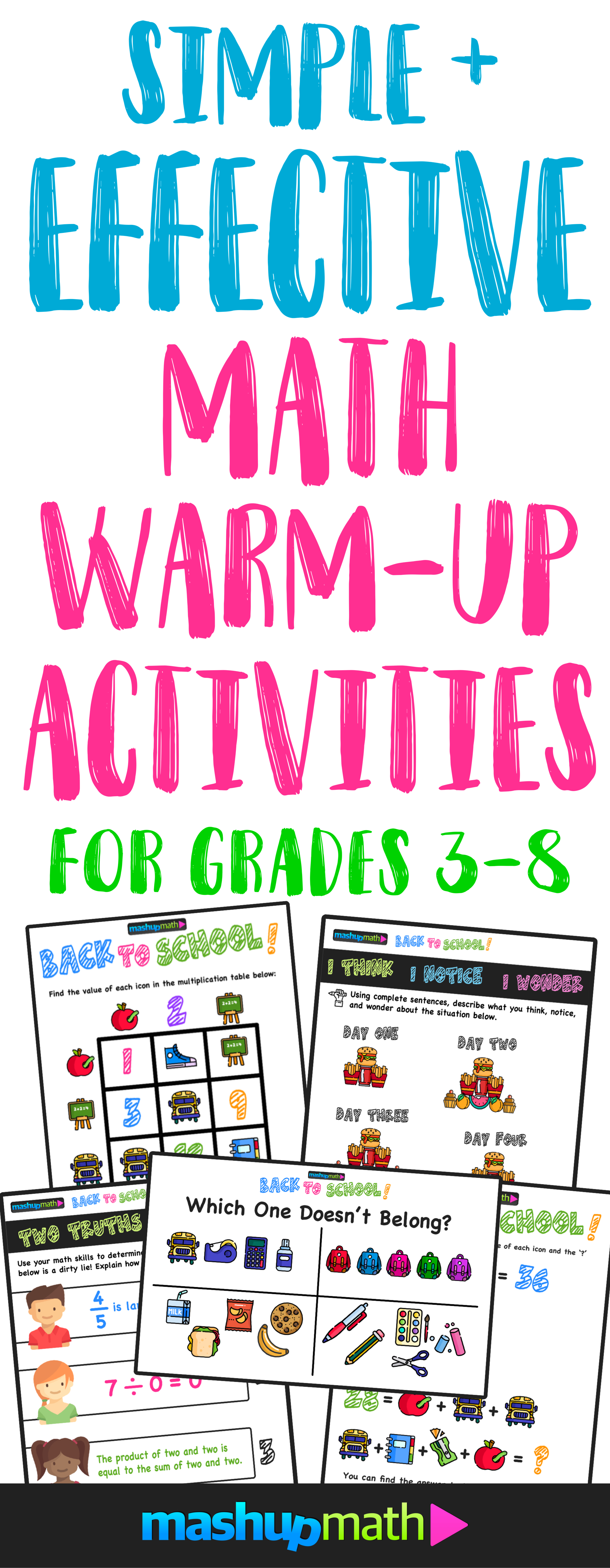
What Math Teaching Strategies Work Best? 16 Math Education Experts Share Their Suggestions.

6 Comments

What Math Teaching Strategies Work Best? 16 Math Education Experts Share Their Suggestions.

What Math Teaching Strategies Work Best? 16 Math Education Experts Share Their Suggestions.

Math Education Experts Share What Tools and Strategies They Use to Support Students.

A Post By: Anthony Persico

What works in math education is constantly evolving. Math teaching strategies and techniques that were once commonplace in the classroom several years ago are now being replaced with more effective, research-backed methods aimed at making mathematics a more approachable, meaningful and equitable subject.

I recently reached out to 16 math education experts, including Stanford University Math Education Professor Jo Boaler, and asked the following question: What new belief, behavior, teaching habit, or tool has most improved your teaching over the past 12-18 months and why?

The diverse collection of responses below will help you to identify some new strategies to add to your teaching toolbox and ultimately assist you in becoming a more effective math educator who is better equipped to meet the needs of your students. Enjoy!

What math teaching strategies are the experts using?

What math teaching strategies are the experts using?


Eddie Woo

Eddie is an Education Ambassador for the University of Sydney, the founder of YouTube’s MisterWooTube channel, and the author of Woo’s Wonderful World of Mathematics and It’s a Numberful World. You can follow him on Twitter @misterwootube.

Snip20190805_1.png

Eddie Says…

I have been exploring the power of open-endedness in mathematics classroom over the last couple of years, and love the way that it has helped me tease out mathematical thinking in my students. It’s so easy for students to fixate on getting the “right answer” when facing a question in mathematics, and I love the way that open problems emphasize the aspects of reasoning and communication. It’s also fantastic to see how easily a task can be reshaped so that it has a low floor and a high ceiling, to ensure that struggling learners can access the activity and highly competent mathematicians can also find rich avenues for exploration and investigation.


Chris Woods

Chris is a High School Math Teacher, STEM Presenter, and host of the STEM Everyday Podcast. You can follow him on Twitter @dailystem.

Snip20190729_24.png

Chris Says:

In the past few years, I’ve made the change to get kids holding shapes and equations in their hands more often. It usually starts by handing out some combination of paper, scissors, rulers, colored pencils, tape, and glue sticks to my students, nothing fancy. What happens next is I try to help them “see” how a surface area formula works by building a triangular prism or help them “visualize” how a parabola is formed by drawing a series of lines on a grid. And when math is more than just numbers and letters on a worksheet or an answer on a calculator, it is suddenly something beautiful, creative, and worthy of exploration and discovery.


Kristen Acosta

Kristen is a K-6 Math Coach, Teacher, and Presenter. You can access her math resources at www.kristenacosta.com and follow her on Twitter @kristenmacosta.

Snip20190723_9.png

Kristen Says:

It’s amusing that number lines have been around forever, but are so underutilized in helping students with making connections to a bigger picture. When I stumbled upon Clothesline Math (used as an open number line), my students’ number sense improved greatly. Clothesline Math has helped my students see the interconnectedness of how math works.

You can learn more about clotheslines math on Kristen’s website.


Kyle Pearce

Kyle is a K-12 Mathematics Consultant who delivers presentations and workshops, blog contributor at Tap Into Teen Minds, and co-host of the Make Math Moments podcast. You can follow him on Twitter @MathletePearce.
Snip20190729_26.png

Kyle Says:

Over the past 12-18 months, one of the biggest epiphanies I’ve had is how important it is to actually understand the math. I’m not talking about how to “do it”, but developing the conceptual understanding of the how and why it works, the connections from one idea to another, and how it develops in young children all the way to high school mathematics. Currently, I’ve been building my own understanding of Proportional Reasoning and I’ve built out a full course for members of the Make Math Moments Academy. You can learn more about it here: makemathmoments.com/academy.


Makeda Brome

Makeda is a math educator and 2020 Teacher of the Year Recipient in Port St. Lucie, Florida. You can follow her on Twitter @thebromenator.
Snip20190729_27.png

Makeda Says:

Over the last year-and-a-half, I have become more and more aware of social justice education on teaching and how I play an integral role in that. While our classrooms may be more diverse, much of our teaching practices have not changed to support the diversity in our classrooms. Twitter chats and movements like #ClearTheAir, #HipHopEd, and #EduColor have helped me become a better math educator for all of my students and I now support other teachers in doing the same. All of our students deserve equal learning opportunities, I hope the math community commits to engaging in this work!


Brian Aspinall

Brian is a K-12 math educator, TEDx presenter, and author of Code Breaker: Increase Creativity, Remix Assessment, and Develop a Class of Coder Ninjas!. You can follow him on Twitter @mraspinall.

Snip20190729_28.png

Brian Says:

For me, two tools have greatly impacted my teaching pedagogy. Both Scratch and Minecraft offer a sandbox environment for students to create content, try something new, immerse themselves in mathematics and be creative. Not only do they support a constructivist approach to learning, students receive immediate feedback from the tools, freeing up teacher time to consolidate with other students.

Brian shares lesson plan examples on his blog at brianaspinall.com and in his books, Code Breaker and Block Breaker.

Learn more: How to use Minecraft: Education Edition in Your Classroom


Alice Keeler

Alice is a YouCubed Consultant, Speaker, Google Certified Teacher, and author of several books including Teaching Math with Google Apps: 50 G Suite Activities. You can follow her on Twitter @alicekeeler.

Snip20190729_29.png

Alice Says:

Students who think they struggle in math are all thinkers. I have yet to meet a kid who isn't a thinker. Instead of giving them DOK 1 problems I use OpenMiddle and other interesting problems where step one is... hmmm, I'm not sure, let me think about it. Turns out they are math people.

The other thing I do is tell a story using Google Slides to explain the math problem. Show your feelings, step .1 take a selfie, show how you collaborated, you're required to google something... and explain it.


Jennifer Chang Wathall

Jennifer is an advocate for Concept-Based Curriculum and author of Concept- Based Mathematics: Teaching for Deep Understanding in Secondary Schools. You can connect with her on Twitter @JenniferWathall and visit her website www.jenniferchangwathall.com for more information.
Snip20190729_16.png

Jennifer Says:

I enjoyed a glorious 27-year teaching career and something that completely transformed my practice was embedding an inductive teaching approach. The inductive teaching approach creates an environment for students to uncover the beauty and creativity of mathematics for themselves through inquiry based learning.

The inductive teaching approach encourages students to inquire through experimentation, enables connections between different topics to be made, and supports deep conceptual mathematical understanding which gives students the ability to apply and transfer to different contents.

Learn More: What Does Inquiry-Based Learning Look Like in the Math Classroom?


Berkeley Everett

Berkeley is a K-5 Math Coach, facilitator to UCLA’s Math Project, designer for Math Visuals. You can follow him on Twitter @BerkeleyEverett.

Snip20190729_30.png

Berkeley Says:

Is it possible for tasks to differentiate themselves while communicating the idea that math is about relationships (not answers)? This year I took my questions to another level with Open Questions from Marian Small. Instead of "12 is 2/3 of ___" she would pose "___ is 2/3 of ___." Suddenly the task is more accessible and more challenging. Plus, it encourages students to focus on ideas and relationships instead of answers. For more, check out Marian Small's great books, including Good Questions (look for the 3rd Edition).


Lauren Baucom

Lauren is a High School Math Teacher, doctoral student at the University of North Carolina at Greensboro, and national presenter. You can follow her on Twitter @LBmathemagician.

Snip20190729_31.png

Lauren Says…

Collective learning is a new term that I am fascinated by, and love finding evidence of it in educational spaces. As educators, we often focus on the learning that we hope is occurring in the students who enter our classrooms. As math coaches, we hope to see the confirmation of learning as educators make adjustments to their practice. Both of these are examples of individual learning. There is a powerful type of learning that is harder to visualize, collective learning, or the learning that is happening between a group of people. For example, in a classroom that promotes student discourse, two students may learn different things from a lesson. The conversation that is facilitated between them will multiply the learning that occurs in that room, as each student brings their individual learning and jointly shares with the others. As a teacher, I often forget about asking myself, “What did we learn collectively today?”, not as an offshoot of “I taught it, so they learned it.”, but from the richness that was created from being together.


Peter Liljedahl

Peter is an Education Professor at Simon Fraser University in British Columbia, Canada and Math Education Consultant. You can follow him on Twitter @pgliljedahl.

Snip20190729_18.png

Peter Says:

My favorite practice for the last few years is the use of visibly random groups. Although it is something I have been researching and publishing on for many years, it is a practice that still keeps giving me new surprises every year. It emerged as a reaction to my research that was showing that both self-selected and strategically formed groups create a space where the students know what their role will be that day—and for many, that role was not to think. Random groups do not create this. In addition, random groups bypass all our biases of what students are capable of, reduces social barriers, and drives more autonomous learning behavior. More recently, it has also shown that students take random groups as a sign of confidence in them as learners and thinkers.


Margie Pearse

Margie is a math coach and curriculum head, a contributor to Edutopia, and the author of Teaching Numeracy: 9 Critical Habits to Ignite Mathematical Thinking. You can follow her on Twitter @pearse_margie.

Snip20190805_2.png

Margie Says:

I was greatly influenced by The Formative 5. I taught in a district that was committed to infusing literacy strategies across content areas, so assessing BDA style in math was something I was very familiar with, but The Formative 5 took the idea of checking for understanding throughout a lesson one step further. I knew there were certain points in each lesson where understanding was critical to moving forward, but I couldn’t put my finger on it until the idea of a Hinge Point was introduced in the book and that was revolutionary to me.


Sunil Singh

Sunil is a math learning specialist and author of Math Recess: Playful Learning in an Age of Disruption and Pi of Life. You can follow him on Twitter @Mathgarden.

Snip20190729_19.png

Sunil Says…

As a math educator, we tend to be caught up in the micro details of problem solving and strategies more often than not. While this makes sense, given the analytical nature of mathematics, I have found that some of the more valued human qualities are equally important in students trusting the journey of learning mathematics. For me, the idea of kindness as a virtue, has become a pillar in teaching mathematics. Through kindness we build trust and friendship, which facilitates a learning environment that allows risk, failure, and the acquisition of resilience.


Denis Sheeran

Dennis is a math education specialist, administrator, and the author of Hacking Mathematics: 10 Problems That Need Solving and Instant Relevance: Using Today's Experiences to Teach Tomorrow's Lessons. You can follow him on Twitter @MathDenisNJ and visit his website www.denissheeran.com for more information.

Snip20190729_20.png

Denis Says…

I've been an administrator for the past seven years, supervising math teachers and departments in NJ. In fact, it was in the early part of that experience that I was inspired to write Instant Relevance, Using Today's Experiences to Teach Tomorrow's Lessons. One of the biggest shifts that needs to happen in the classroom is less teacher talking and more student discourse. The saying goes, "whoever is doing the talking is doing the learning" and that needs to be a focus in math classrooms. So, I came across a tool that measures the amount of time teachers and students are talking in the classroom by identifying your voice, multiple voices, and volume and then graphs the data for you on demand. It's called TeachFX. They call themselves a Fitbit for teachers that measures student engagement. As a full time math consultant now, I use the tool during professional development sessions and during teacher observations to give objective feedback to teachers after observing their classrooms. You'd be shocked to find out how much talking most teachers really do, when they do it, and how that contrasts what they thought they'd be doing.


Mark Chubb

Mark is a math teacher, instructional coach, and blog contributor to Building Mathematicians. You can follow him on Twitter @MarkChubb3.

Snip20190729_22.png

Mark Says…

For years, I have believed the most important thing we can do as educators is to plan for rich learning experiences, so our students could learn through problem solving. After years of being a math coach, I now see that providing rich experiences isn't enough. If we are aiming to make sure we are maximizing learning in our classrooms it takes us as the teachers to be learning about our students as developing mathematical thinkers, and to be continually curious about their understanding. That is, we need to be noticing and wondering about our students regularly. This is the essence of what assessment means. Here are strategies and practical advice to help us notice and wonder about our students: Noticing and Wondering - A Powerful Tool for Assessment.

Learn More: Using Notice-Wonder Activities to Support Math Learning


Jo Boaler

Jo is a Professor of Math Mathematics Education at Stanford University, founder of YouCubed, and author of Mathematical Mindsets and Limitless Mind: Learn, Lead, and Live Without Barriers. You can follow her on Twitter @joboaler.

Snip20190723_6.png

Jo Says:

My teaching has been most helped by the knowledge that connected brains are the most powerful and that when we engage students in mathematics through multiple forms of activity - drawing, writing, moving, modeling, building, calculating, and more—they learn most effectively. Mindset messages are very important, but they need to be accompanied by the opening of mathematics teaching, so that students see the potential for growth. When we combine growth messages with open, growth teaching, mathematics becomes a beautiful subject for students. We share many ways to do this on www.youcubed.org and in my book Mathematical Mindsets.

Learn More: 5 Growth Mindset Books Every Math Teacher Should Read


Of course, the above strategies, suggestions, and ideas for teaching math just scratch the surface of all there is to learn about the art of teaching mathematics effectively. Subscribe to our mailing list here to get more free daily resources, lesson plans, and insights for K-12 math teachers in your inbox every week.

Read More Posts About Math Education:
NewBlogImage.png

Anthony is the lead educator and founder of Mashup Math. He lives in Denver, Colorado and is also a YouTube for Education partner. Follow him on Twitter at @mashupmath.

6 Comments

Fraction to Decimal: An Easy Way to Convert

6 Comments

Fraction to Decimal: An Easy Way to Convert

Snip20190701_7.png

Image Source: Google Calculator

An Easy Way to Convert Fraction to Decimal

Are you ready to learn how to convert a fraction to a decimal?

(Click here to learn how to do the opposite and convert a decimal to a fraction)

Before you learn an easy way to convert a fraction to a decimal (with and without a calculator), you need to understand what decimals and fractions are:

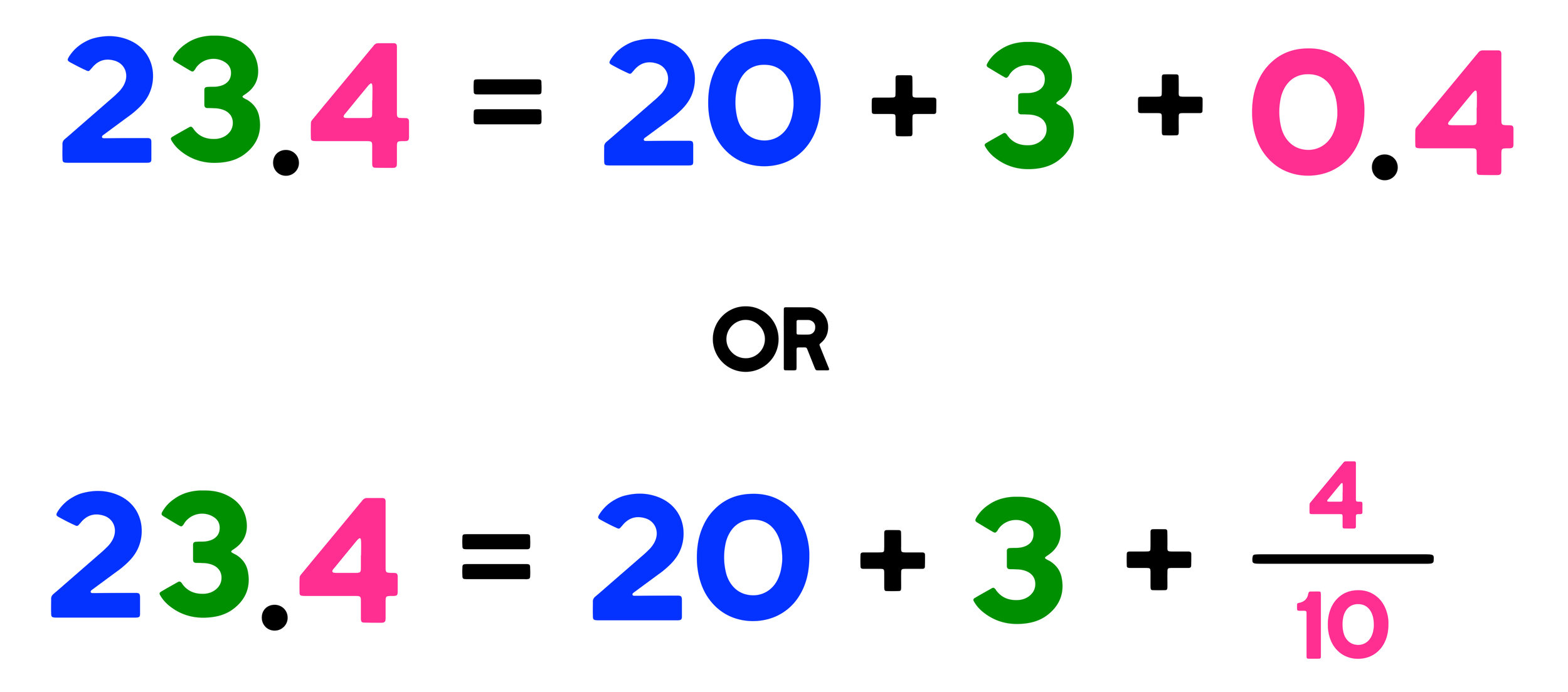
  •  A decimal number is used to represent a non-whole number where a decimal point is used followed by digits that represent a value that is smaller than one.

 
GraphicOne.jpg
 
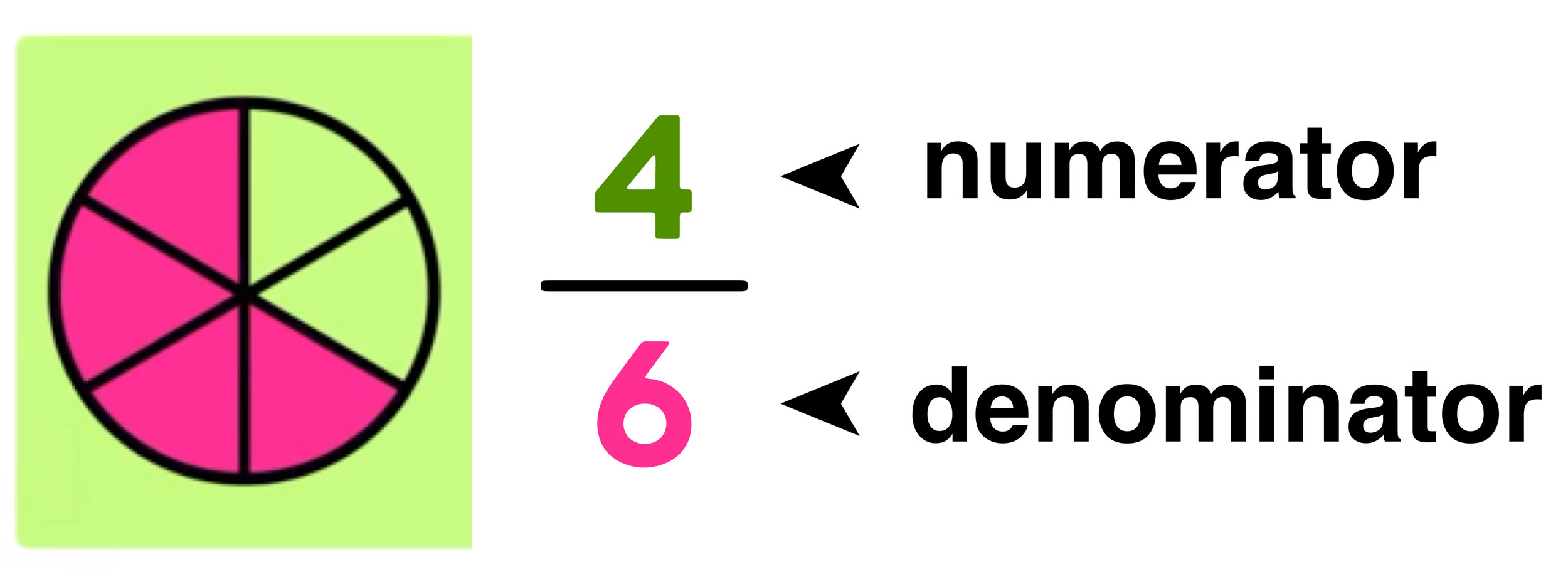
  • A fraction represents a part of a whole number. A fraction is a ratio between the upper number (the numerator) and the lower number (the denominator). The numbers are stacked vertically and separated with a bar.

 
Graphic2.jpg
 

The key takeaway from these definitions is that decimals and fractions are different ways of representing the same thinga number that is not whole.

How to Convert Fraction to Decimal

You can easily convert a fraction to a decimal by using a few simple strategies:

1.) By Using a Calculator

The easiest way to convert a fraction to a decimal is to divide the numerator (the top of the fraction) by the denominator (the bottom of the fraction) by using a calculator. The resulting answer will be the value of the fraction expressed as a decimal number.

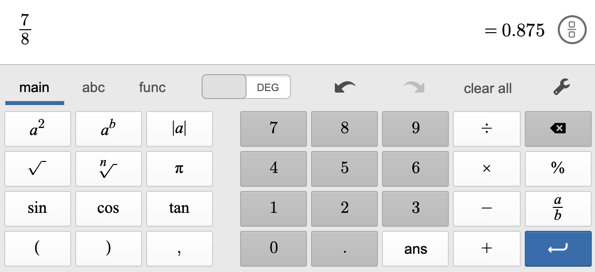
For example, to convert the fraction 7/8 to a decimal using a calculator, simply perform 7 divided by 8 and press enter. The resulting decimal would be 0.875.

Therefore, you can say that 7/8 expressed as a decimal is 0.875

Image Source: Google Calculator

Image Source: Google Calculator

Snip20190701_4.png

2.) Without a Calculator

How can you convert a fraction to a decimal without a calculator?

The solution is using long division.

For example, if you wanted to convert the fraction 7/8 to a decimal without using a calculator, you would have to use long division where the dividend is 7 and the divisor is 8.

Just like in the last example, by using the long division strategy, you can conclude that 7/8 expressed as a decimal is 0.875


How to Change Fraction to Decimal on Calculator

Snip20190701_5.png

Screenshot from www.calculatorsoup.com

If you need a fast and easy way to convert a fraction to a decimal, then you can take advantage of the many free online fraction to decimal conversion calculators that are available.

This free decimal to fraction calculator from www.calculatorsoup.com not only performs the conversion, but also shows the calculations (how the long division was performed to get the result), which is a handy tool since it will not only help you find a correct answer, but also understand the process as well.

To use the fraction to decimal calculator, simply input the decimal value and press calculate. This calculator can convert both a fraction and a mixed number to decimal.

Are you looking to learn more about working with decimals and understanding place value? Click here for more free resources


Fraction to Decimal Chart

A fraction to decimal chart is a handy tool for making quick conversions.

While there are many free fraction to decimal chart resources available online, I prefer this free fraction to decimal chart from www.sciencemadesimple.net for its readability and simplicity.

Pro tip: Keep a printed copy of your fraction to decimal chart with you while you study and practice math. This strategy will help you to memorize the common conversions (ex. 1/2=0.5 or 1/8=0.125).

Fraction to Decimal Worksheet (with Answers)

Do you need more practice with learning how to convert a fraction to a decimal? The following decimal to fraction worksheet and answer key will give you plenty of opportunities to apply the three step process to converting a decimal to a fraction.

Click here to download your free Fraction to Decimal Worksheet with Answers.

And if you are looking for a more in-depth lesson on how to convert fraction to a decimal, check out this free fraction to decimal video lesson:


Share your ideas, questions, and comments below!

(Never miss a Mashup Math blog--click here to get our weekly newsletter!)

NewBlogImage.png

By Anthony Persico

Anthony is the content crafter and head educator for YouTube's MashUp Math . You can often find me happily developing animated math lessons to share on my YouTube channel . Or spending way too much time at the gym or playing on my phone.

6 Comments

Decimal to Fraction: 3 Easy Steps

10 Comments

Decimal to Fraction: 3 Easy Steps

TitleImage.jpg

Decimal to Fraction: Everything You Need to Know

Are you ready to learn how to convert a decimal to fraction?

(and if you’re looking to learn how to convert a fraction to a decimal, click here)

Before you learn an easy way to complete both of these conversions (with and without a calculator), let’s make sure that you understand what decimals and fractions are:

  •  A decimal number is used to represent a non-whole number where a decimal point is used followed by digits that represent a value that is smaller than one.

 
GraphicOne.jpg
 
  • A fraction represents a part of a whole number. A fraction is a ratio between the upper number (the numerator) and the lower number (the denominator). The numbers are stacked vertically and separated with a bar.

 
Graphic2.jpg
 

The key takeaway from these definitions is that decimals and fractions are different ways of representing the same thinga number that is not whole.

How to Convert Decimal to Fraction

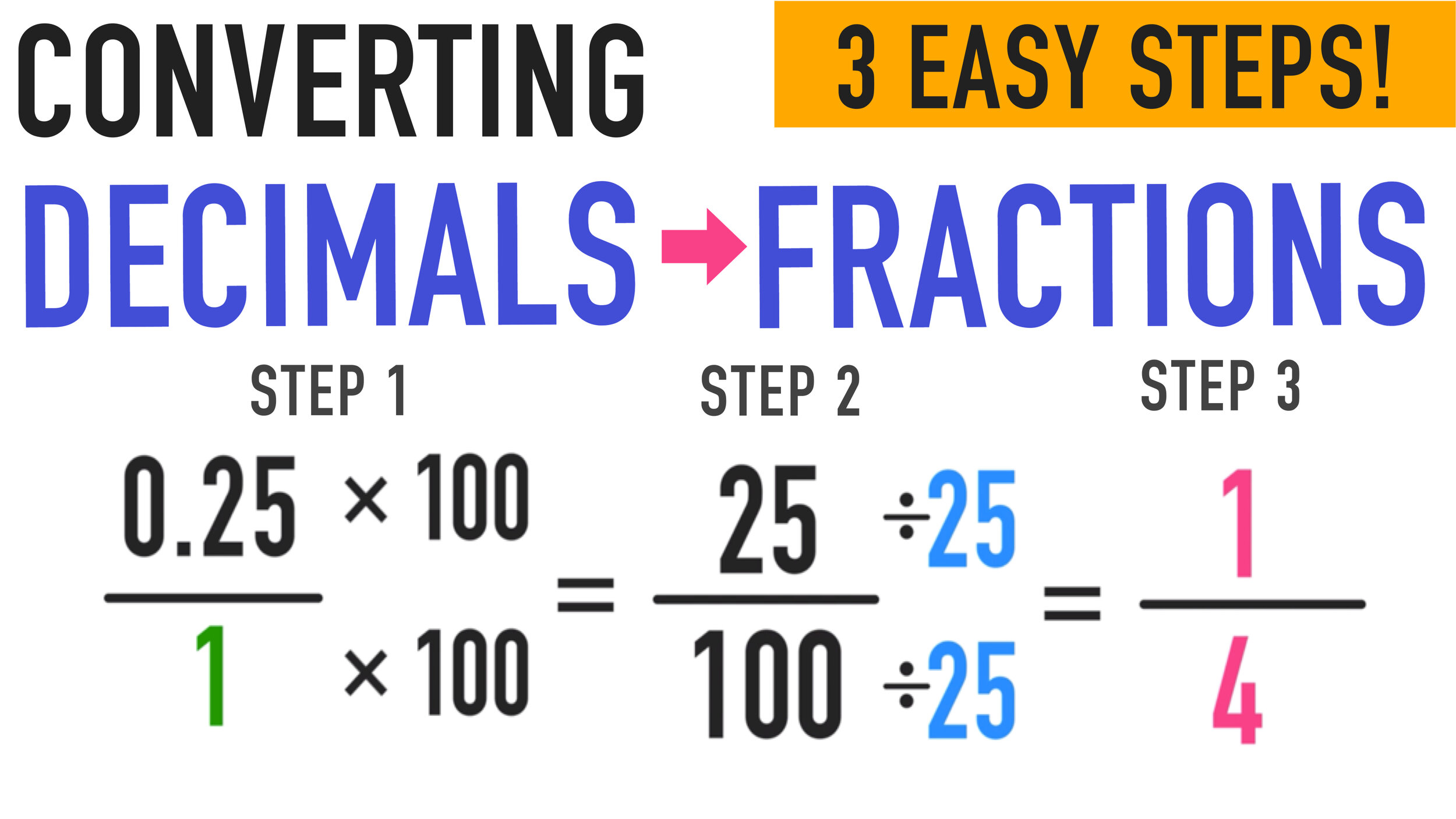
You can convert a decimal to a fraction by following these three easy steps.

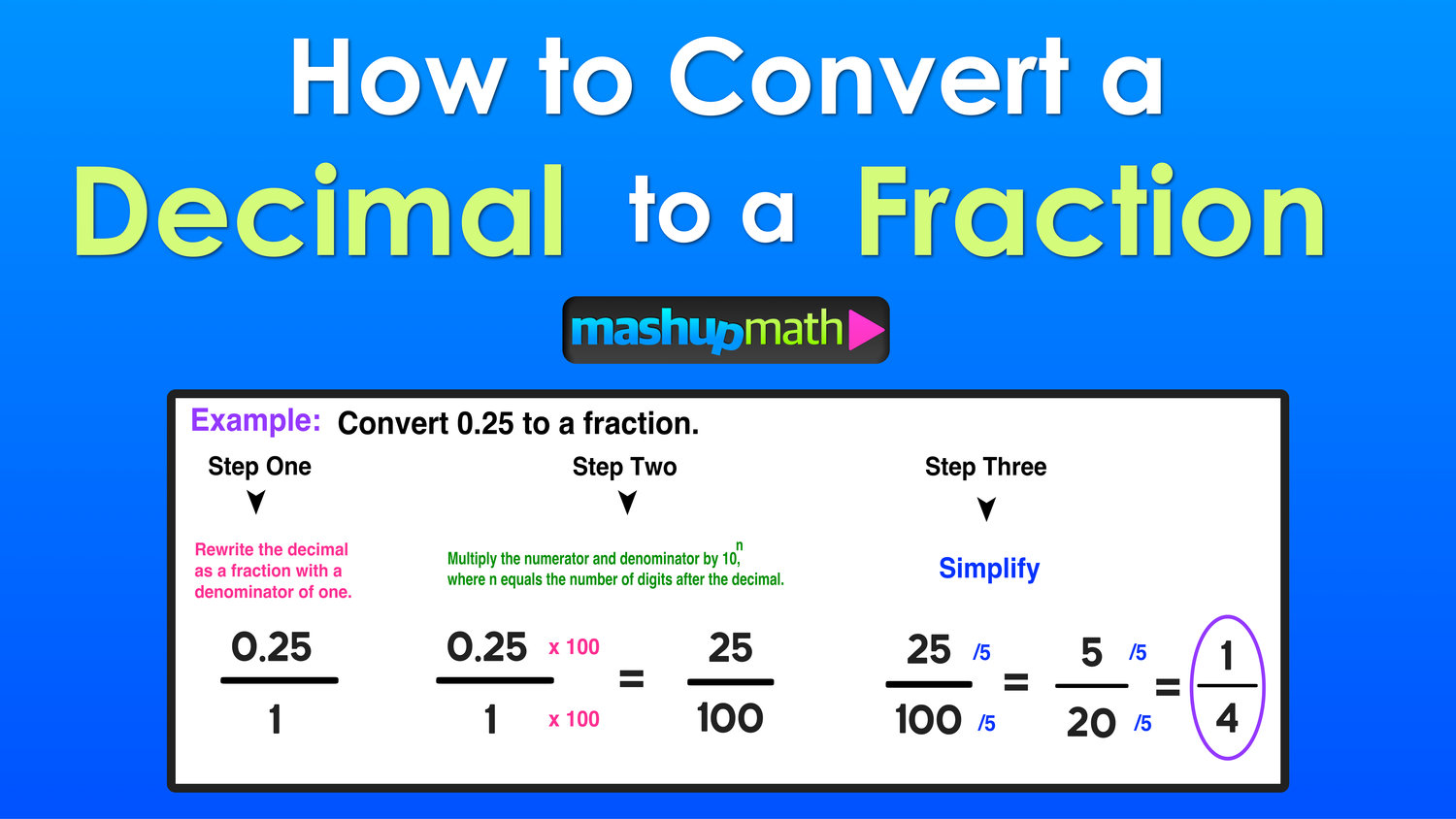
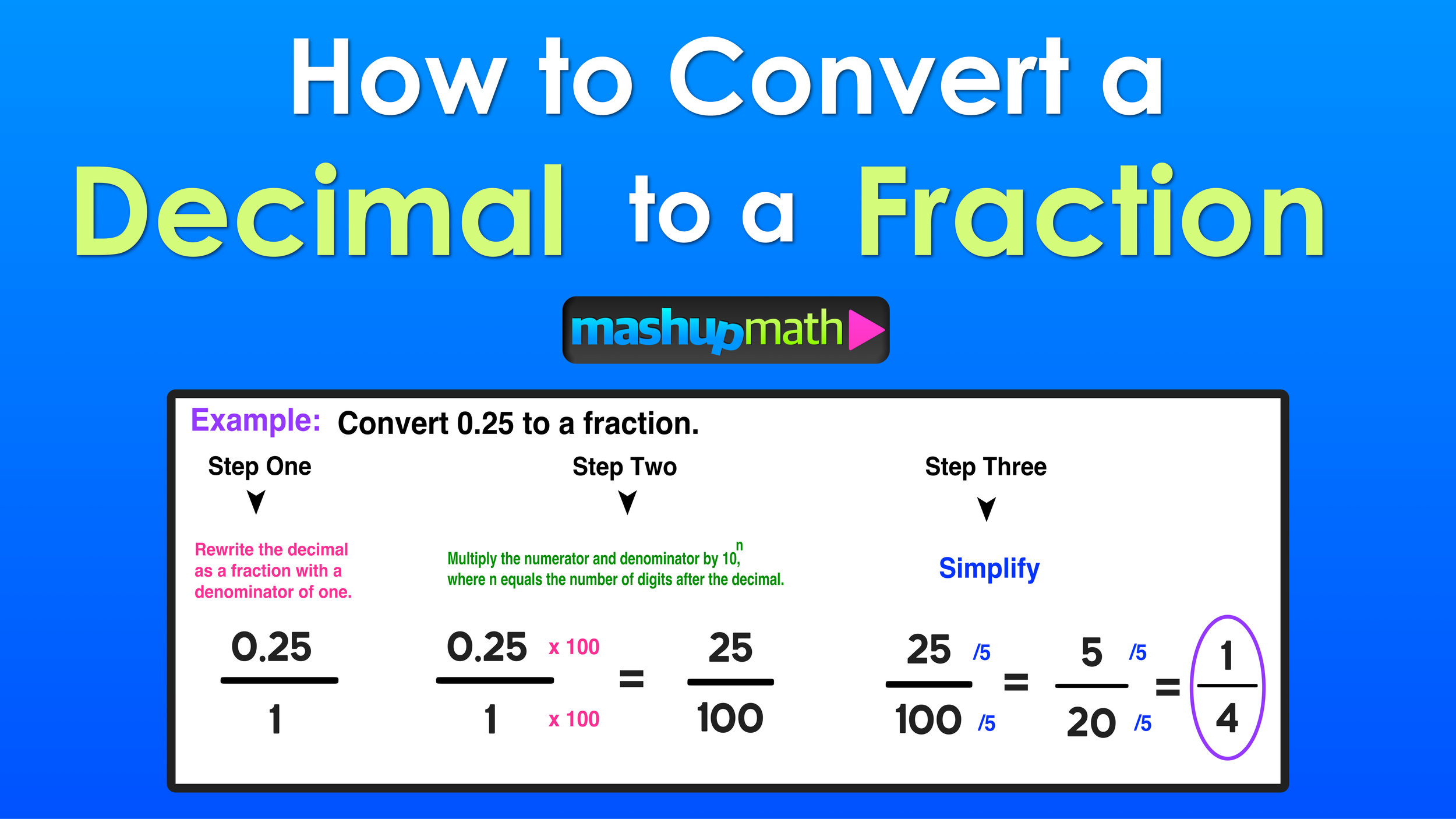
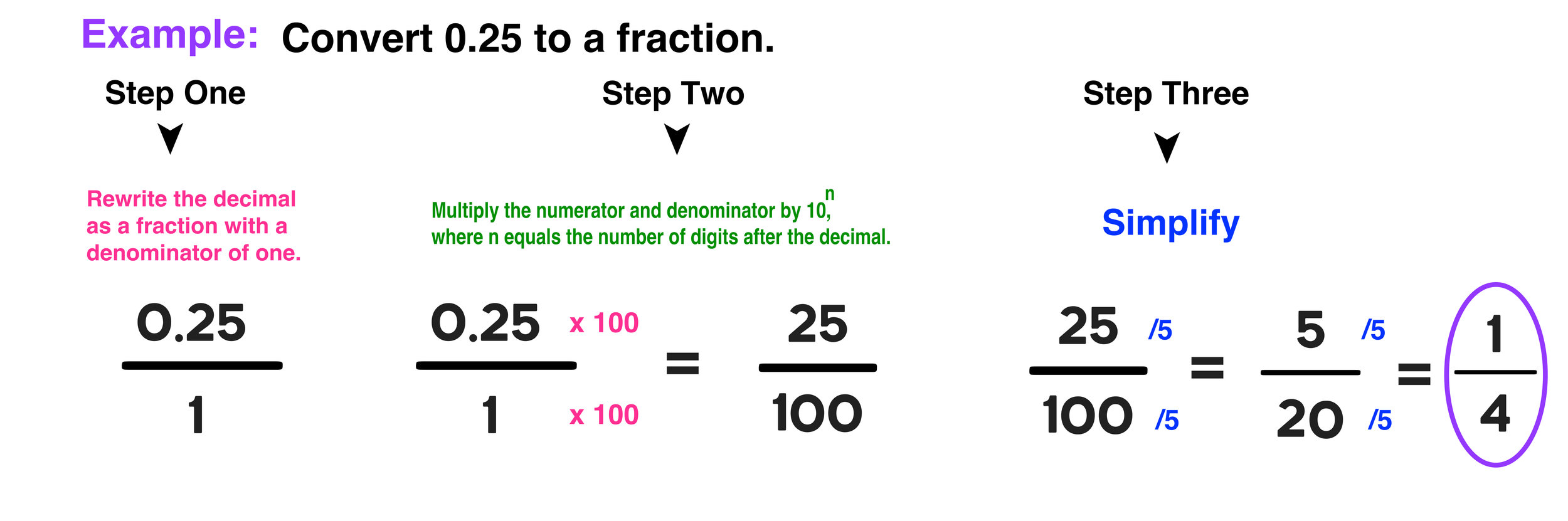
In this case, you will use the decimal 0.25 as an example (see the graphic below).

Step One: Rewrite the decimal number over one (as a fraction where the decimal number is the numerator and the denominator is one).

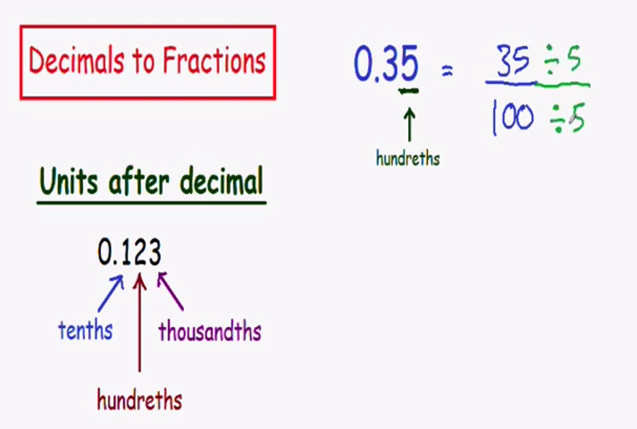
Step Two: Multiply both the numerator and the denominator by 10 to the power of the number of digits after the decimal point. If there is one value after the decimal, multiply by 10, if there are two then multiply by 100, if there are three then multiply by 1,000, etc.

In the case of converting 0.25 to a fraction, there are two digits after the decimal point. Since 10 to the 2nd power is 100, we have to multiply both the numerator and denominator by 100 in step two.

Step Three: Express the fraction in simplest (or reduced form).

If you need more help with simplifying fractions, check out this free video lesson.

Example.jpg

By following these three steps in the above decimal to fraction example, you can conclude that the decimal 0.25, when converted to a fraction, is equal to 1/4.

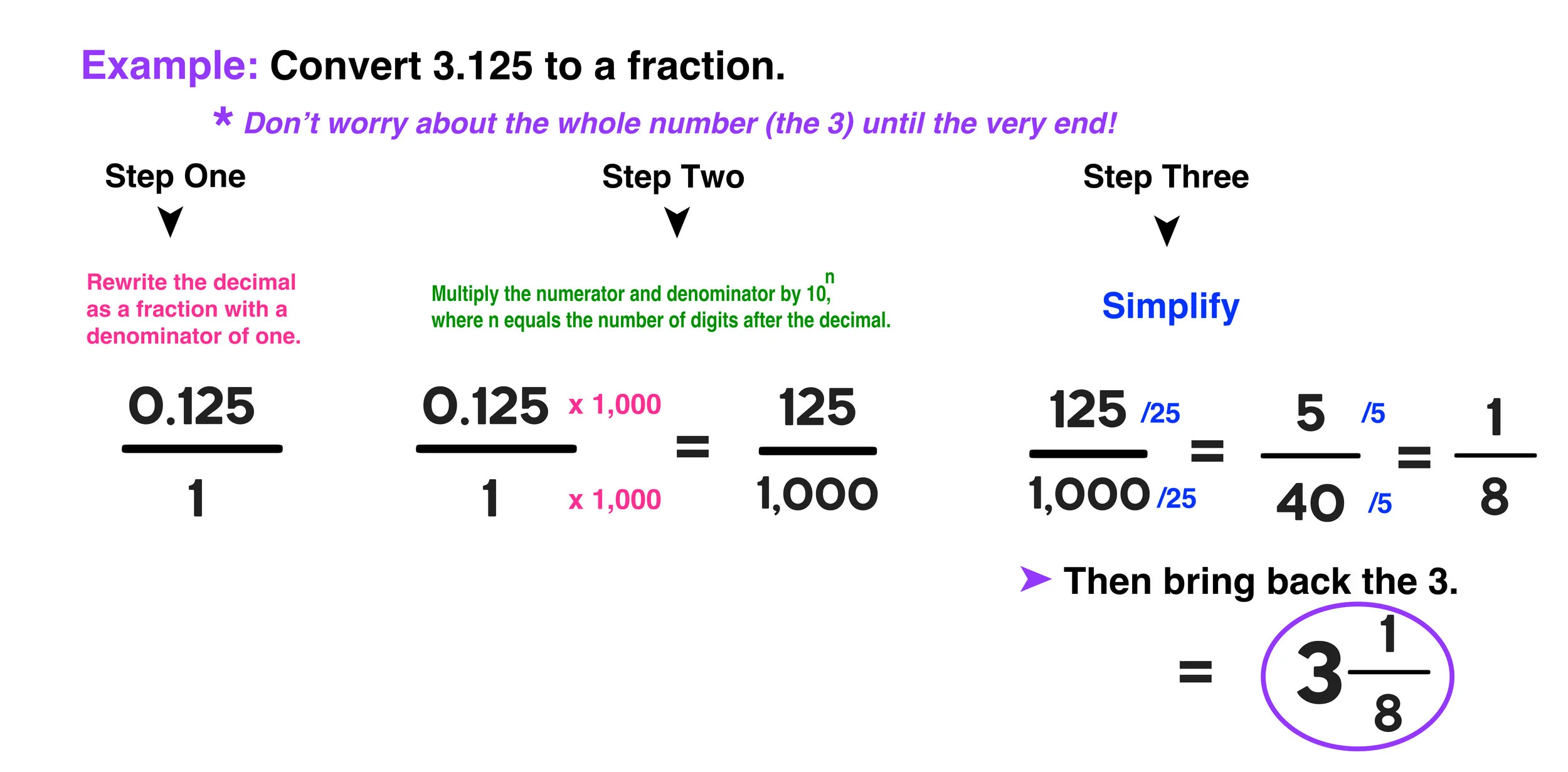
Here is another example of how to convert a decimal to fraction:

Notice that the answer to this example is a mixed number (a whole number and a fraction combined).

Notice that the answer to this example is a mixed number (a whole number and a fraction combined).

Decimal to Fraction Calculator

Snip20190628_2.png

If you need a fast and easy way to convert a decimal to a fraction, then you can take advantage of the many free online decimal to fraction conversion calculators that are available.

This free decimal to fraction calculator from www.calculatorsoup.com not only performs the conversion, but also shows the calculations (using the three step method shown above), which is a handy tool since it will not only help you find a correct answer, but also understand the process as well.

To use the decimal to fraction calculator, simply input the decimal value and press calculate. Depending on the value that you input, the calculator will convert the decimal to a fraction or a mixed number.

There is also a repeating decimal to fraction calculator (follow the instructions on the webpage to perform this function).

Are you looking to learn more about working with decimals and understanding place value? Click here for more free resources


Decimal to Fraction Worksheet

Do you need more practice with learning how to convert a decimal to a fraction? The following decimal to fraction worksheet and answer key will give you plenty of opportunities to apply the three step process to converting a decimal to a fraction.

Click here to download your free Decimal to Fraction Worksheet with Answers.

And if you are looking for a more in-depth lesson on how to convert decimal to fraction, check out this free decimal to fraction video lesson:


DF.jpg

Free Decimal to Fraction Chart (PDF)

Looking for a Useful Decimal to Fraction Chart for Making Conversions?

Click here to download your free printable Decimal to Fraction Conversion Chart.


Share your ideas, questions, and comments below!

(Never miss a Mashup Math blog--click here to get our weekly newsletter!)

NewBlogImage.png

By Anthony Persico

Anthony is the content crafter and head educator for YouTube's MashUp Math . You can often find me happily developing animated math lessons to share on my YouTube channel . Or spending way too much time at the gym or playing on my phone.

10 Comments

4th Grade Math Word Problems: Free Worksheets with Answers

2 Comments

4th Grade Math Word Problems: Free Worksheets with Answers

free4th.jpg

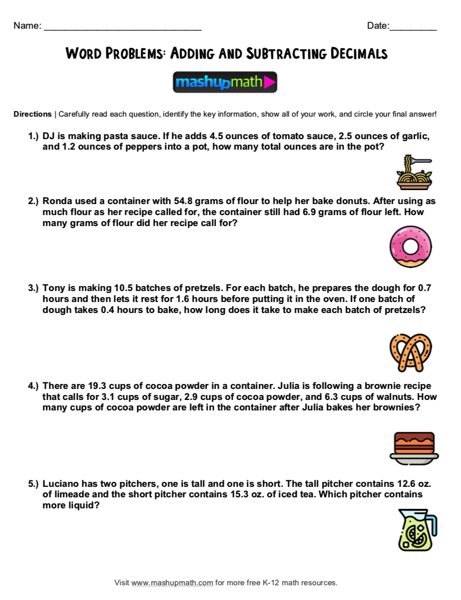
Free Multi-Step 4th Grade Math Word Problems PDF

Are you looking for engaging multi-step 4th grade math word problems with answers to add to your upcoming lesson plans? The following collection of free 4th grade maths word problems worksheets cover topics including addition, subtraction, multiplication, division, mixed operations, fractions, and decimals.

Students need to gain a strong understanding of place value in order to understand the relationship between digits and how these relationships apply to operations including addition, subtraction, multiplication, division, and more.


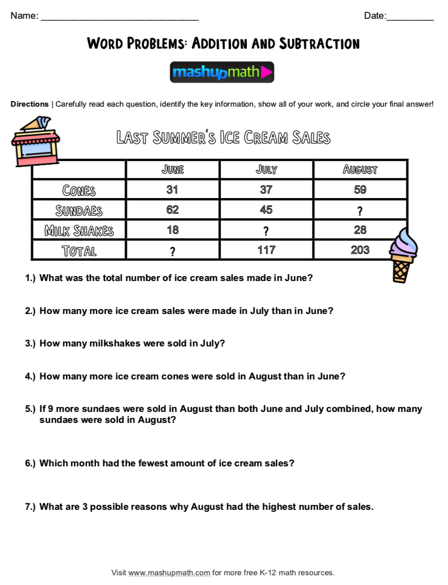
Mixed Addition and Subtraction 4th Grade Math Word Problems (PDF Download)

Click the link below to download your free 4th grade mixed addition and subtraction PDF worksheet and answer key.

free worksheet

Looking for more free 4th grade math worksheets? Click here to access our full PDF library.

Snip20190611_1.png

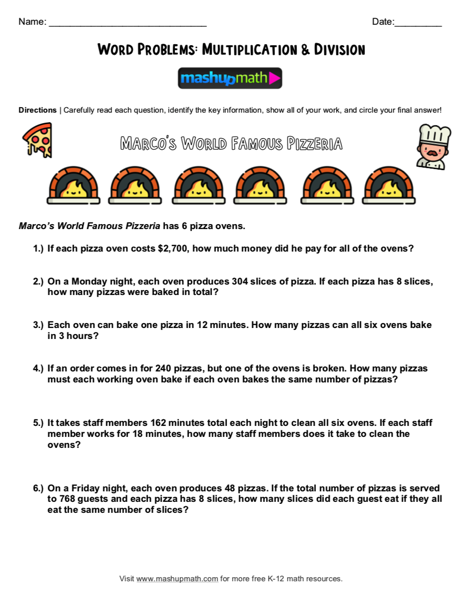
Mixed Multiplication and Division 4th Grade Math Word Problems (PDF Download)

Click the link below to download your free 4th grade mixed multiplication and division PDF worksheet and answer key.

Free worksheet

Looking for more free 4th grade math worksheets? Click here to access our full PDF library.

Snip20190611_2.png

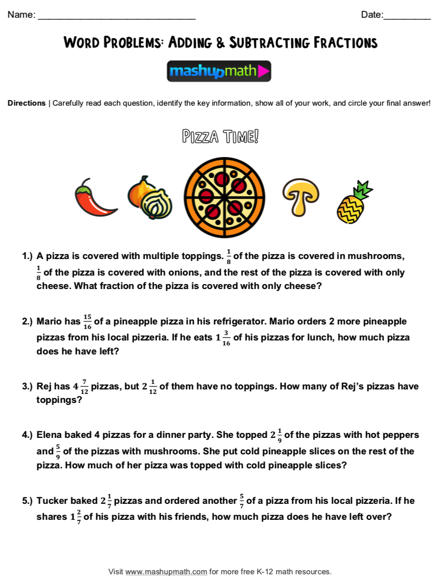
Adding and Subtracting Fractions 4th Grade Math Word Problems (PDF Download)

Click the link below to download your free 4th grade adding and subtracting fractions PDF worksheet and answer key.

FREE WORKSHEET

Looking for more free 4th grade math worksheets? Click here to access our full PDF library.

Snip20190611_3.png

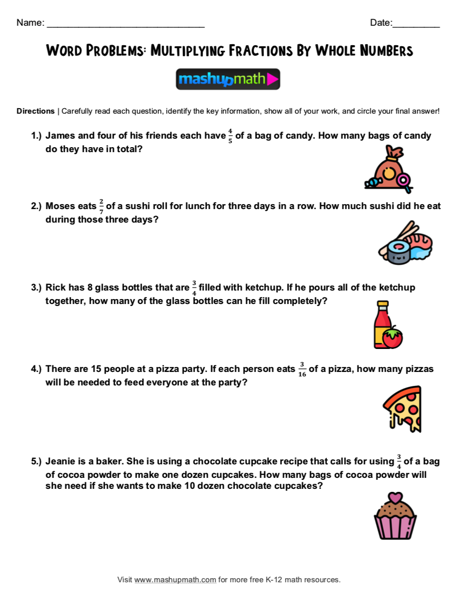
Multiply Fractions 4th Grade Math Word Problems (PDF Download)

Click the link below to download your free 4th grade multiplying fractions PDF worksheet and answer key.

Free Worksheet

Looking for more free 4th grade math worksheets? Click here to access our full PDF library.

Snip20190611_4.png

Add and Subtract Decimals 4th Grade Math Word Problems (PDF Download)

Click the link below to download your free 4th grade adding and subtracting decimals PDF worksheet and answer key.

Free Worksheet

Looking for more free 4th grade math worksheets? Click here to access our full PDF library.

Snip20190611_5.png

Do you have any questions or anything to add? Share your thoughts in the comments below.

(Never miss a Mashup Math blog--click here to get our weekly newsletter!)

NewBlogImage.png

By Anthony Persico

Anthony is the content crafter and head educator for YouTube's MashUp Math . You can often find me happily developing animated math lessons to share on my YouTube channel . Or spending way too much time at the gym or playing on my phone.

2 Comments

5 Effective Strategies for Improving Your Math Warm Up Activities

5 Comments

5 Effective Strategies for Improving Your Math Warm Up Activities

MathWarmUps.jpg

Are your daily math warm up activities engaging enough to truly capture your students’ focus?

The most effective lesson-opening activities (engagement hook, anticipatory set, warm-up, etc) do two things: assess your students’ prior knowledge and build anticipation for the lesson ahead.

Achieving this goal requires a solid mix of fun and engaging strategies and activity ideas (and rarely relying on assigning routine practice problems).

For some awesome tips and activity ideas for how to improve your warm up activities and make the most of the first five minutes of your lessons, check out my brand new list of effective strategies:


1.) Show a Video Clip

Some math concepts are meant to be seen, and sometimes your students will need visual aids to help grasp complex mathematical ideas. By starting class with a short video clip, you are engaging your students’ ability to think about math visually—a mindset which will sustain throughout the remainder of the lesson, to everyone’s benefit.

Try It! Try using the video clip of Unit Rates in the Real-World below prior to teaching a lesson on solving word problems involving unit rates.


Would you like FREE math resources in your inbox every day? Click here to sign up for my free math education email newsletter (and get a free math eBook too!)


2.) Puzzles and Challenges

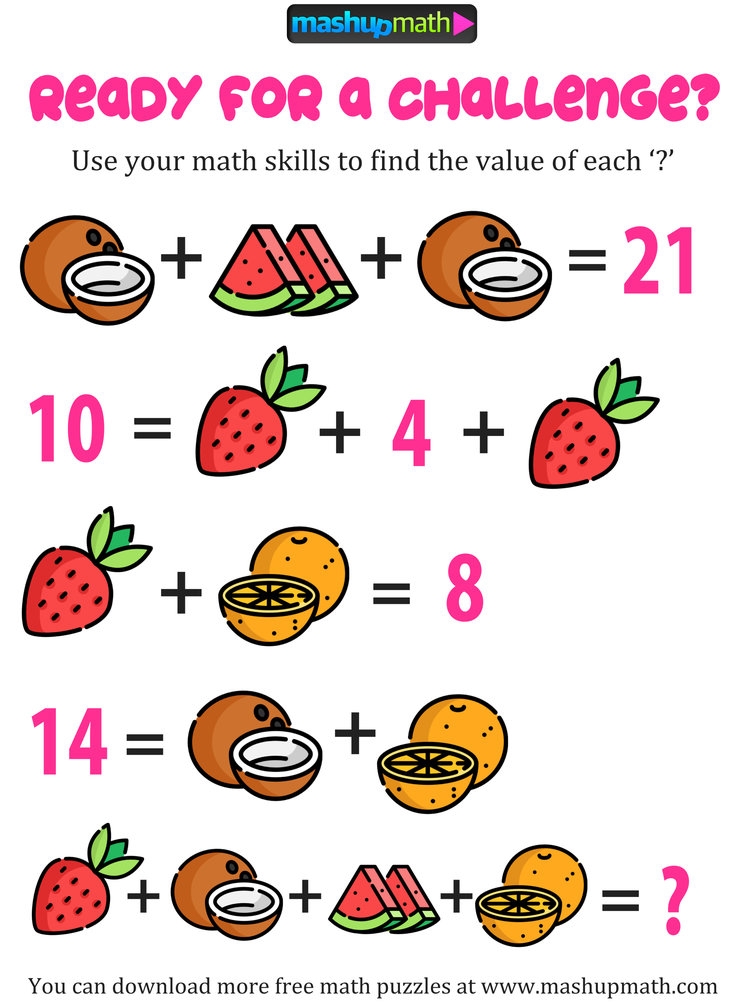
Engaging math challenges and puzzles are a great tool for giving your kids opportunities to have fun while problem solving and thinking mathematically at the same time, especially if you want to prevent them from growing bored of routine practice problems.

Try It! Try sharing this fun math puzzle with your kids at the start of your next lesson and watch your students’ engagement and interest skyrocket!

 
Fixed.jpg
 

Are you looking for more daily math challenges and puzzles to share with your kids?

My best-selling workbook 101 Math Challenges for Engaging Your Students is now available as a PDF download. You can get yours today by clicking here.

 
101C_NewAd.jpg
Get Your Math Puzzles
 

3.) Which One Doesn’t Belong? (WODB)

Instead of working on practice problems during a lesson's warm-up, students will be shown 4 somewhat related images and have to apply their reasoning skills to decide which of the images does not belong.

And here’s the catch….WODB activities do not have a single correct answer. The activity is designed to be interpreted in a variety of different ways in order to spark deep mathematical thinking and discussion (in small groups, whole class, or both).

Want to learn more about WODB and get more free samples? click here

Try It! Try using the WODB graphic below prior to a lesson on percentages.

 
Click here to get more free WODB graphics like this.

Click here to get more free WODB graphics like this.


Are you looking for more daily WODB? math graphics?

You can now share 101 daily WODB warm-up activities for grades 1-9 with your kids with our PDF workbook!

 
BookPlug-1.jpg
GET YOURS NOW
 

4.) Think-Notice-Wonder (Writing Prompt)

Writing about math encourages creativity, exploration, and communicating one's thoughts and feelings, which leads to deep and meaningful understanding of difficult math concepts.

Think/Notice/Wonder is a great strategy for getting your kids engaged in math writing every day.

Want to learn more about how to use TNW math activities with your kids? click here

Try It! Try using the graphic below before a lesson on solving equations.

GettyImages-514657035.jpg

Want more? Download 101 Daily Think-Notice-Wonder Writing Prompts for Engaging Your Kids

You can now share 101 Daily Think-Notice-Wonder Writing Prompts with your kids with our PDF workbook!

 
Plug2.jpg
GET YOURS NOW
 

5.) Two Truths and One Lie (2T1L)

2T1L activities help your kids to develop reasoning skills, make logical arguments, express their ideas in words, and engage with visual mathematics—which ultimately leads to deeper and more meaningful understanding of challenging topics and concepts.

Try It! Try using the 2T1L graphic below to start your next lesson! 

 
BTS_2T1L.jpg
 

Looking to Share More 2T1L With Your Kids This Year?

You can now share 101 Two Truths and One Lie Math Activities for Grades 3-5 with your kids with our PDF workbook!

 
BlogAd_2T1L.jpg
GET YOUR PDF DOWNLOAD
 

What strategies are you using to engage your kids during the first five minutes of class? Share your thoughts and suggestions in the comments section below!

(Never miss a Mashup Math blog--click here to get our weekly newsletter!)

By Anthony Persico

NewBlogImage.png

Anthony is the content crafter and head educator for YouTube's MashUp Math and an advisor to Amazon Education's 'With Math I Can' Campaign. You can often find me happily developing animated math lessons to share on my YouTube channel . Or spending way too much time at the gym or playing on my phone.

 
pin.jpg
 

5 Comments