Who Put Letters in Math?—Solved

Who Put Letters in Math?—Solved

Who Put Letters in Math?

Who Added Letters to Math and Why the Heck Did They Do That?
 

Who put letters in math?


We’ve all been there before. You’re sitting in math class staring at an equation that is filled with not only numbers (which are to be expected in a math equation), but freaking letters as well (what gives?). Feeling frustrated and confused, you can’t help but to scratch your head and wonder, “who put letters in math, and why?”

And now you’re here, looking to figure out exactly who put letters in math and why it is even necessary in the first place (this isn’t English class, after all).

While the concept of working with letters in math may seem silly, it is actually also pretty brilliant, given that the “invention” of using letters is a foundational part of the field of algebra.

So, who put letters in math? The bulk of the credit goes to one man. Are you ready to learn his name?

What Do Letters in Math Mean?

Before you learn about the man who added letters to math, it is important that you understand why letters are used in math and what they actually represent.

In math, letters, more commonly known as variables, are used to represent different values in various expressions and equations.

You can think of variables as place holders that represent unknown values or quantities and they are most prominently used in algebra. Without variables, you would not be able to form equations or solve problems!


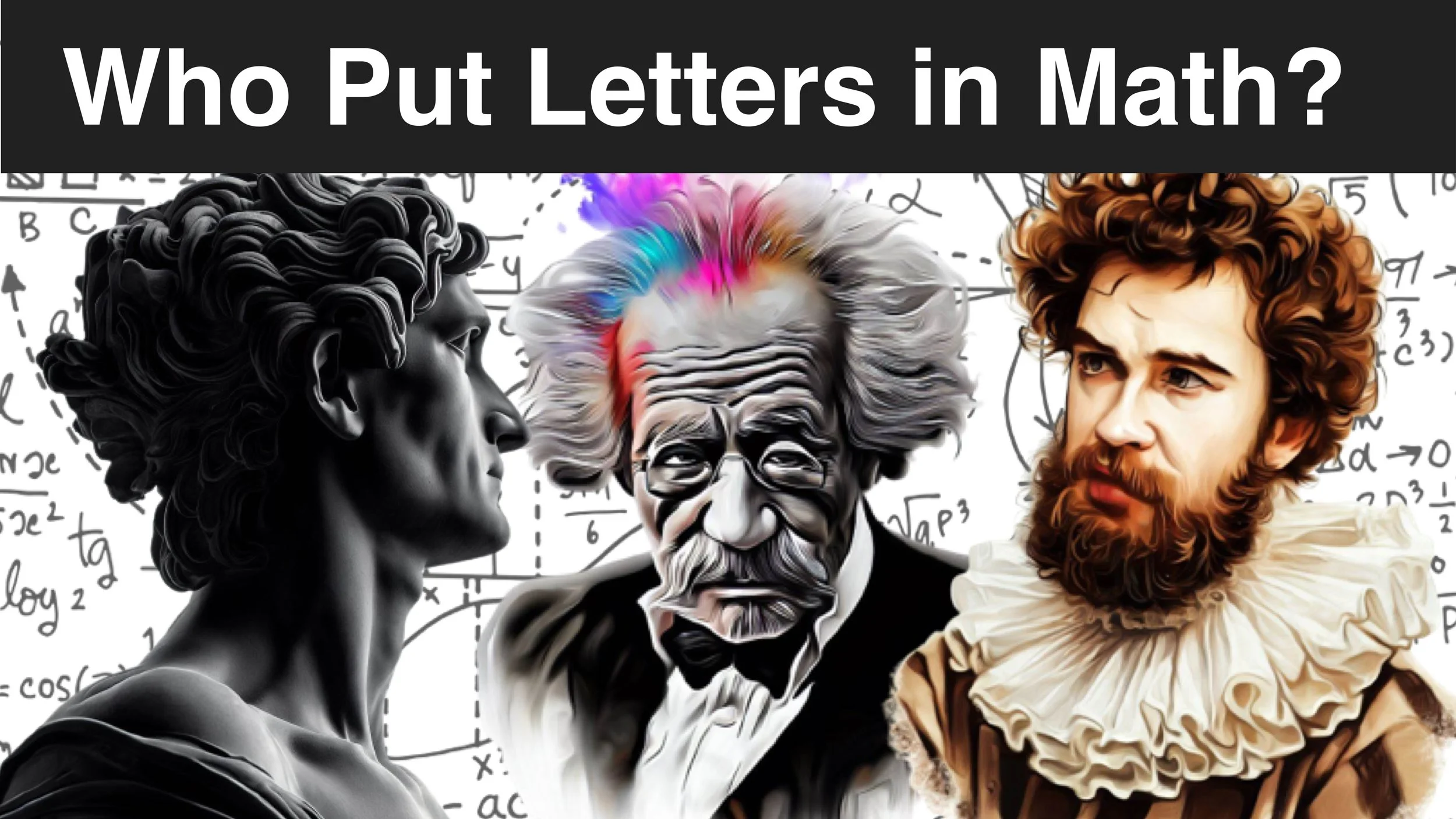
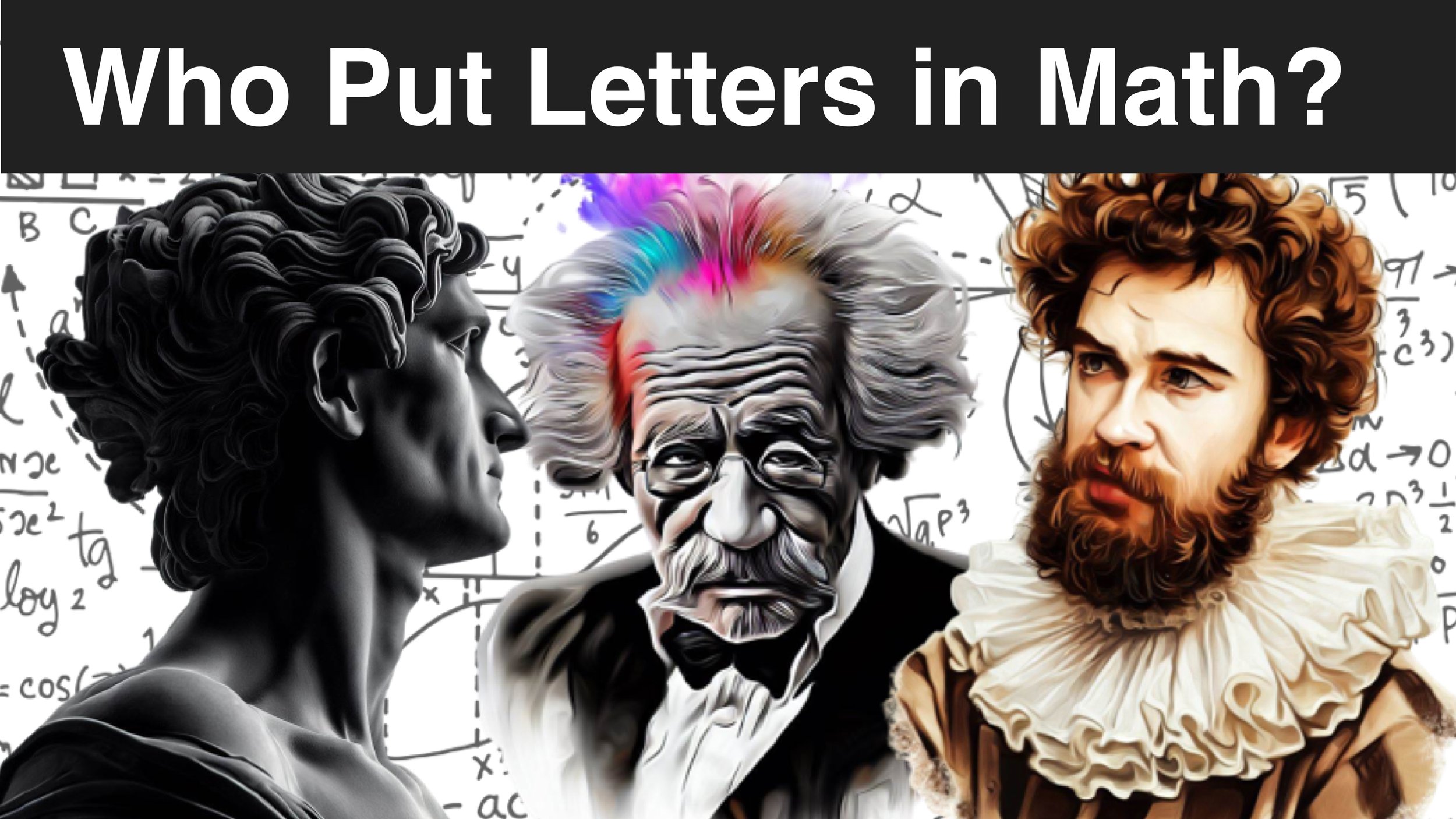
Diophantus of Alexandria is often credited as the Father of Algebra.


Who Put Letters in Math?

Answering this question will require a short tour through the history of math, starting in Ancient Greece. The first recored use of letters in mathematical equations and expressions is credited to the Ancient Greek mathematicians, most notably Diophantus of Alexandria, who is considered the “Father of Algebra.”

In his famous textbook Arithmetica, Diophantus used an abbreviated notation system and symbols to represent unknown quantities and values. And while his work put the field of mathematics on the path of including letters in math, Diophantus’ system of using symbols was very different from the algebraic notation that you are seeing in your math classes.

So, if it wasn’t Diophantus who added letters to math, who was it?

Who Put Letters in Math?

Answer: François Viète

Much later on, towards the end of the 16th century, a French mathematician named François Viète first introduced the concept of using letters to represent unknown numbers and quantities when solving math equations. Viète’s work truly revolutionized the field of algebra and algebraic notation. In his initial works, he developed a notation system where consonants were used to represent known quantities and vowels were used to represent unknown quantities. This system would gradually morph into the modern algebraic notation system that we use today.

Now that you have your answer, here are some fun facts about this relatively unknown 16th century French Mathematician:

  • Viète is most famous for being known as the first mathematician to use a letter-based algebraic notation system for solving equations, which laid the foundation for algebra as we know it today.

  • In addition to being a mathematician, Viète was an extremely talented codebreaker. He spent time serving as a cryptanalyst and decoding secret messages sent by rival nations for King Henry IV.

  • He was also a licensed private attorney and travelled all around France working as a lawyer. Viète would eventually become a respected legal advisor to the King.

  • Viète's famous algebra textbook, Canon Mathematicus, was not published until fourteen years after he died.

  • Viète also made major contributions to the field of trigonometry. Most notably, he developed a formula for the relationship between the angles and sides of any triangle, which is still used in modern mathematics and is known as Viète's Formula.
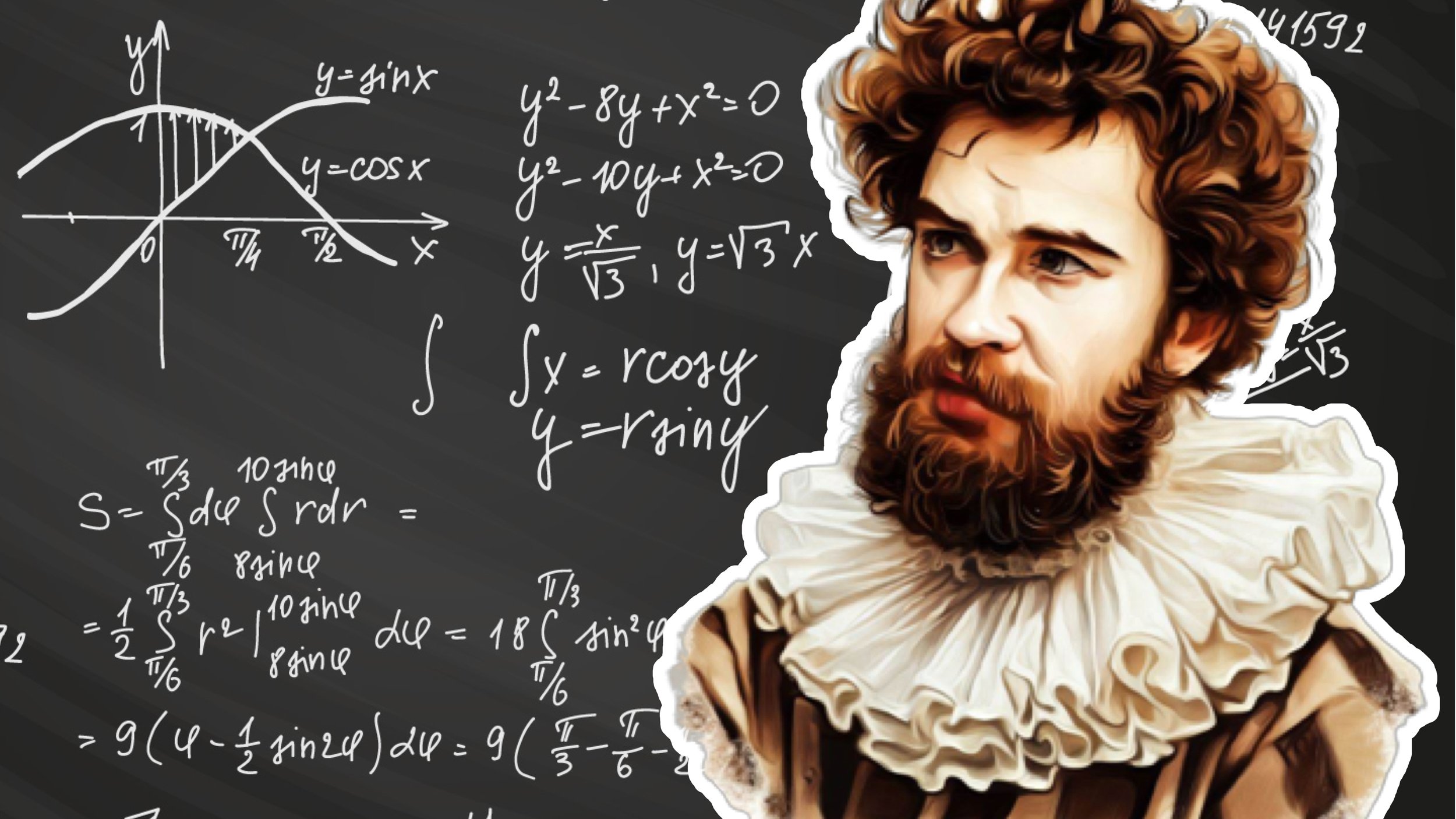
 

Who Added Letters to Math? 16th century French mathematician, François Viète, is credited as being the first to introduce the concept of using letters to represent unknown quantities.


Why Were Letters Added to Math?

Finally, now that you know who added letters to math, its important that you really understand why they were put there and why they are so useful in algebra.

The greatest impact of adding letters to math is that it made the subject more universal and accessible. Since math principles and theorems are universal, the use of letters as placeholders for specific values or inputs allowed mathematicians to represent general mathematical facts which are applicable to a wide range of values.

From a historical perspective, the introduction of using letters to represent unknown values in math equations was truly groundbreaking and it changed the field of mathematics forever. This revolutionary concept sparked the evolution of algebra from a field of study that was primarily focused on calculation to one of manipulation and generalization—which led to countless advancements and breakthroughs in the fields of science, technology, mathematics, and engineering.


Einstein’s famous theory of relativity equation, E=MC^2, would not be possible if not for the use of letters in math. Photo by Artturi Jalli on Unsplash


For example, consider Albert Einstein’s famous theory of relativity equation, E=MC^2.

In this famous equation involving mostly letters, E is used to represent energy, M is used to represent mass, and C is used to represent the speed of light. In a nutshell, Einstein’s equation states that mass (M) can be converted into energy (E) and vice versa. The concept itself is truly groundbreaking and it would not be possible without the use of letters in math.

As for being relevant to algebra students in the modern day who are not concerned with developing their own theories of relativity, it is important to know that letters in math allow you to simplify abstract and complex mathematical situations, making them much easier to conceptualize and solve. The use of letters in expressions and equations allows you to see patterns, make generalizations, and develop new problem-solving methods that are applicable to a vast array of scenarios and problems.

Conclusion: Letters in Math

It’s totally normal to be surprised and confused when you are first introduced to letters symbolizing values in math. Exploring who is responsible for adding letters in math as well the why behind their introduction has taken you on a journey through the history of math that ranges from Ancient Greece to 16th century France to the modern day. So, who put letters in math? In terms of crediting one person, the award goes to François Viète and his initial use of letters to represent quantities in algebraic expressions and equations. Without this contribution, algebra as we know it today would be a very different field of study.

More Free Resources You Will Love:

Who Invented Math? A Quick Explanation for Students

The history of math runs deep and spans across a variety of ancient cultures and civilizations, which leads many to wonder who invented math?

Let’s explore who gets the credit and why!

What is the Last Number?—Explained

What is the Last Number?—Explained

What is the Last Number?

To Infinity and Beyond: Is There a Final Number?


What is the last number? Photo by Mika Baumeister on Unsplash


When you were a child and learning how to count, values like 50 and 100 were considered large and perhaps, at that time, you wondered when you would be able to count from one all the way until the very last number, whatever that number may be.

And while “what is the last number?” is a seemingly simple question, the answer is actually extremely complex, controversial, and even philosophical.

Searching for an answer to the question “what is the last number?” will take you on a journey through the nature of numbers and the incredible concept of infinity. If you are ready to take this fascinating mathematical journey with us, continue reading as we will explore the concept of infinity, the largest known numbers known to man, and the idea of a “last number.”


What is the last number in the world? (Image: Mashup Math FP)


To Infinity and Beyond: What is the Last Number?

In math, any conversation about determining the “last number” will involve the concept of infinity.

In fact, many will say that infinity is the final answer to the question “what is the last number?” But, infinity isn’t actually a number. Instead, infinity is an abstract concept that describes a quantity that never ends and is unbounded. In math, you can think of infinity like a highway that goes on forever. No matter how far you travel along this highway, there will always be more road ahead.

With this in mind…

What is the last number?

Answer: There is no such thing as the biggest number or last number. Why? Because the concept of infinity exists.

Simply put, numbers continue on and on indefinitely and they never end. So, there could never be a final number.

Just like the highway that never ends, when we count numbers, no matter how high we go, there will always be another number that is larger than the number you have counted to. This idea is the very definition of the concept of infinity.

If I asked you to present me with the largest number you could think of, I could simply take that number and add one to it. And then you could take that number and add one more to it, and so on forever and ever!

Therefore, while infinity is not actually a number that can be counted, it is an abstract concept that represents the idea that numbers are infinite and that a last number can never be reached. And while infinity cannot be called the “last number,” it can be used to explain why a last number does not exist.


The concept of infinity: Imagine a highway that goes on and on forever in both directions. No matter how far you travel along this highway, there will always be more road ahead.

Photo by Amanda Sandlin on Unsplash


What is the Largest Number?

While there is no final number or last number, there are still some extremely large numbers out there.

Despite the infinite nature of numbers, mathematicians have identified many exceptionally large values and numbers. For example, a googol is a name for the value that starts with 1 and followed by 100 zeroes.

Mathematicians and scientists use the word googol to represent this value so they don’t have to ever write the number out in long-form, which would look as follows:

  • 10,000,000,000,000,000,000,000,000,000,000,000,000,000,000,000,000,000,000,000,000,000,000,000,000,000,000,000,000,000,000,000,000,000,000,000,000,000,000,000,000,000,000,000,000

And, because of the concept of infinity, we can not say that a googol is the last number, because numbers go on forever. Because of the nature of numbers, there also exists a googolplex, which is a 1 followed by a googol’s worth of zeroes (OMG!).

Do you want to see what a googolplex would look like written in long-form? Well, so would we, but this number is so big that there is actually not enough room in the observable universe to write out a googolplex in long-form, even if every digit were written in the smallest possible font (OMG!).

And even though a googolplex is so mind-bogglingly large that it exceeds the total number of atoms in the universe, it is still not considered the last number.

What is the largest number in the world?

While there is no last number, the largest number ever named is called Rayo’s Number.

Discovered in 2021 and named after Agustin Rayo, this value is considered the largest number that can be named with an expression using googol symbols.

However, despite being the largest named number, Rayo’s Number still can not claim the title of the
"last number in the world,” which further demonstrates why a final number does not exist.


What is the largest number in the world? Photo by Jeremy Thomas on Unsplash


What Would Happen if We Knew the Last Number in the World?

Now, let’s pretend that there actually was a last number and that our proverbial infinite highway of numbers did come to an end. What would this mean for math and human’s understanding of the world?

Simply put, the existence of a last number would change math and science as we know it forever. But how? For starters, it would completely change our understanding of the concepts of space and time, both of which depend on the concept of infinity and the never-ending nature of numbers.

While it’s fun to play with the question “what is the last number?”, it is even more interesting to think about why we are intrigues by this question in the first place. The answer is likely due to the human desire for completeness and closure (we are finite creatures after all).

But, what makes subjects like math and science so mysterious and awe-inspiring is there limitless nature and concepts that extend beyond the limits of human understanding. The concept of infinity and the never-ending nature of numbers gives the human mind access to a vast world of exploration, expansion, and possibilities.


What is the largest number? Exploring this question will not give you a definitive answer, but it will give you an appreciation for the mysterious nature of numbers and why mathematics is such a profound field of study. Photo by Alexander Sinn on Unsplash


Conclusion: What is the Last Number in the World?

While exploring the questions “what is the last number?” does not lead us to a definitive answer, it does take us down along a fascinating journey through the concept of infinite and the never-ending nature of numbers. This journey illuminates the magic of mathematics and the beauty of numbers.

Given the nature of infinity, there can be no last number because numbers never end and every value is followed by another forever and ever—stretching on towards the often incomprehensible concept of infinity,

And while many seek the final number out of curiosity and a human desire for closure, it is the fact that there is no final number that reminds us that it is the mysterious and never-ending nature of mathematics that makes the subject so profound, inspiring, and helpful to our understanding of the universe.


Keep Learning:

How to Get Infinity on a Calculator—Explained

How to Get Infinity on a Calculator—Explained

How to Get Infinity on a Calculator: Step-by-Step

Learn How to make infinity on a calculator in a few easy steps


How to Get Infinity on a Calculator: Is It Possible?


Are you trying to figure out how to get infinity on a calculator or what equals infinity on a calculator? In this short post, we will take a look at how you can work with and display infinity on a calculator.

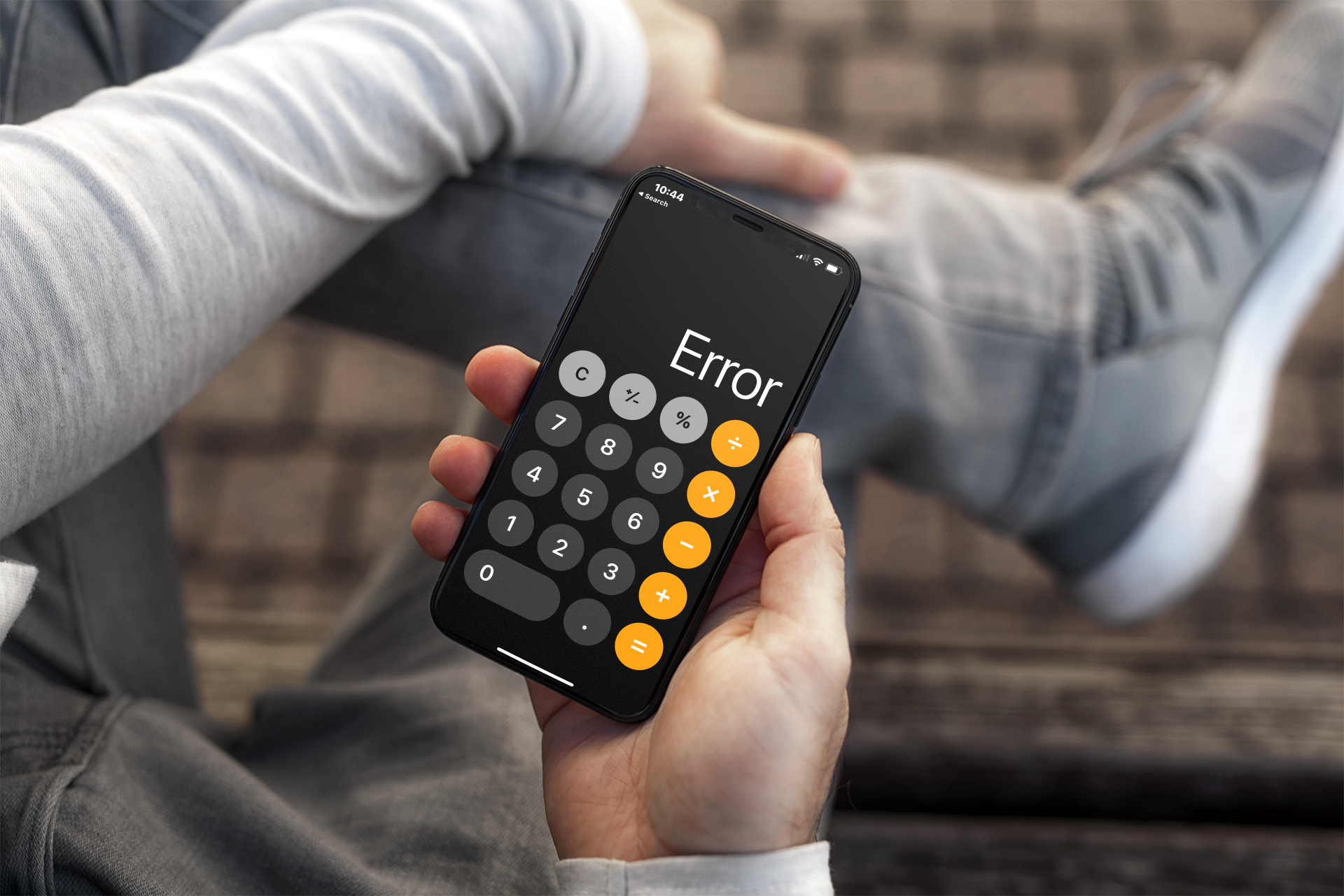
Before we move on, note that not all calculators are the same and that many of them can not accurately represent infinity due to a lack of computing power and/or display capabilities. When this is the case, you will often see an error message which means that the calculator is trying to display infinity, but is coming up short.


How to Get Infinity on a Calculator: Many calculators will display an error message instead of infinity. (Image: Mashup Math Placeit)


What is Infinity? (And What Does it Mean on a Calculator?)

Before you learn how to work with infinity on a calculator, it’s important that you understand the meaning of infinity in the context of math and making numeric calculations. Notably, infinity is not a number. Instead, it is a concept, meaning that infinity represents a quantity with no boundaries that is larger that any number the human mind can think of.

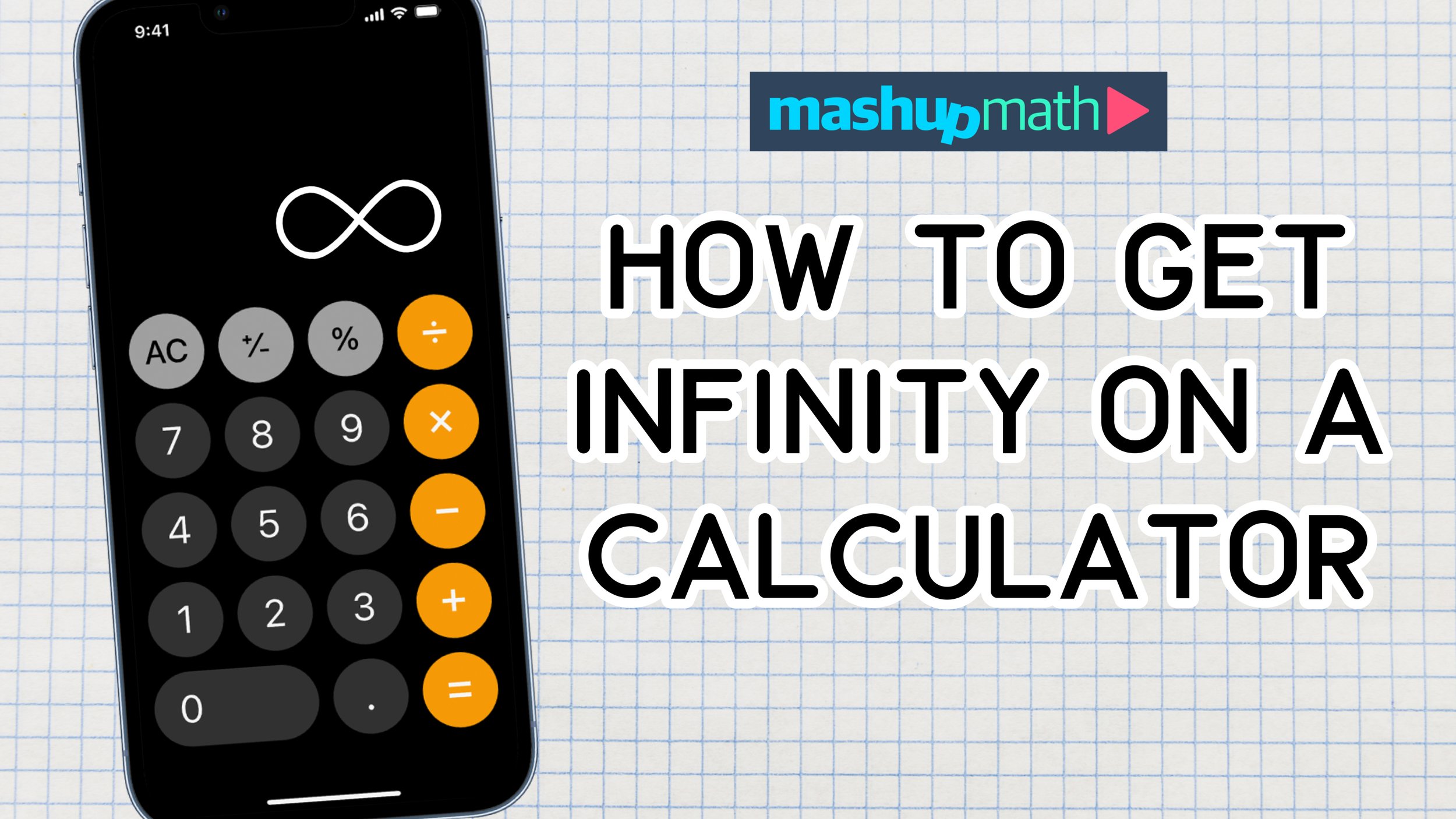
The ∞ symbol is commonly used in math to represent infinity, but many calculators can not display this symbol and you will rarely see an infinity button on a calculator. However, this does not mean that you can not get infinity on a calculator. Continue reading to find out why.

How to Get Infinity on a Calculator?

Okay, now you are ready to learn how to get an infinity on a calculator (and to see whether or not the calculator that you are using is capable of displaying infinity at all).

There are a few different ways to get infinity on a calculator, but the most common (and most simple) way to divide a number by zero.

As a general rule in math, any real number divided by zero is consider to be undefined.

In the case of dividing by zero, undefined and infinity both mean the same thing. The output depends on what type of calculator you are using.

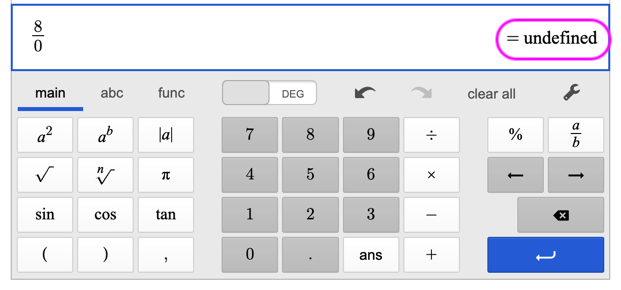
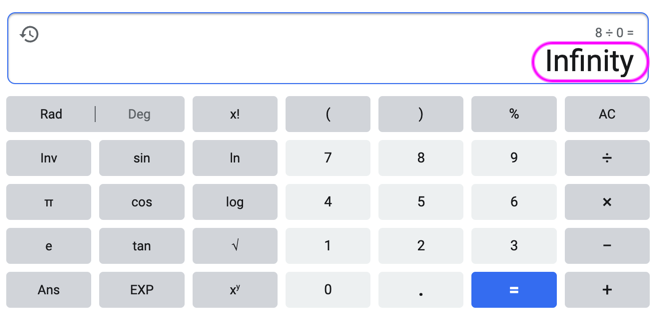
For example, lets consider the following calculation: 8 ÷ 0

We will be performing this calculation on three different calculators:

As you can see below, each calculator gives a different display output for 8 ÷ 0

iPhone Calculator

Error

Desmos Calculator

Undefined

Google Calculator

Infinity

So, we input 8 ÷ 0 into three different calculator and we received three different responses:

  • Apple iPhone Calculator: 8 ÷ 0 = Error

  • Desmos Scientific Calculator: 8 ÷ 0 = Undefined

  • Google Calculator: 8 ÷ 0 = Infinity

Given the three different answers, you may be wondering what equals infinity on a calculator?

Well, in terms on operations in math, any number divided by zero or any value that exceeds a calculators computing power limits essentially equals infinity. If the calculator can calculate infinity (like Google’s online calculator), then the output will be either the infinity symbol, ∞, or the word infinity.

However, most calculators can not show infinity and, rather, will show either the word undefined (like the Desmos calculator) or will show an error message (like the iPhone calculator).

What Equals Infinity on Advanced Calculators?

What equals infinity on a calculator? Photo by Jakub Żerdzicki on Unsplash

While most standard and scientific calculators can not display or perform operations involving infinity, there are more advanced calculators with high levels of computing power that do have the capacity to display infinity.

These advanced calculators have a wider range of functions and buttons, some of which include the infinity symbol.

For example, the popular TI-84 graphing calculator from Texas Instruments does not have an infinity button, but it does have the capability the make calculations involving infinity by inputting 1E99 (or -1E99 to specify negative infinity).

So, if you ever plan on making many complex calculations involving infinity, an advanced graphing calculator is a great tool to have.


Conclusion: How to Get Infinity on a Calculator

In math, infinity is an incredibly fun and interesting concept to explore. When it comes to making calculations, the steps for how to get infinity on a calculator depends on the calculator you are using and its computing power. But, even if your calculator can not display infinity or the infinity symbol, ∞, the presence of an error message or an undefined message often means that the answer is infinite.

So, the next time that you perform a mathematical operation on a calculator, such as dividing a number by zero, your calculator will push itself to its computational limits and give you an answer that either reads error, undefined, or infinity.

In all of these cases, your calculator has acknowledged the boundless and mysterious concept of infinity, which is pretty darn cool!


Infinity (Image: Mashup Math FP)


Keep Learning:

I Met a Man on the London Bridge Riddle—Answer and Explanation

I Met a Man on the London Bridge Riddle—Answer and Explanation

I Met a Man on the London Bridge Riddle: Solved

What is the answer to the famous ‘I Met a Man on the London Bridge’ Riddle?


I Met a Man on the London Bridge Riddle


A simple, yet surprisingly challenging, word riddle has recently been trending on the internet and many are struggling to find the solution. The riddle, which is shown below, gives you only three sentences and no picture. With this limited information, you must determine the mans name and win the guessing game.

If you want to try and solve the ‘I Met a Man on London Bride’ riddle on your own, carefully read the riddle below and play with it in your mind for a while until you figure out the answer. And, if you want to see the I Met a Man on the London Bridge Riddle Answer, keep scrolling down to the bottom of this post for a full explanation.

Now, let’s take a look at the riddle:

I met a man on London Bridge. He tipped his hat and drew his name and cheated at the guessing game. What was the man’s name?

At first glance, this famous riddle probably seems nonsensical. How can there possibly be enough information to determine the man’s name? We promise you that the riddle itself gives you enough information to figure out the answer, but it will surely take some mental effort to solve this one.

Again, if you want to try to solve the riddle on your own, pause now. Otherwise, continue reading to see the answer and explanation.

I Met a Man on the London Bridge Riddle Answer

Are you ready to learn the answer to the I Met a Man on the London Bridge riddle?

Answer: The man's name is Andrew.

The charm of this simple riddle lies in how it steers the reader down a literal path of interpretation, while actually hiding the answer in plain sight. The man’s name, which is Andrew, is hidden in the riddle itself (hence why we stated that no additional information was needed to solve the riddle). This type of misdirection is used in many riddles, including the famous Woman in a Boat riddle.

Additionally, the I Met a Man on the London Bridge riddle is extra tricky when you have the words read aloud to you, rather than reading them in written form.

Either way, the man’s name is included in the riddle in the line “he tipped his hat and drew his name.” The misdirection here is that the word drew is not a physical action, but actually a cleverly disguised nickname.

The name Drew is short for Andrew, so the answer to the riddle is that the man’s name is Andrew.


The man’s name, which is Andrew, is hidden in plain sight.

Photo by Kimber Nilsson on Unsplash


Conclusion

The I Met a Man on the London Bridge riddle is an awesome example of how a few simple statements can be used to bend and divert your assumptions and perceptions of meaning. The riddle uses our tendency to look for explicit information when solving problems against us by using misdirection.

In addition to being an enjoyable brain exercise, solving the I Met a Man on the London Bridge riddle reminds the reader that we often make assumptions and apply mental biases when solving problems, which can cause us to make simple problems more complicated than they need to be and overlook solutions that are often right in front of our face from the very start.

So, working on riddles like I Met a Man on the London Bridge is a great way to remind ourselves to approach solving problems with an open mind, to apply outside-of-the-box thinking, and to do your best to not allow presumptuous thinking to narrow your perspective.

Ready for Another Riddle?

There’s a woman in a boat on a lake wearing a coat, if you want to know her name it’s in the riddle I just wrote. What is the woman’s name?

Can you solve it? Click here to see the answer.

Keep Learning:

What is a Whole Number in Math?

What is a Whole Number in Math?

What is a Whole Number in Math?

What is a whole number in math, is 0 a whole number, and how can you tell if a number is a whole number or not?


What is a whole number in math?


Do you remember when you first started learning how to count? At this early stage, you likely used your fingers as a simple counting tool. One, two, three, four, and so on. While the days of counting on your fingers are likely long behind you, the journey that you began then has led you to this point, where you are ready to learn about whole numbers, what they are, and how they fit into the number system.

Before we dive into learning about whole numbers, lets quickly review the definition of a natural number so that you can understand the difference between a natural number and a whole number later on.

What is a Natural Number?

In math, natural numbers are the numbers that we use for counting and ordering values or amounts. The set of natural numbers starts at 1 and is as follows: { 1, 2, 3, 4, 5, 6, 7, 8, 9, 10, 11, 12, 13, 14, 15, …}

Natural numbers are sometimes referred to as counting numbers. Notice that the set of natural numbers does not include 0, fractions/decimals, or negative numbers.

We can visualize the natural numbers on a number line as shown in Figure 01 below:


Figure 01: What is a Natural Number?


What is a Whole Number?

Now that you know what a natural number is, you can extend that understanding to whole numbers.

In math, whole numbers are a set of numbers that includes all of the natural numbers as well as 0.

The set of whole numbers starts at 0 and is as follows: { 0, 1, 2, 3, 4, 5, 6, 7, 8, 9, 10, 11, 12, 13, 14, 15, …}

Notice that, just like the set of natural numbers, the set of whole numbers does not include fractions/decimals or negative numbers.

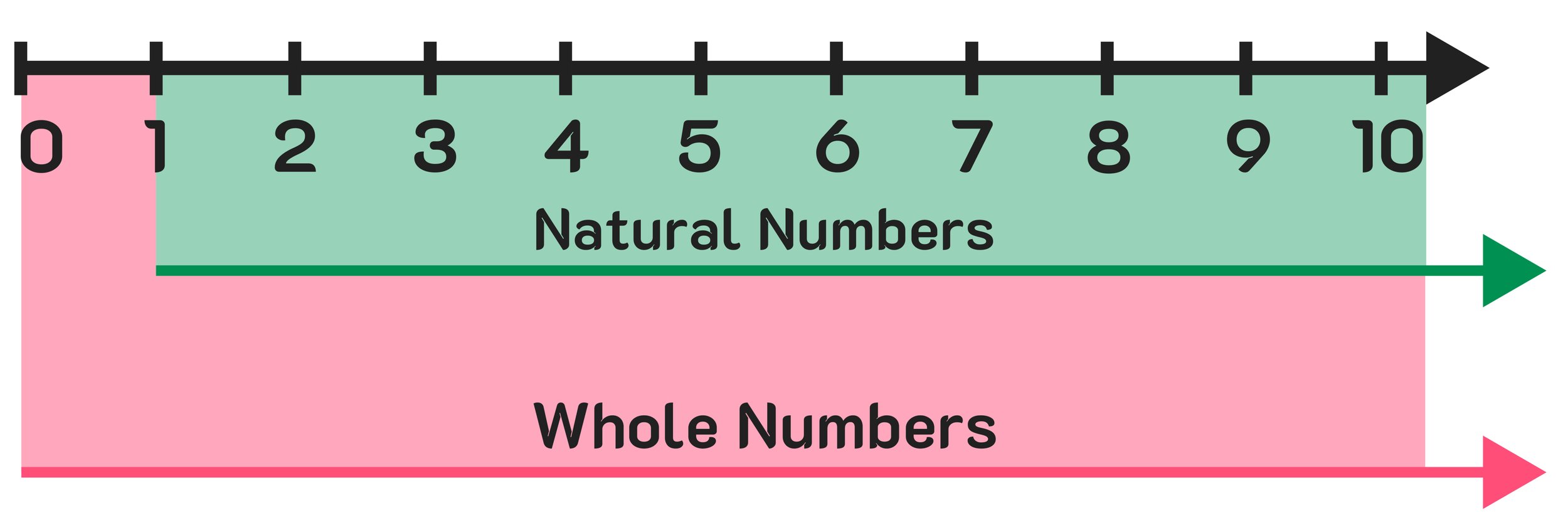
We can visualize the whole numbers compared to the natural numbers on a number line as shown in Figure 02 below:


Figure 02: What is a whole number?


Simply put, the set of whole numbers is just the entire set of natural numbers with zero included.

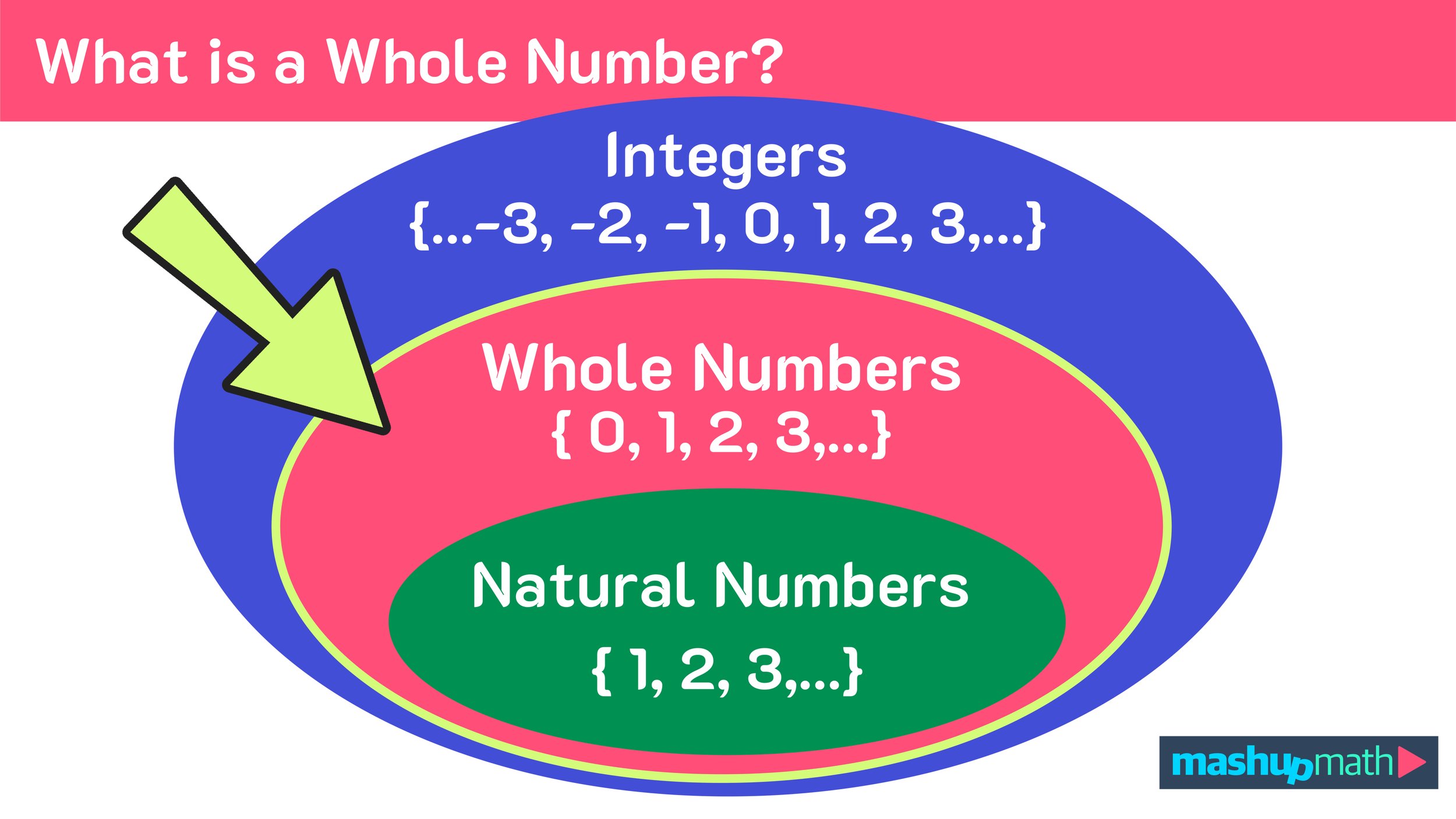
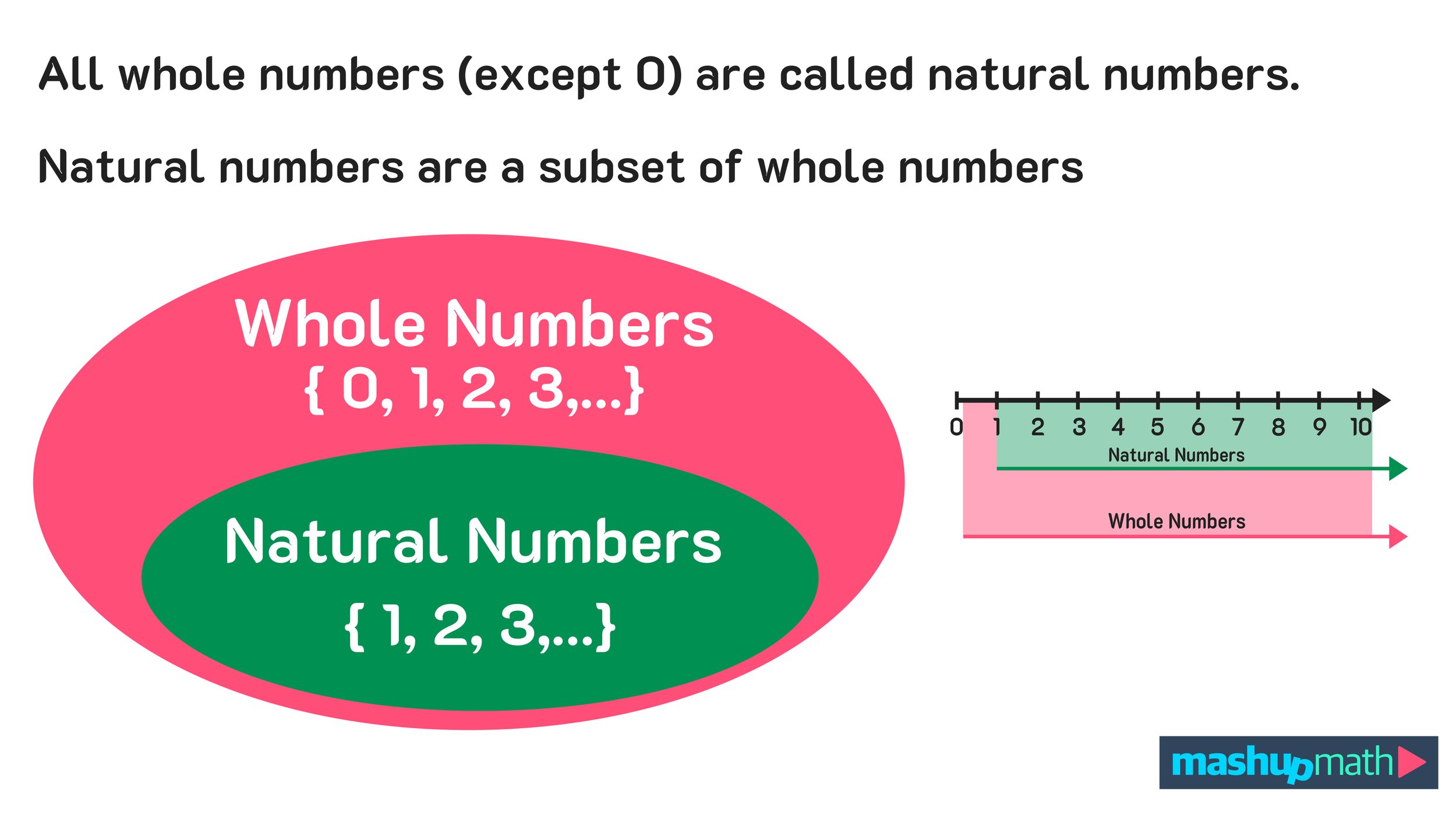
With this in mind, we can say that the set of natural numbers is a subset of the set of whole numbers, which is why the diagram in Figure 03 below is often used to demonstrate this relationship.


Figure 03: Natural numbers are a subset of whole numbers. All whole numbers (except zero) are natural numbers too.


The Role of Zero: Is 0 a Whole Number?

Next, let's explore commonly asked question regarding whole numbers: Is zero a whole number? The answer to this quest is yes!

Zero is a whole number.

When it comes to the universe of numbers (and its subsets), the value zero is important because it represents a quantity of “nothing” or an empty set. In the case of whole numbers, zero is the dividing point that separates the positive numbers from the negative numbers (since zero is neither positive or negative).

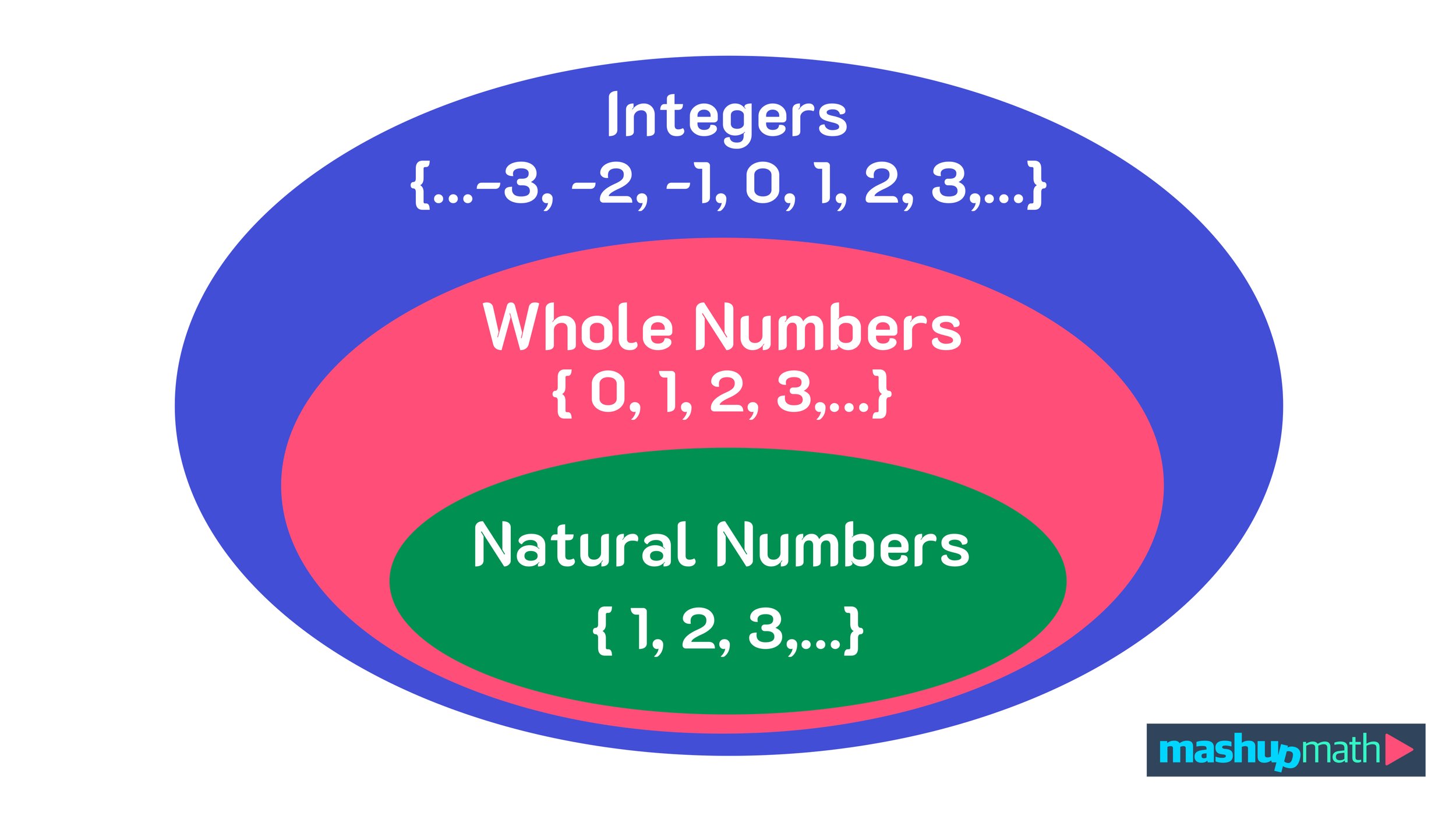
As you continue to study the universe of numbers, you will continue to consider negative numbers and the set of integers, which includes all zero, all of the natural numbers, and their negative counterpart.

The set of integers in comparison to whole numbers and natural numbers, as well as the role of zero, is shown in Figure 04 below.

The set of integers does not include any values with fractional or decimal part. It does not have a starting point and is as follows {…,-5, -4, -3, -2, -1, 0, 1, 2, 3, 4, 5,…}

Figure 04: Is zero a whole number? Zero is a whole number and an integer as well.

Figure 05: Whole numbers and natural numbers are subsets of integers.

Examples of Whole Numbers

Now you are ready to extend your understanding of whole numbers to a few examples with real-world context:

  • Example #1: The number of members in the chess club. You can’t have a fraction of a person or a negative person as a member of a club, so the number used to describe the number of members will always be a whole number such as 7 or 12. And, of course, if nobody joins the chess club, you could say that there are zero members.

  • Example #2: The amount of marbles in a bag. You can’t have a fraction of a marble or a negative marble, so the number used to describe the amount of marbles in a bag will always be a whole number such as 22 or 60. And, if the bag is empty, you could say that the amount of marbles is zero.

  • Example #3: The number of cars for sale at a dealership. Again, it is not possible to have a fraction of a car or a negative car, so the number of cars for sale will be a whole number such as 5 or 116. If all of the cars are sold and there is nothing for sale at the dealership at any point in time, then the amount of cars for sale can be zero.


Figure 07: Whole Numbers in the Real-World: The number of cars available for sale at a dealership will always be a whole number such as 25 since it’s impossible to have a fraction of a car or a negative car and the amount of cars available can be zero if the lot is empty. Photo by Alex Suprun on Unsplash


Conclusion: What is a Whole Number in Math?

In math, the universe of numbers can be broken into several subsets.

The most basic of these subsets are the Natural Numbers (also known as counting numbers), which related to elementary finger counting as follows: {1, 2, 3, 4, 5, …}.

Whole numbers are a set of numbers that includes all of the natural numbers as well as 0.

Unlike the set of natural numbers, which starts at 1, the set of whole numbers starts at 0 and is as follows: { 0, 1, 2, 3, 4, 5, 6, 7, 8, 9, 10, 11, 12, 13, 14, 15, …}. Whole numbers can not be fractions or negative.

The set of whole numbers is just the entire set of natural numbers with zero included and we can say that the natural numbers are a subset of whole numbers.

While not a natural number, zero is a whole number and it plays an important role in the universe of numbers as a divider/boundary between the positive numbers and the negative numbers.

This understanding of whole numbers will help you as you continue on with your study of real numbers and their subsets, especially your next likely destination: integers.


More Free Resources You Will Love:

Why Am I So Bad at Math? (And How to Get Better)

If you are wondering, why am I so bad at math? The fault is likely due to you having a fixed mindset for learning, which is often a product of being negatively affected by harmful misconceptions about your ability to learn math.