10 Free Maths Puzzles with Answers!

Comment

10 Free Maths Puzzles with Answers!

10 Fun (and Free) Maths Puzzles with Answers

A Post By: Anthony Persico

Are You Ready for These Super Fun (and Slightly Brain-Bending) Maths Puzzles?

Every month, thousands of individuals, young and old, search the internet for maths puzzles with answers. Why? Because working on challenging and engaging maths puzzles is more than just a recreational activity. In fact, studies show that working on maths puzzles has several educational benefits including boosting interest in mathematics, improving problem-solving skills and algebra skills, and cultivating reflective learning abilities.

So, if you’re one of these individuals looking to reap the benefits of working on challenging maths puzzles (while having some serious fun while doing so), then you’re in the right place!
MathsPuzzle.jpg

Now that you know the benefits of challenging your mind by trying to solve maths puzzles, you’re just about ready to try and solve today’s collection of super fun maths riddles.

Note that these maths riddles with answers are appropriate for individuals ages 12 and up.

Before you get started, here are a few tips to keep in mind when attempting to solve any of today’s maths puzzles:

  • Read every maths puzzle carefully and allow yourself to think for a bit before getting started.

  • Use proven strategies like visualizing, diagram drawing, and trial-and-error.

  • You’re going to struggle! When you find yourself feeling discourages and/or messing up, that means you are in the process of reaping the benefits of solving maths puzzles and improving your problem-solving skills!

  • Whenever you find an answer, ask the question “does this solution make sense?”

  • If at any time you get stuck, close the page and take a break. This is a good time to take your mind off of the problem by doing something else like going out for a walk. The puzzle will likely become more manageable when you revisit it later on.

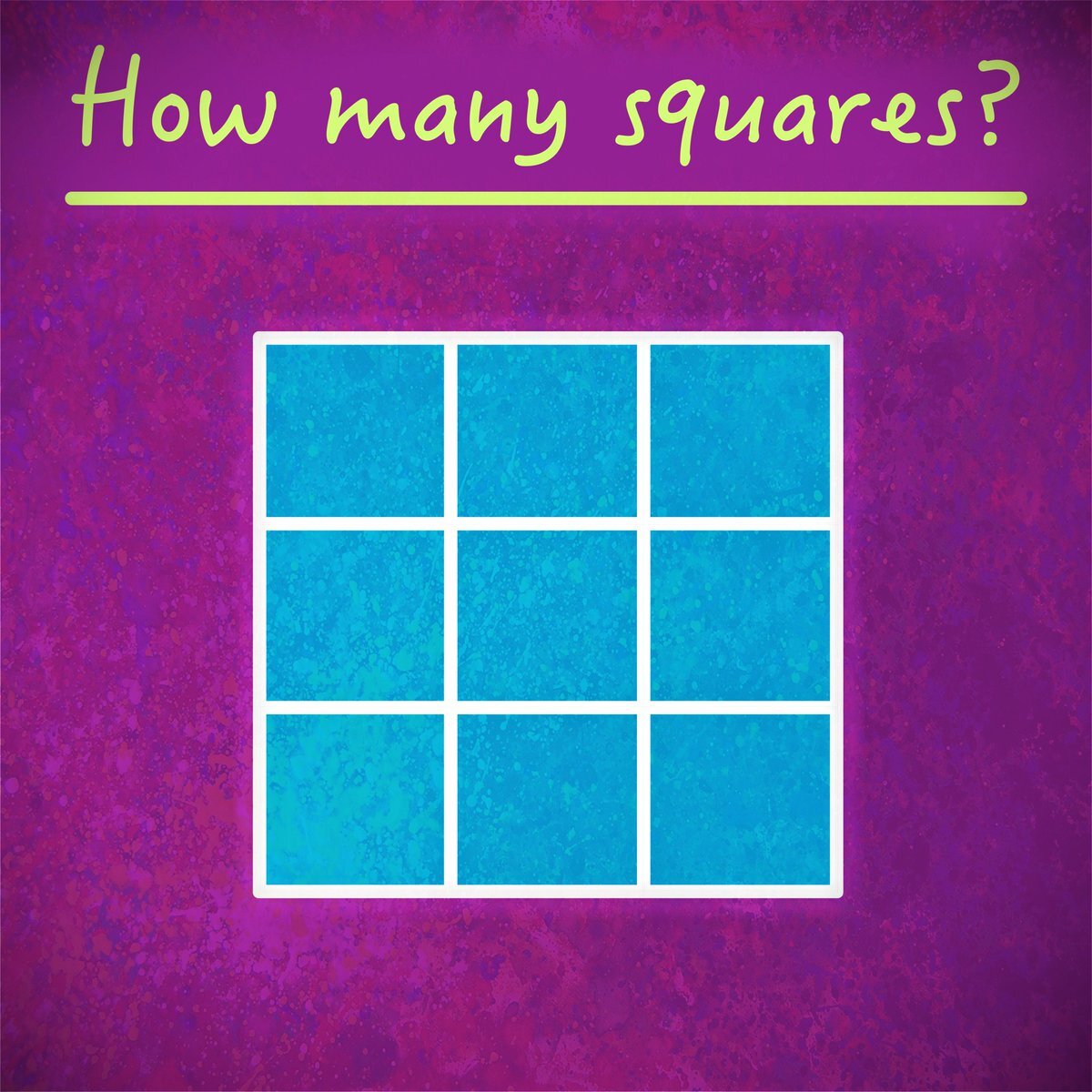
Practice Problem: How Many Squares?

Before you attempt the 10 Maths Puzzles with Answers on your own, you may want to get warmed-up with a relatively easy maths puzzle just to get your brain fired up and ready for some more challenging problems later on.

Of course, you can choose to continue on and skip this practice problem if you’d like.


Here is the problem:

How many SQUARES are in the 3x3 grid?

How to solve:

This is a relatively straightforward maths puzzle to solve, provided that you consider two pieces of information:

  • A square is a plane figure with four equal sides and four right angles.

  • Some squares are overlapping in the diagram.

Want to try the problem on your own? If so, don’t go any further. Stop here and try to solve the puzzle and come on back when you’re finished.

The most common way to solve this problem is to consider all the squares, from smallest to largest, and count them as follows:


Final Answer: 14 Total Squares

Wasn’t that fun? Now you are ready to move onto some more challenging maths puzzles!


10 Fun Maths Puzzles with Answers

Each of the following math puzzles with answers includes an image graphic. Click on any image to enlarge. The complete answer key for all 10 maths puzzles is included at the bottom of the page.

Have fun!

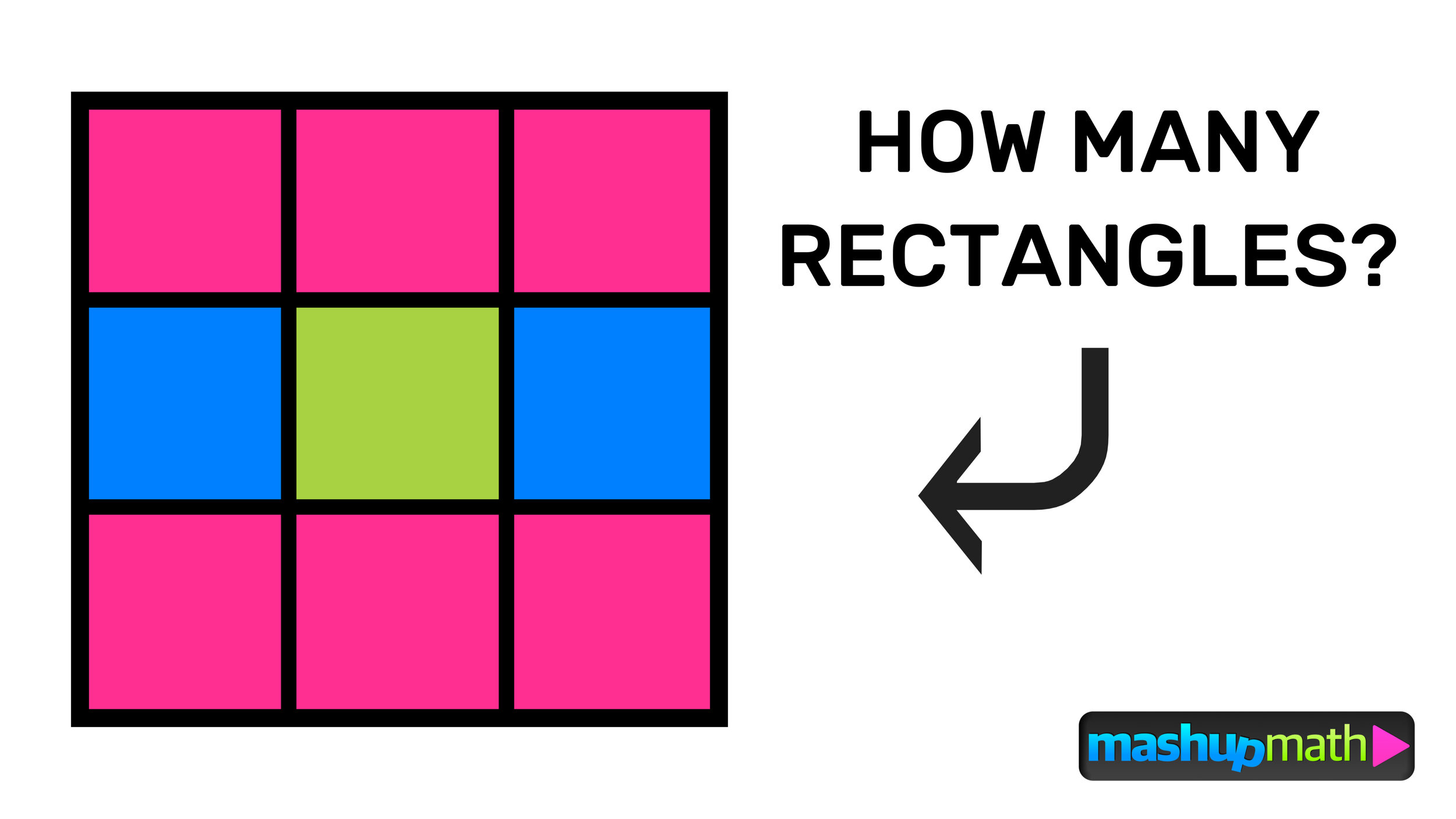
1.) Maths Puzzles 01 of 10: How Many Rectangles?

This problem may seem very similar to the practice problem, but the subtle difference between Squares and Rectangles is a very big deal that makes this problem rather tricky. (Click here to learn more about this controversial maths puzzle)

Can you solve it?

(Hint: By definition, is a square a rectangle?)


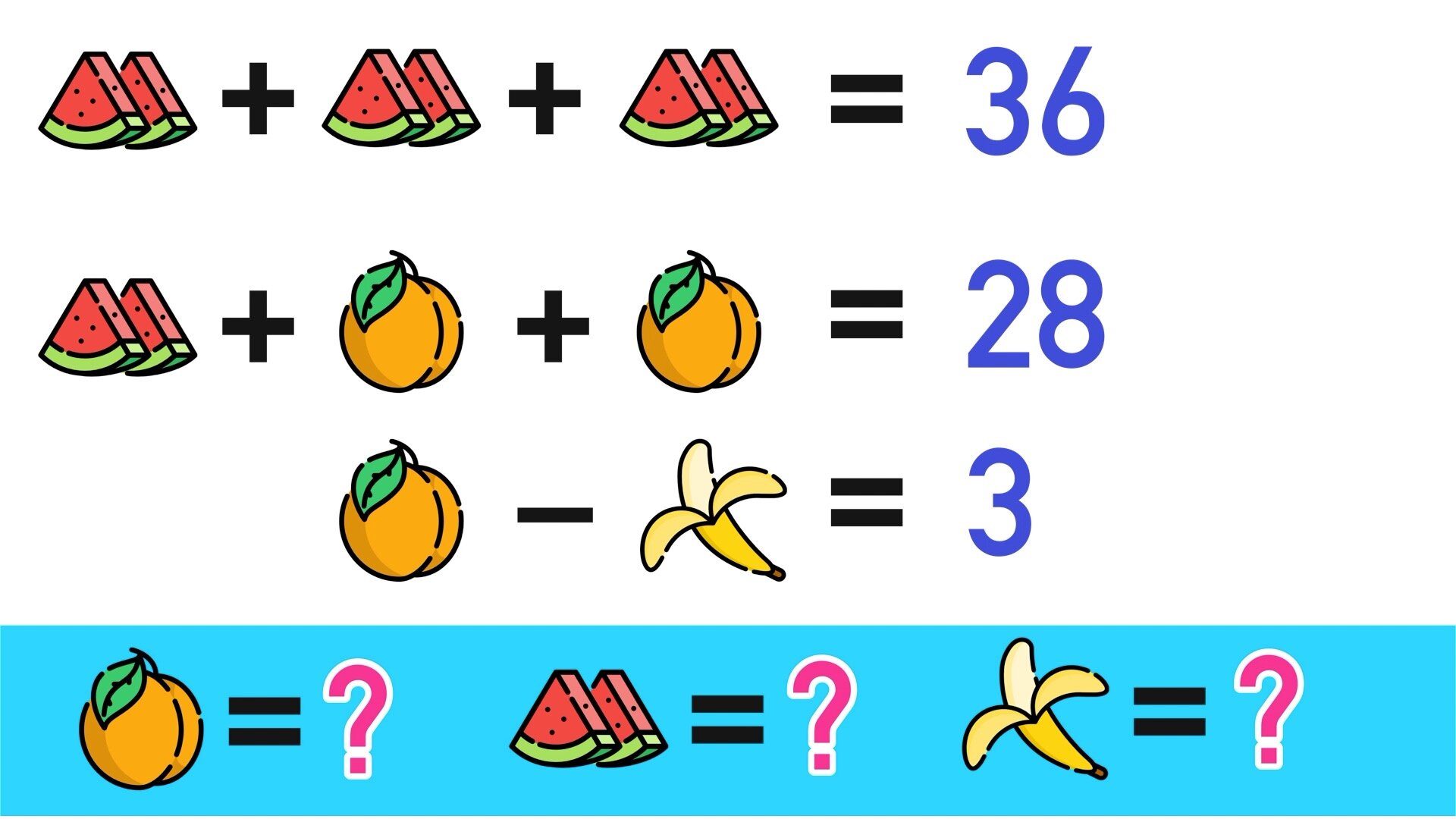
2.) Maths Puzzle 02 of 10: Factors and Fruit

Problem: If each piece of fruit in the diagram below is equal to one of the following numbers: 1, 2, 3, or 5, then what is the value of each fruit so that both equations are true?


3.) Maths Puzzle 03 of 10: Moon Math

Problem: What is the value of the missing number “?” in the lunar diagram below?


Hint: Look for a pattern.


4.) Maths Puzzle 04 of 10: Which is More Pizza?

Problem: Which deal gets you the most pizza (if each deal costs the same amount):

  • One 18” pizza pie, or

  • Two 12” pizza pies

Can you solve it?

maxresdefault (1) copy.jpg

Use the area of a circle formula: A= π(r^2)


5.) Maths Puzzle 05 of 10: Super Maths!

Problem: Find the value of each symbol and the ‘?’ in the puzzles below:

Puzzle 1

Puzzle 2

Puzzle 3


Are you looking for more super fun Maths Riddles, Puzzles, and Brain Teasers?

The best-selling workbook 101 Math Riddles, Puzzles, and Brain Teasers for Ages 10+! is now available as a PDF download. You can get yours today by clicking here.
 
Get Yours Now
 

6.) Maths Puzzle 06 of 10: How Many Triangles

Problem: What is the total number of triangles in the diagram below?


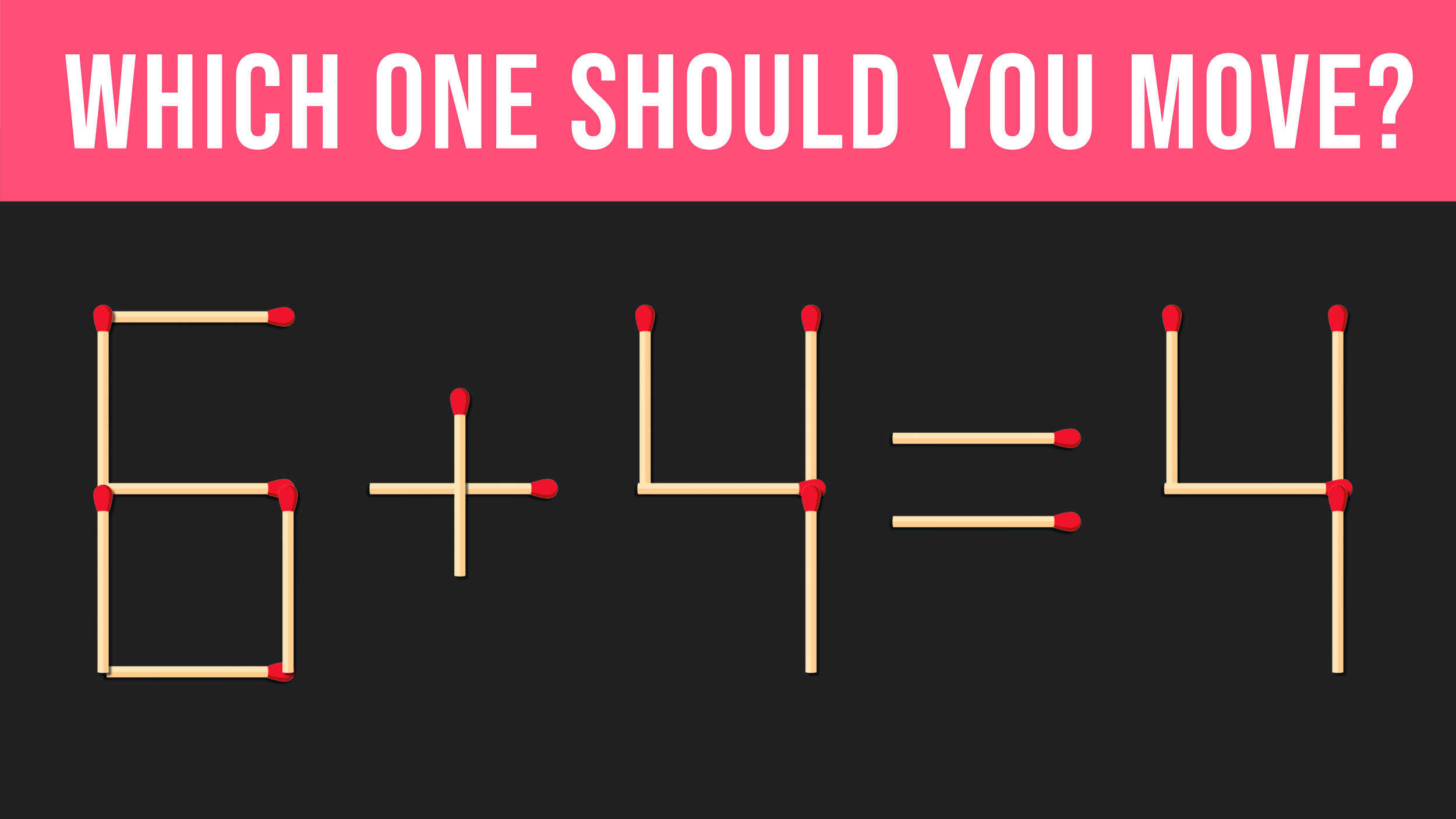
7.) Maths Puzzle 07 of 10: Matchsticks Maths

Problem: Make the maths equation true by moving ONE AND ONLY ONE matchstick?

(*Bonus if you can find all three possible answers)

See Also: video tutorial on solving the matchstick maths problem.
Move copy.jpg

8.) Maths Puzzle 08 of 10: How Many Total Handshakes?

Problem: If there are 20 people in a room and they shake every other person’s hand once and only once, how many handshakes would take place?

Handshakes.jpg

9.) Maths Puzzle 09 of 10: Shopping Spree!

Problem: At the mall, the total cost of a pair of shoes and a hoodie is $150. The cost of the hoodie is $100 more than the cost of the pair of shoes. How much does each item cost?


10.) Maths Puzzle 10 of 10: Parking Lot Puzzle

Problem: In the diagram below, what is the number of the parking spot occupied by the car?


11.) Bonus Maths Puzzle! : The Big Triple!


MATHS PUZZLES ANSWER KEY:

  1. 36 Total Rectangles (click here to learn more about how to solve this problem)

  2. Melon=5, Apple=2, Grapes=3, Lemon=1

  3. ?=8 (the relationship between the diagonals are cubes and cube roots)

  4. Area of 18” Pizza: ~254.3 square inches > Area of two 12” pizzas: 226 square inches

    (click here to learn more about how to solve this problem)

  5. Puzzle #1: DK=12, Bananas=8, Barrell=4, ?=24

    Puzzle #2: Mario=12, Peach=12, Toad=6, Bowser=0, ?=30

    Puzzle #3: Van=8, Zombie=9, Scooby=5, ?=77

  6. 27 Total Triangles

  7. 8-4=4, 5+4=9, 0+4=4 (Here is a great video explanation)

  8. 190 handshakes (19+18+17+16+...+3+2+1=190)

  9. Hoodie costs $125, Shoes cost $25

  10. 87 (click here to learn how to solve this problem)

11. (BONUS!) 1+2+3=6 and 1 x 2 x 3 = 6

Click here to sign up for our math education mailing list to start getting free K-12 math activities, puzzles, and lesson plans in your inbox every week!


Do YOU Want More Fun Math Riddles, Puzzles, and Brain Teasers?

Check out our math riddle videos on YouTube!


Did I miss your favorite math riddle for adults? Share your thoughts, questions, and suggestions in the comments section below!

(Never miss a Mashup Math blog--click here to get our weekly newsletter!)

By Anthony Persico

Anthony is the content crafter and head educator for YouTube's MashUp Math and an advisor to Amazon Education's 'With Math I Can' Campaign. You can often find me happily developing animated math lessons to share on my YouTube channel . Or spending way too much time at the gym or playing on my phone.

You Might Also Like…
 
NewPin05.jpg
NewPin07.jpg

Comment

We Spent All Morning Working on This Rectangle Math Puzzle. Can You Solve It?

5 Comments

We Spent All Morning Working on This Rectangle Math Puzzle. Can You Solve It?

The controversial real answer is finally revealed. Can you solve it?

A Post By Anthony Persico

Title.jpg

It’s no secret that we are obsessed with math riddles, puzzles, and brain teasers here at Mashup Math. Why? Because there are not many better feelings in life than finally reaching an aha moment after mulling over a brain-bending math brain teaser for a while (sometimes hours!) and figuring out the correct answer.

Like most math fans, we love problem-solving, and, like most math fans, we can be rather hardheaded when it comes to believing that our answer is correct and that any other answer is obviously wrong.

So, it was no surprise that a seemingly simple yet controversial math puzzle forced us to drop everything we were doing and spend an entire morning arguing about who had found the elusive right answer.

We have been sharing the rectangle math riddle with math fans for a while—well, sort of. The original math puzzle was nearly identical, except that it asks How Many Squares? (Not How Many Rectangles). This problem, shown below, is not too difficult to solve and it is appropriate for students at the elementary levels and above.

The Original Problem: How Many Squares?

When squares are involved, most people can figure out that the answer is 14 total squares.

(Hint: if you are unsure of how to solve the Squares Problem, remember that some of the squares are overlapping).


14 Total Squares

 
DSj7YRFU0AASzCr.jpg

But What If I asked How Many Rectangles?

The How Many Squares Problem? is relatively simple and easy to solve. So, why does replacing Squares with Rectangles cause so much controversy?

This craziness all started when I received a text from a friend asking me if I had a quick math puzzle that I could send her to share with her son, a 4th-grade student, to try and solve before bed. With the How Many Squares? puzzle in mind, I quickly sketched the puzzle on a piece of lined paper using a Sharpie, took a picture with my phone, and sent it over to her. And, since I already had the picture, I also tweeted it out to all of our followers and went on with my evening.

This was the Tweet that launched a thousand different answers:

It wasn’t until the next morning that I saw that the tweet had over 200 replies and that I had accidentally asked How Many Rectangles? instead of How Many Squares?

And so, the controversy began.

Dozens of different solutions were being shared and several arguments breaking out.

I could have spent my entire day reading Twitter replies, but instead, I shared the puzzle with some friends who happen to be self-proclaimed Geometry wizards to see if there was a consensus solution. And I myself was on a quest to figure out why such a seemingly simple math puzzle had caused so much controversy.

Want to try the problem on your own? If so, don’t go any further. Stop here and try to solve the puzzle and come on back when you’re finished.

giphy.gif

Gee, that was pretty quick! Are you ready to see the solution?

Unlike many popular math riddles and brain teasers that are purposely ambiguous and can have multiple answers, this math puzzle has one single, undeniable answer, and it’s 36 total rectangles.

Before we look at why 36 is the solution, let’s take a look at some of the most common responses on Twitter:

As you can see, there is a wide variety of answers and only a small percentage of people found the correct answer.

Some people even went as far as to claim that there are actually zero rectangles and blamed my inability to draw straight lines freehand…

Snip20210108_19.png
Snip20210108_18.png
 

I'll be sure to use a ruler next time.

Anyways, here is one more notable Tweet that will launch our discussion into why the actual answer is 36 rectangles:

Snip20210108_22.png
 

How to Solve the Rectangles Math Riddle

Miri’s tweet is notable because she draws attention to a very important math fact that many people are forgetting or unaware of—that a square is a rectangle.

What!?

It’s true. By definition, a rectangle is a plane figure with four straight sides and four right angles, especially one with unequal adjacent sides.

And a square certainly fits this definition. In fact, a square a special kind of rectangle (check out the Is a Square a Rectangle? video below for a more in-depth explanation.


Now that we know that a square is a rectangle, we can use the same approach to How Many Squares? problem to solve the Rectangle Math Puzzle.

Here’s a handy diagram of how to find each possible rectangle:

Diagram.jpg

Rectangle Math Puzzle Solution Breakdown

Start by counting all of the squares, in which there are 14 in total (shaded in pink). Did you remember to count the large perimeter square?

Squares: 14

Then move onto counting ALL of the rectangles:

1x3 Rectangles (Blue): 6

2x3 Rectangles (Green): 4

1x2 Rectangles (Orange): 12

Finally, find the sum of all of the rectangles:

14 + 6 + 4 + 12 = 36 Total Rectangles


Do YOU Want More Fun Math Riddles, Puzzles, and Brain Teasers?

Wasn’t that fun? If you want to take on more brain-bending math puzzles to sharpen your mind and improve your problem-solving skills, check out the links below:

5 Comments

The PEMDAS Rule Explained! (Examples Included)

15 Comments

The PEMDAS Rule Explained! (Examples Included)

The PEMDAS Rule Explained!

What is the PEMDAS Rule and how does it apply to the math order of operations?

PEMDASBANNER copy.jpg

A Post By Anthony Persico

What is the PEMDAS rule for math order of operations and solving problems? When studying math, you learn about a process called the order of operations. This process is a rule that must be followed when solving math problems that have multiple operations such as subtraction, addition, multiplication, division, groupings, and/or exponents.

There are many memory tricks for remembering the math order of operations in the correct order, but the most popular is the PEMDAS rule.

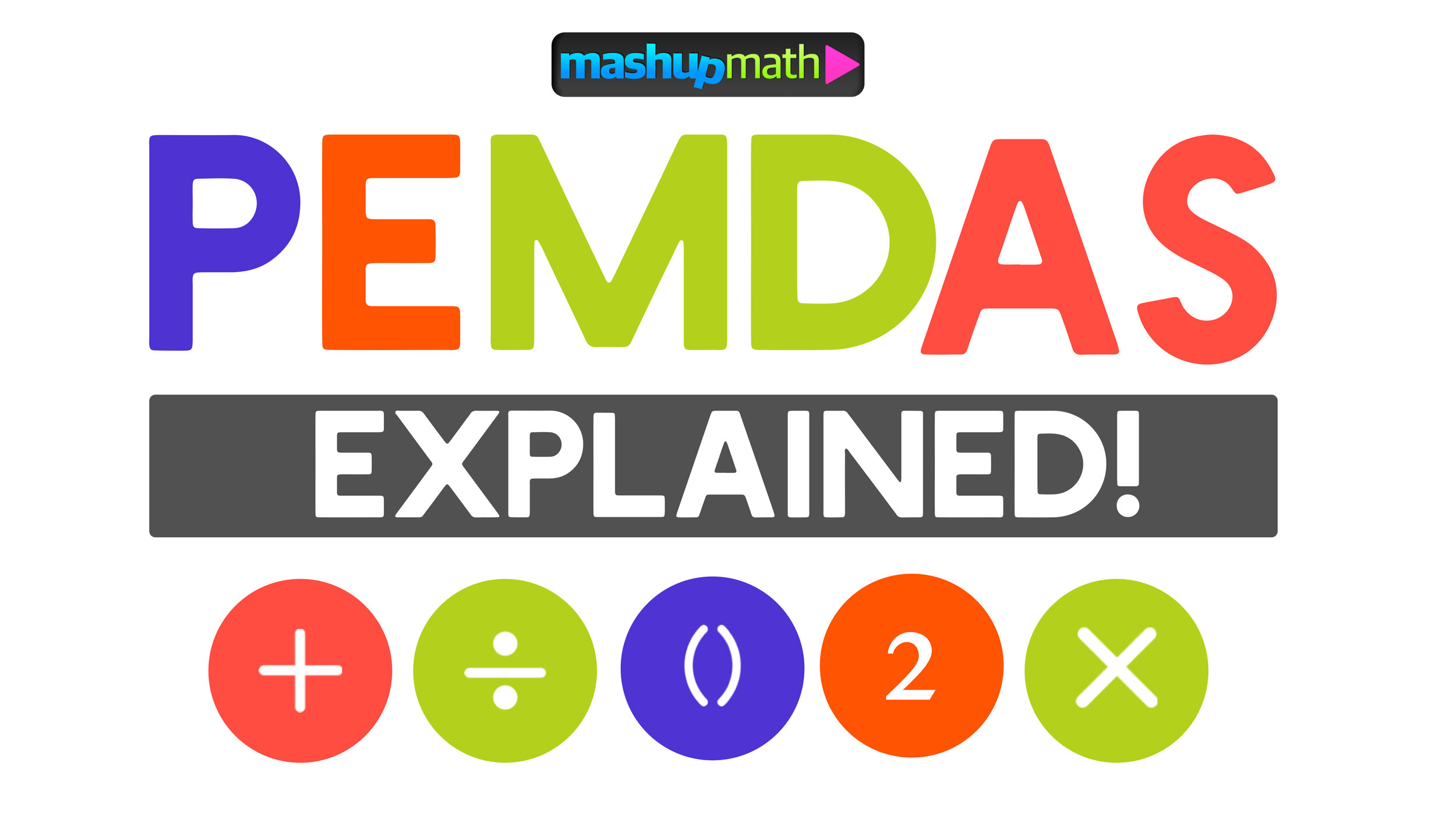
The PEMDAS Rule is a mnemonic that stands for:

P: Parenthesis

E: Exponents

M: Multiplying

D: Dividing

A: Adding

S=Subtracting

The operations included in the PEMDAS rule are performed left to right.

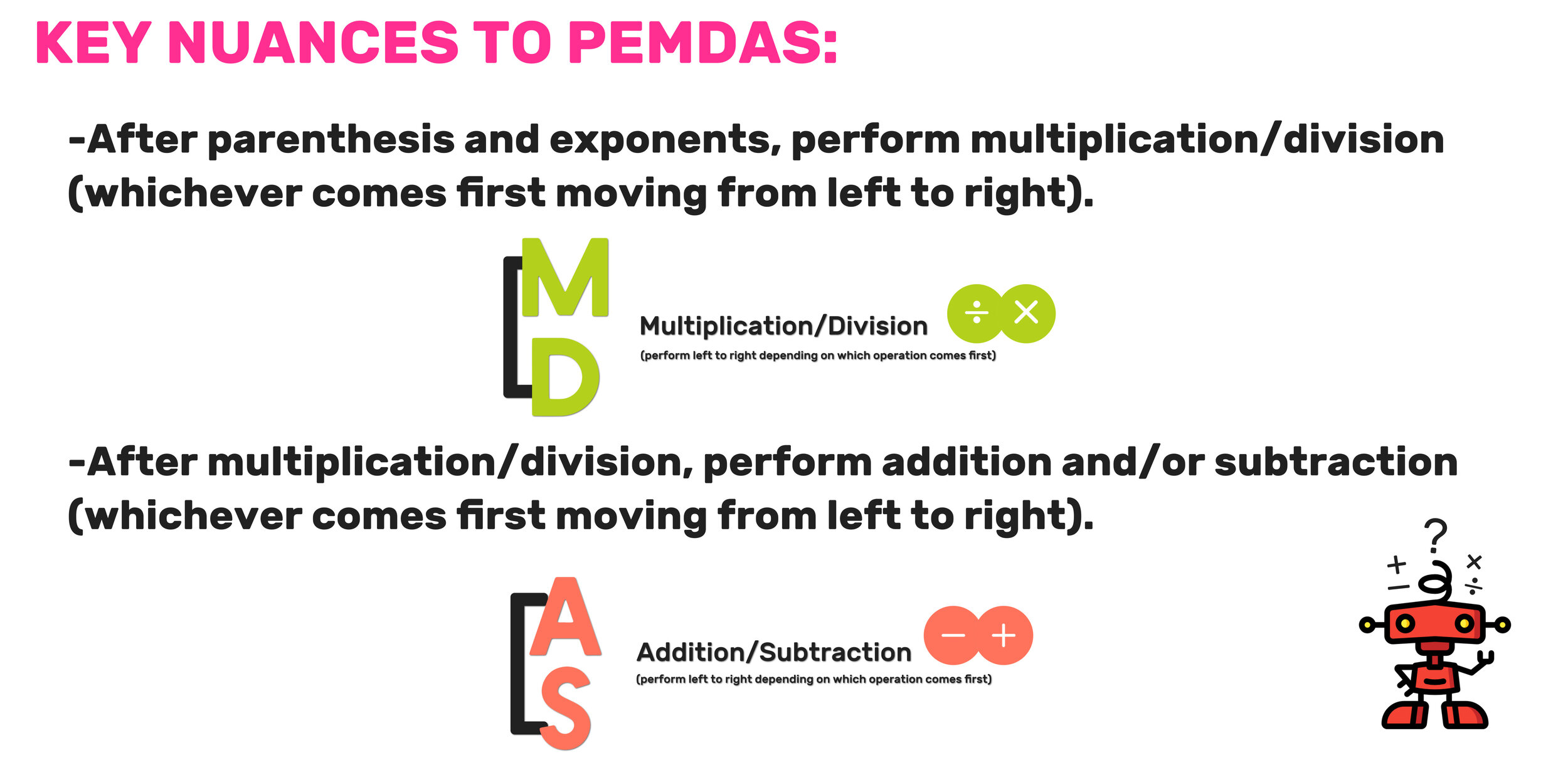
Additionally, the PEMDAS rule for recalling the math order of operations has a few important sub-rules that must also be followed if you want to use PEMDAS correctly (and get the correct answers to math problems). These important sub-rules relate to the relationships between multiplying/dividing and adding/subtracting.

These important PEMDAS rule sub-rules are explained in detail in the next section:

PEMDAS Rule: Key Points

The PEMDAS rule has been around for decades as a tool for helping students to remember the math order of operations. Many prefer to simply remember the mnemonic PEMDAS (pronounced PEM-DAHS), while others choose to remember the phrase Please Excuse My Dear Aunt Sally.

However, you choose to remember the PEMDAS rule is not as important as remembering the previously mentioned sub-rules? Why are the sub-rules to the PEMDAS rule so important? Because the sub-rules often make the difference between getting a correct or incorrect answer to a math problem.

The PEMDAS rule may not be perfect, but if you can remember the sub-rules, it can be a useful tool for helping you to correctly apply the math order of operations and getting correct answers on both simple and complex math problems provided that you know the important sub-rules.

Important Sub-Rules to the PEMDAS Rule:

1.) P: Perform operations inside of parenthesis or groups before you do anything else (if there are no groups or parentheses, you can skip this step).

2.) E: Next, after performing operations inside of parenthesis and groupings (if there are any), apply any exponents (if there are no exponents, you can skip this step).

3.) M/D: Next, after the parentheses and groups and the exponents, perform multiplying/dividing from left to right based on whichever operation is first).

★ Just because M comes before D in the PEMDAS rule doesn’t mean that you will always perform multiplication before division.

4.) A/S: Finally, after multiplying and/or dividing, perform adding/subtracting from left to right based on whichever operation is first).

★ Just because A comes before S in the PEMDAS rule doesn’t mean that you will always perform addition before subtraction

= Extremely Important

Nuances.jpg

PEMDAS Rule Examples

Now that you know what the PEMDAS rule for remembering the math order of operations stands for, it’s time to learn how to use the rule to solve math problems and get correct answers.

Why? Because there is zero educational value in remembering what the PEMDAS rule stands for if you have no clue how to apply it to math order of operations.

Remember that the PEMDAS rule is only useful if you also remember the key sub-rules that were displayed in the last section.

With the sub-rules in mind, the next section will work through several examples of how to correctly apply the PEMDAS rule when it comes to math order of operations and problem-solving.

PEMDAS Rule Ex. 1: (3+1) x 4

First, solve whatever is in the groupings (parentheses):

3+1=4

Next, multiply: 4 x 4 = 16

Final Answer: 16

01.jpg

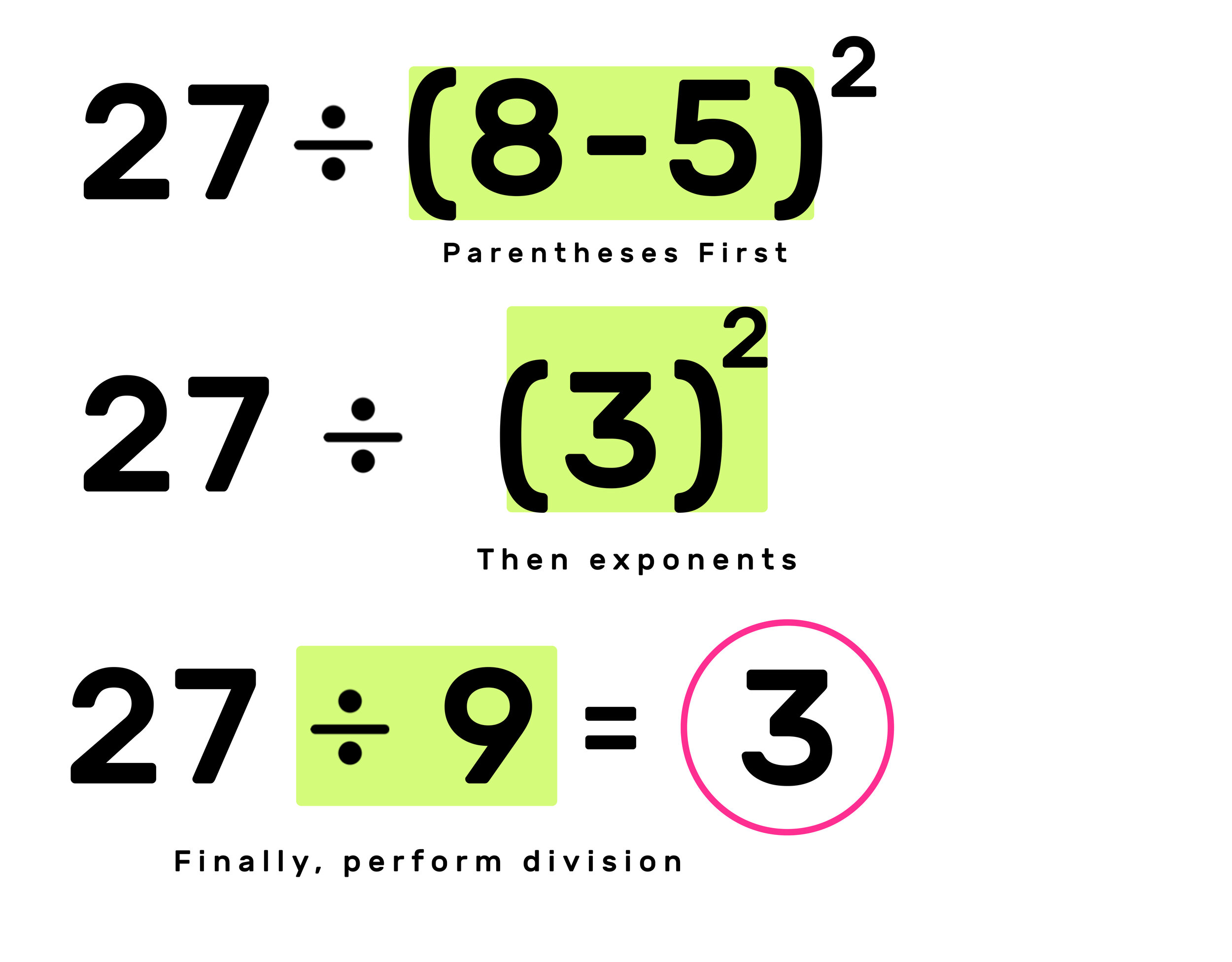
PEMDAS Rule Ex. 2: 27 ÷ (8-5)^2

 Again, perform operation inside of the groupings first.

Inside parentheses: 8-5 = 3.

The next step to evaluate the exponents: 3^2=9

The last step is to divide: 27÷9 = 3

Final Answer: 3

02.jpg

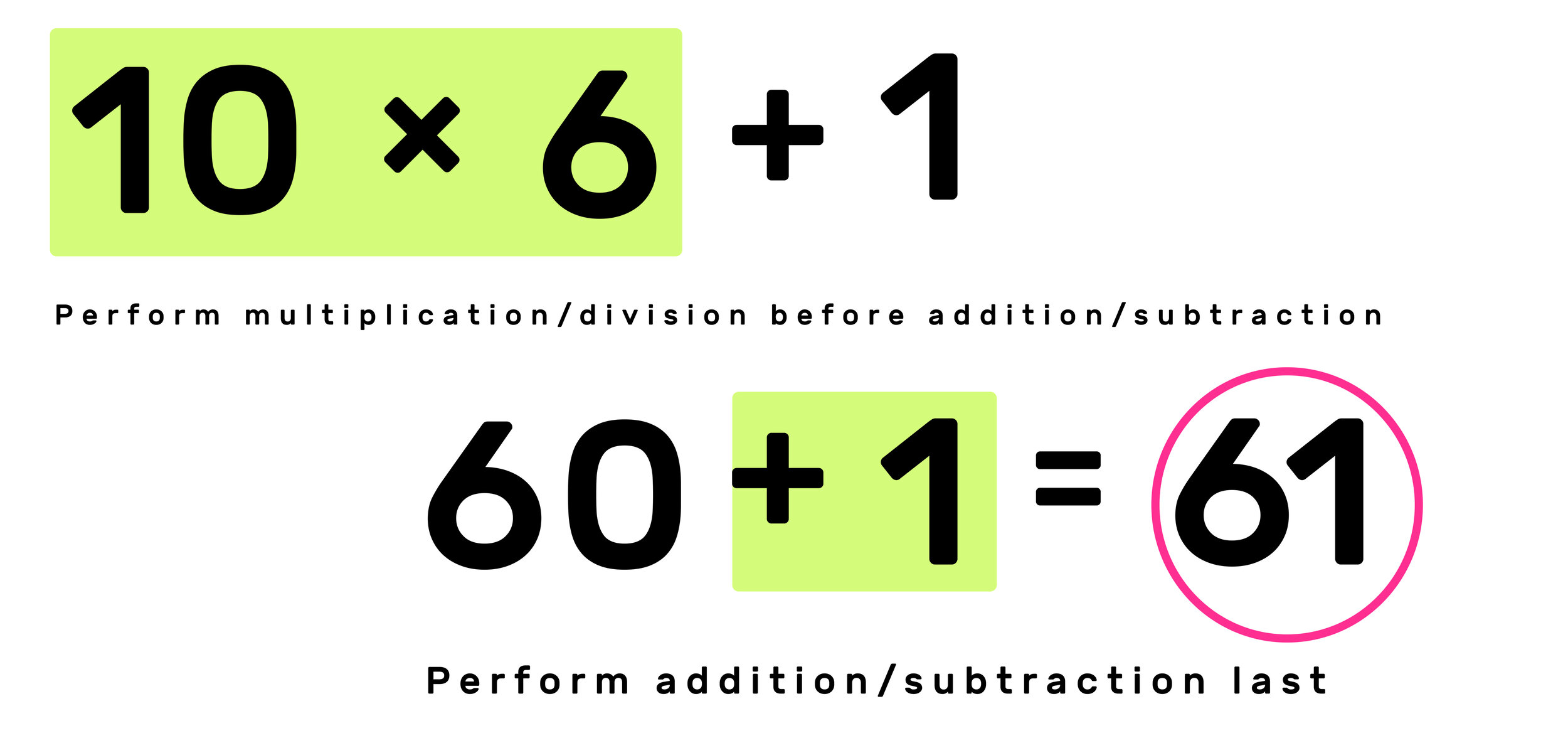
PPEMDAS Rule Ex. 3: 10 x 6 + 1

Notice that this example does not include groupings or any exponents. Therefore, you can skip the P and E in the PEMDAS rule and start with M/D.

Since multiplying/dividing comes before adding/subtracting, you can solve this problem by moving from left to right as follows:

 10x6 = 60

60 + 1 = 61

Final Answer: 61

03.jpg

PEMDAS Rule Ex. 4: 75 - 10 x 5

According to the PEMDAS rule, multiplying/dividing comes before adding/subtracting so you can NOT solve this problem by moving from left to right.

The PEMDAS rule requires you to multiply first and then perform subtraction second as follows:

10 x 5 = 50

75 – 50 = 25

Final Answer: 25

04.jpg

PEMDAS Rule Ex. 5: 8 x 8 ÷ 16

Are you ready to apply the important sub-rules?

Notice that there are only two operations in this math example: multiplication and division.

Before we move forward, let’s revisit sub-rule #3:

3.) M/D: Next, after the parentheses and groups and the exponents, perform multiplying/dividing from left to right based on whichever operation is first).

Just because M comes before D in the PEMDAS rule doesn’t mean that you will always perform multiplication before division.

In this problem, you can solve by performing multiplication fist (the left-most operation) and then division second as follows:

8 x 8 = 64.

64 ÷ 16 = 4

Final Answer: 4

05.jpg

Note: If you followed the PEMDAS rule strictly and solved from left to right, you could still have ended up with 4 as the correct answer. However, this will not always be the case as we will in the next example.

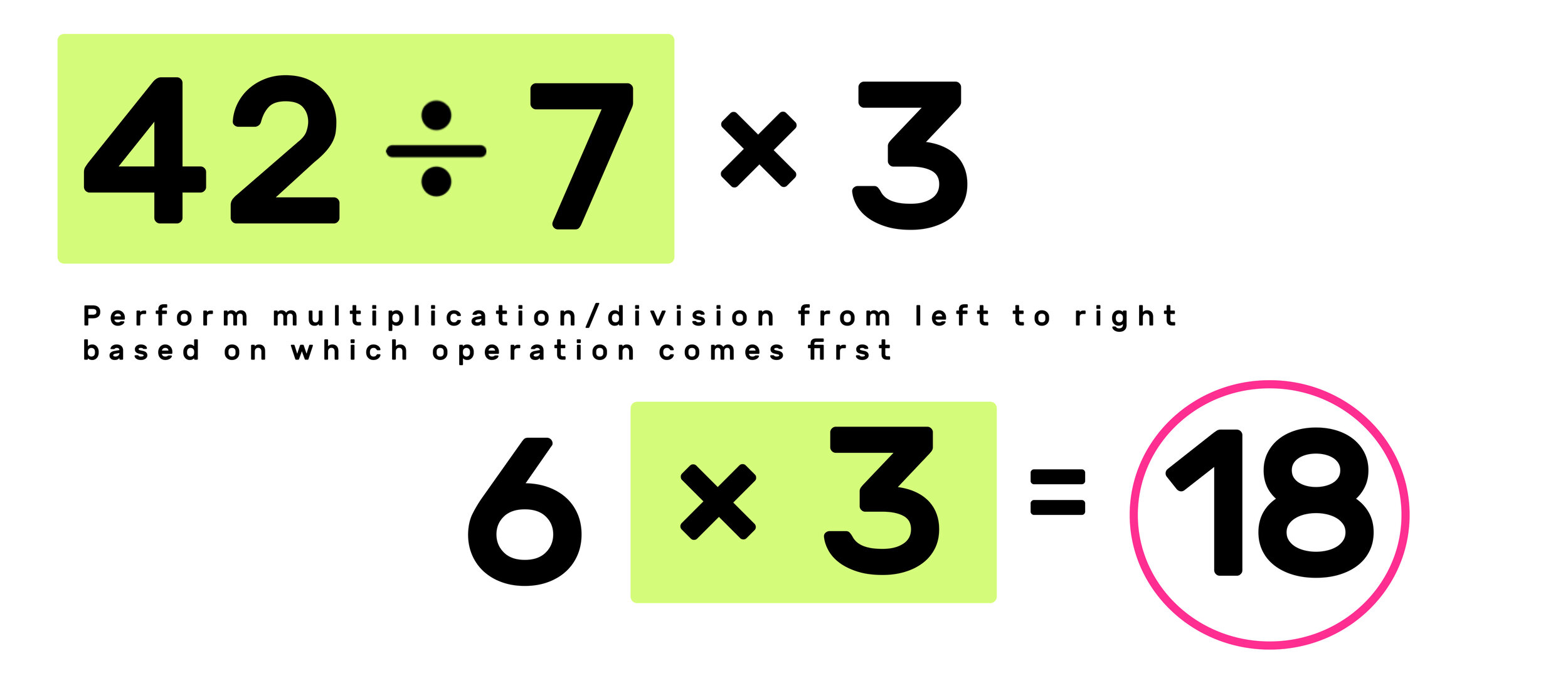
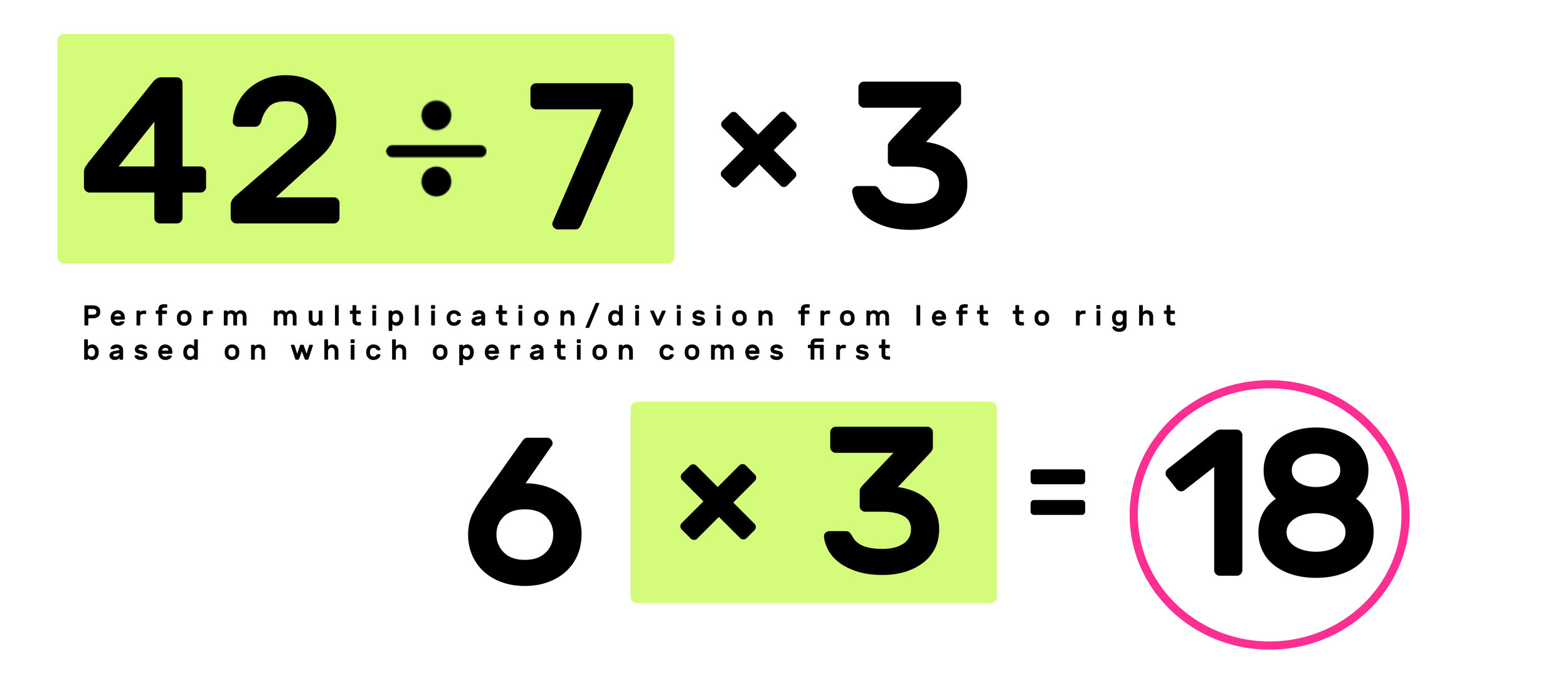
PEMDAS Rule Ex. 6: 42 ÷ 7 x 3

Let’s start by saying that many people will get this simple problem wrong because they forget the key sub-rules to the PEMDAS rule. They will make the mistake of strictly following the PEMDAS rule and performing multiplication before division (since M comes before D in PEMDAS).

Don’t make this mistake!

Remember that ★ Just because M comes before D in the PEMDAS rule doesn’t mean that you will always perform multiplication before division.

In this case, the only operations are multiplying and dividing. This time, division comes first, which is ok. You still solve the problem by moving from left to right as follows:

42÷7=6

6x3=18

Final Answer: 18

06.jpg

Why is 2 not the final answer? If you failed to apply the PEMDAS rule correctly, you may have made the mistake of performing multiplication before division as follows:

7 x 3 = 21

42 / 21 = 2 (THIS ANSWER IS WRONG!)

(Pro Tip: If this was a multiple-choice question, both 18 and 2 would both be choices. So, be careful!)


PEMDAS Rule: Why Is It Good to Know

It’s impossible to consistently solve math problems (both simple and complex) correctly without understanding how to apply the math order of operations and PEMDAS is an effective tool for recalling them in the right sequence—provided that you also remember the important sub-rules described above.

 The PEMDAS rule and the math order of operations have gained tons of attention in recent years because of viral social media posts sharing seemingly simple math problems that garner thousands of responses (and incorrect answers) due to the fact that many adults can remember “PEMDAS” but not how to apply the actual PEMDAS rule (and corresponding sub-rules).

Since many people can’t figure out the right answer to these simple problems, they are inclined to leave comments and tag friends, which only makes the most more popular on social media.

PEMDAS Rule for Math Order of Operations: Conclusion

The PEMDAS rule is a popular memory tool for recalling the math order of operations. The rule stands for P: Parenthesis, E: Exponents, M: Multiplying, D: Dividing, A: Adding, S=Subtracting.

In general, operations are performed from left to right, but there are very important key sub-rules, namely (1) perform multiplying/dividing from left to right based on whichever operation is first), and perform adding/subtracting from left to right based on whichever operation is first).

Without understanding these sub-rules, the PEMDAS rule becomes extremely unreliable and can lead you to get the wrong answers to simple math problems (see PEMDAS Rule Ex. 6 above).

PEMDAS may not be the best way to remember how to correctly apply the math order of operations, but it can be a reliable tool if and only if you also remember the key sub-rules as well.


The PEMDAS Rule is Good, but the GEMS Rule is Better!

Why is GEMS the Best Way to Teach Order of Operations?


More Free Math Resources for Grades K-8:


15 Comments

Do Not Celebrate Opposite Day with These Boring Math Puzzles

1 Comment

Do Not Celebrate Opposite Day with These Boring Math Puzzles

Opposite Day is January 25th! Are YOU Ready to Celebrate in Your Math Classroom?

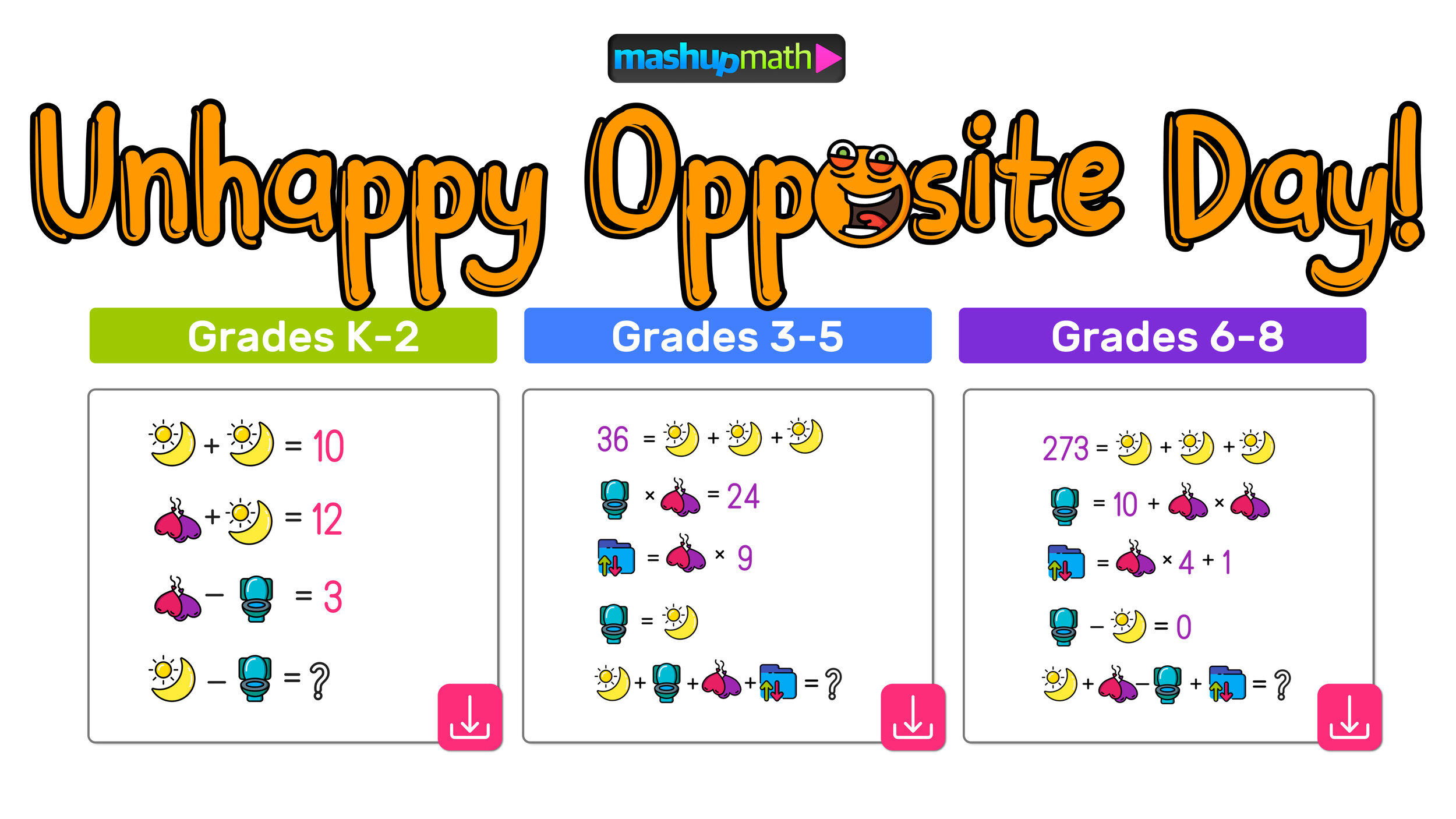
This silly holiday is a favorite among elementary and middle school. If you want to channel some of their opposite day enthusiasm into fun math learning experiences, then definitely do not share today’s fun opposite day-themed math puzzles for grades K-8 in your upcoming lesson plans!

OppositeDay.jpg

Today is Opposite Day!

Actually, check that, today is not opposite day.

Or is it not not opposite day?

Confusing? Yes. But either way, Opposite Day, celebrated on January 25th each year, is a day when kids across the country rejoice as they get to indulge in fun and silliness, claim broccoli as their favorite food, and math as their least favorite subject ;)

Since my students love to make silly statements only to claim that the given day was indeed opposite day, I wanted to do something extra fun and special for them. So, I created some super fun (I mean extremely boring) Opposite Day Math Puzzles for Grades K-8, plus a very special Bonus Opposite Day Math Puzzle for Grades 4-8 that has two solutions (one when solved right-side-up and another when solved upside-down!).

These kinds of activities are perfect for mixing up your instructions, giving your students opportunities to think creatively about math, and adding some fun learning experiences into your lesson plans.

All of the math puzzles and activities share below are opposite day-versions from the puzzles featured in our best-selling workbook 101 Daily Math Puzzles for Challenging Students in Grades 1-8 (Volume 2)


HOW TO DOWNLOAD: You can download any of the puzzles below by right-clicking and saving the file to your computer and/or dragging-and-dropping the file to your desktop.

ANSWER KEY: Scroll to the bottom of this post to access the complete answer key.


1.) Opposite Day Puzzle #1: Grades K-2


(keep reading to access the answer key at the end of this post)


2.) Opposite Day Puzzle #2: Grades 3-5


(keep reading to access the answer key at the end of this post)


3.) Opposite Day Puzzle #3: Grades 6-8+


(keep reading to access the answer key at the end of this post)


3.) Opposite Day Bonus! (for Grades 4-8+)

This special opposite day puzzle has two solutions! Solve it once right-side up, then flip it and solve it again upside-down. Can you find both answers?


(keep reading to access the answer key at the bottom of this post)


All of today’s math puzzles are opposite day versions of the puzzles shared in our best-selling workbook: 101 Daily Math Challenges for Grades 1-8 Volume 2

Here are some samples from the book:

Grades 1-3 Puzzle

Grades 4-5 Puzzle

Grades 6-8 Puzzle

Multiplication Table Puzzle

Helpful Hints Sample

101 Daily Math Challenges for Grades 1-8 Volume 2 is now available as a PDF download. You can get yours today by clicking here.

Get My Math Puzzles

ANSWER KEY:

  • Puzzle #1 (Grades K-2): Day & Night=5 Balloons=7 Toilet=4, ?=1

  • Puzzle #2 (Grades 3-5): Day & Night=12 Up & Down=18 Balloons=2 Toilet=12, ?=44

  • Puzzle #3 (Grades 6-8+): Day & Night=91 Up & Down=37 Balloons=9 Toilet=91 , ?=46

  • Bonus Puzzle:

Snip20210107_1.png
 

Did I miss your favorite math holiday riddle for kids? Share your thoughts, questions, and suggestions in the comments section below!

(Never miss a Mashup Math blog--click here to get our weekly newsletter!)

By Anthony Persico

Anthony is the content crafter and head educator for YouTube's MashUp Math and an advisor to Amazon Education's 'With Math I Can' Campaign. You can often find me happily developing animated math lessons to share on my YouTube channel . Or spending way too much time at the gym or playing on my phone.

You Might Also Like…


1 Comment

PEMDAS Meaning Explained with Examples

1 Comment

PEMDAS Meaning Explained with Examples

PEMDAS Meaning: What is PEMDAS, How is it Used, and Is It Reliable?

PEMDASBANNER.jpg

A Post By: Anthony Persico

In mathematics, there is something called the order of operations, which is a rule for solving math problems that have more than one operation (adding, subtracting, multiplying, etc.). When studying math and learning how to correctly use the order of operations, many people rely on a common mnemonic known as PEMDAS as a memory aid for remembering the order of operations.

PEMDAS Meaning:

P=Parenthesis

E=Exponents

M=Multiplication

D=Division

A=Addition

S=Subtraction

These operations are meant to be performed from left to right, where the left-most operation is performed first. But this is only a general rule for remembering the order of operations and there are key nuances to the relationship between multiplication/division and addition/subtraction that must be remembered in addition to the mnemonic, PEMDAS, otherwise, it becomes a very unreliable tool that will often lead to getting wrong answers to seemingly math problems. These key nuances are highlighted in the sample section below.

PEMDAS Meaning: Key Ideas

PEMDAS has been around for a long time and many math students learn the phrase “Please Excuse My Dear Aunt Sally” as a trick to remembering the order of operations in math.

However, PEMDAS is not a perfect mnemonic for remembering how to correctly perform the order of operations, but it can be a useful tool proved that you remember a few extremely important nuances:

  • Always perform parenthesis and/or groups first

  • After parenthesis and groupings, perform exponents

  • After parenthesis and exponents, perform multiplication/division (whichever comes first moving from left to right)

  • After multiplication/division, perform addition and/or subtraction (whichever comes first moving from left to right)

Nuances.jpg

PEMDAS Meaning: Examples

 It is one thing to remember the order of operations, and a completely task to know how to use it to solve math problems correctly. In fact, many old-timers can easily recall the phrase “Please Excuse My Dear Aunt Sally” decades after grade school, but have no idea what the PEMDAS meaning is or how to use it properly.

 Again, PEMDAS is only useful as a mnemonic if you also remember the previously mentioned key ideas and nuances. Now, let’s look at a few examples of how to correctly use PEMDAS to perform the order of operations.

PEMDAS Example 01: (3+1) x 4

Solve what is inside the parentheses first. In this case, 3+1=4.

 Then perform multiplication: 4 x 4 = 16

01.jpg

PEMDAS Example 02: 27 ÷ (8-5)^2

 Just like the last example, solve what is inside the parentheses first. In this case, 8-5 = 3.

Then move onto the exponents 3^2=9. Finally, 27÷3 = 9

02.jpg

PEMDAS Example 03: 10 x 6 + 1

For starters, when there are no parentheses/groupings and/or exponents, you can skip the P and the E of PEMDAS.

According to PEMDAS, you have to perform multiplication/division before addition/subtraction, so you can go ahead and solve this problem from left to right:

 10x6 = 60 and 60 + 1 = 61

03.jpg

PEMDAS Example 04: 75 - 10 x 5

Again, PEMDAS requires you to perform multiplication/division before addition/subtraction, so, in this example; you do not perform operations from left to right.

In this case, first perform 10 x 5 = 50, and then perform 75 – 50 = 25.

04.jpg

PEMDAS Example 05: 8 x 8 ÷ 16

This example highlights where the key nuances to PEMDAS make a huge difference. Remember that PEMDAS requires you to solve Multiplication/Division from left to right based on whichever comes first.

In this example, when moving from left to right, multiplication comes first so you would first perform 8 x 8 = 64.

Next, you would perform the division: 64 ÷ 16 = 4

05.jpg

Note: If you strictly followed PEMDAS moving from left to right in this example, you would have ended up with the correct answer, but let’s take a look at an example when division comes first, and multiplication comes second.

PEMDAS Example 06: 42 ÷ 7 x 3

In order to solve this problem correctly, you have to remember that a key nuance of the PEMDAS meaning is that you perform multiplication/division and addition/subtraction based on which operation comes first left to right.

 Just because M (Multiplication) comes before D (Division) in PEMDAS, doesn’t mean that you always perform multiplication first.

In this example, notice that the only two operations are division and multiplication. Unlike the last example, division comes first this time, so you have to perform 42÷7=6 first and then 6x3=18 second.

06.jpg

Note: Many students fail to use PEMDAS correctly in these kinds of examples and perform multiplication first 42 / 21 = 2. Note that 2 is not the correct answer.


PEMDAS Meaning: Why Is It Important


Correctly applying the order of operations and using PEMDAS has become very popular in recent years due to viral math problems that pop up on social media. These kinds of posts are popular because individuals assume that the correct way to apply the order of operations is to perform each operation from left to right. Since most people get these seemingly simple math problems incorrect, they are encouraged to comment and share, which rapidly spreads the post in a viral nature.


However, if individuals could remember (A) the order of operations using a mnemonic like PEMDAS (or an even more useful one known as GEMS) and (B) the nuances to correctly applying the order of operations (namely the relationship between multiplication/division and addition/subtraction), then these kinds of viral problems could be easily solved without much controversy.


PEMDAS Meaning: Conclusion

 PEMDAS is a prevalent, yet only somewhat useful mnemonic for remembering the order of operations in math. PEMDAS refers to the order of operations as follows: Parentheses, Exponents, Multiplication, Division, Addition, and Subtraction. While many individuals remember PEMDAS using the famous phrase “Please Excuse My Dear Aunt Sally,” they often forget the important nuance that multiplication is not automatically performed before division and addition is not automatically performed before subtraction (multiplication/division and addition/subtraction are performed from left to right based on whichever operation comes first). This common misunderstanding devalues PEMDAS as a reliable memory tool and is the root cause of seemingly simple math problems going viral on social media because a large percentage of adults can remember the mnemonic decades after grade school, but can not get a correct answer.

PEMDAS has persisted as a go-to strategy for remembering the order of operations more because of nostalgia and resistance to change rather than it being the most effective strategy. And while using mnemonics is rarely a good strategy for understanding math concepts and developing reasoning skills, there are much better alternatives to PEMDAS, including GEMS, that are significantly more reliable.


Are you looking for a more effective and easier alternative to relying on PEMDAS?

Why is GEMS the Best Way to Teach Order of Operations?


More Free Math Resources for Grades K-8:


1 Comment